
Gamcheon Munhwa Maeul, Busan’s hillside mosaic of homes and art
Published on 09/16/2026 at 17:00 | Editorial responsibility: Rafael Müller, Editor-in-Chief AD HOC NEWS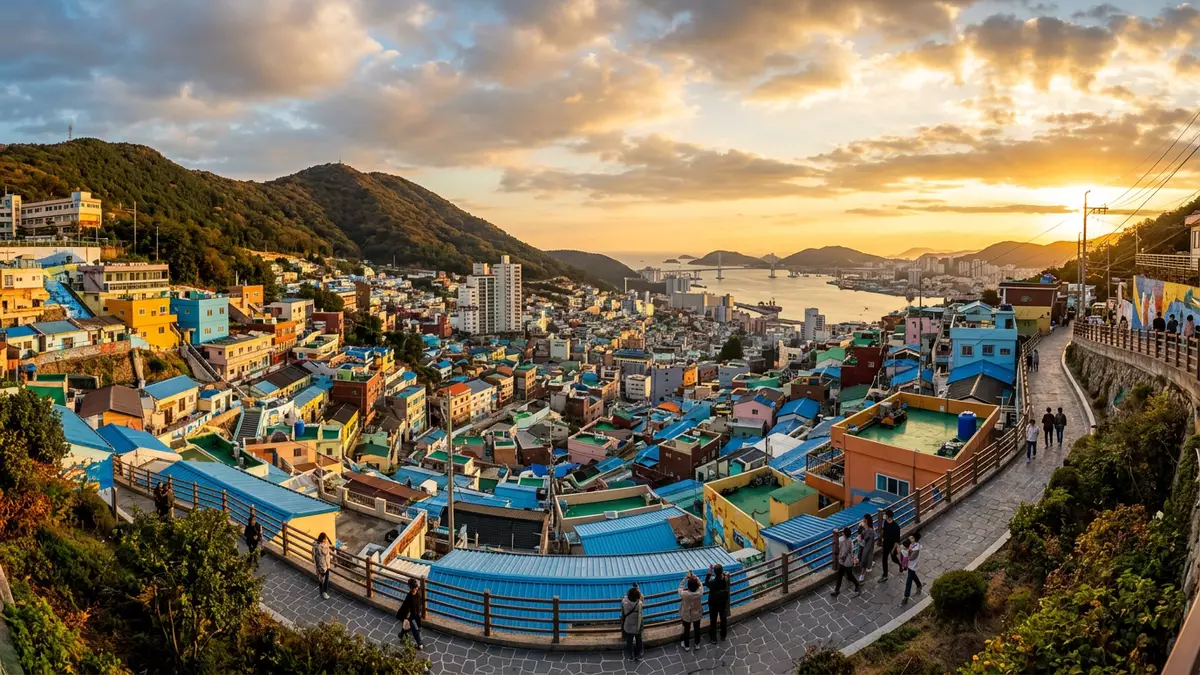
On the steep slopes of Busan’s Saha District, Gamcheon Munhwa Maeul climbs in tight terraces above the harbour, a hillside neighbourhood reshaped over decades into an outdoor gallery of small homes, murals and sculptures. Formed in the mid twentieth century as Korean War refugees settled and built modest housing in rows on the gradient, the village in its present form combines residential streets with art installations and viewpoints that give a layered view across the basin of west Busan.Busan Gamcheon Culture Village
From war-time hillside settlement to cultural village
Gamcheon Munhwa Maeul grew on one of the coastal hills of Gamcheon-dong during and after the Korean War of 1950–1953, when Busan served as a major refuge and administrative centre for South Korea.refugees settled on the slope Families arriving in the city built simple dwellings on the steep ground, stacking houses in stepped fashion so that roofs and small yards formed a sequence of platforms climbing away from the port.
The result was a dense neighbourhood of low-rise homes, alleyways and staircases set on the flank of a coastal mountain, with lanes winding between facades and small courtyards.houses in staircase-fashion In later decades, civic and local initiatives added cultural elements to the existing fabric, turning parts of the hillside into a recognised culture village while residents continued to live in the same terraced streets.
Terraced layout, lanes and viewpoints
The physical form of Gamcheon Munhwa Maeul is central to its character: rows of small houses run along the gradient, each level slightly offset from the next so that the settlement forms a kind of stepped mosaic of coloured facades. From many vantage points, the village appears as a patchwork of blues, greens and pastel tones, with the regular geometry of roofs broken by small additions, balconies and water tanks.
Narrow lanes weave across and up the slope, some incorporating long staircases that connect one terrace to another, others following contour lines to reach small squares and viewing decks.Gamcheon Culture Village Several elevated points look outward across Saha-gu and towards Busan’s harbour areas, while interior viewpoints frame the clustered houses themselves; standing on one of these platforms gives a sense of how closely the dwellings fit together on the limited hillside ground.
Murals, sculptures and everyday life
Beyond its physical layout, Gamcheon Munhwa Maeul is marked by art woven into daily life. Residents and invited artists have added murals along walls, steps and retaining structures, using bright colours and narrative scenes that reflect local stories, sea motifs and characters familiar from Korean culture.murals and sculptures created by the residents Sculptures appear at junctions and small squares, ranging from abstract forms to figurative pieces that occupy corners and ledges.
Many houses along the main walking routes host small galleries, cafés or craft shops on their lower levels, while upper rooms remain residential, so that art spaces sit within an inhabited neighbourhood rather than a separate precinct.Gamcheon Culture Village: When in Busan Lanes away from the central routes are quieter, lined with everyday facilities such as small groceries, workshops and schools, and show Gamcheon Munhwa Maeul as a lived-in part of Busan as well as a place known for its hillside art.
Visiting Gamcheon Munhwa Maeul: what travellers from Western Europe should know
- Gamcheon Munhwa Maeul lies in Gamcheon-dong in Saha-gu, west of Busan’s central districts, on the slopes above the harbour; it is reached by city metro on Line 1 to Toseong Station or Goejeong Station and then by local village buses that climb the hill to stops near Gamcheon Elementary School.traveller guides for Gamcheon
- The terrain is steep, with long staircases and sloping lanes between terraces; moving around the village involves repeated climbs and descents on concrete steps and narrow passageways.
- Nearby, the lower streets connect towards other parts of Saha-gu and the port areas, while upper viewpoints in the village give wide views over Busan’s hillside housing and industrial waterfront.
- The official language is Korean and the currency is the South Korean won.
- Entry requirements depend on your nationality; UK travellers can check the FCDO travel advice at gov.uk/foreign-travel-advice, Irish travellers the Department of Foreign Affairs at ireland.ie.
Searching for Gamcheon Munhwa Maeul on social platforms
These links open searches for Gamcheon Munhwa Maeul on each platform.
Frequently asked questions about Gamcheon Munhwa Maeul
Where is Gamcheon Munhwa Maeul located within Busan?
Gamcheon Munhwa Maeul is in Gamcheon-dong in Saha-gu, on a coastal hillside in the western part of Busan above harbour and port facilities.
What can a visitor expect on a first walk through the village?
A walk through Gamcheon Munhwa Maeul brings steep staircases, narrow lanes between small terraced houses, outdoor murals and sculptures, and occasional viewpoints looking across Busan’s basin.
What makes Gamcheon Munhwa Maeul distinctive among Busan’s neighbourhoods?
The combination of its war-time terraced housing layout, bright hillside colours, resident-created art and mixed use as both lived-in neighbourhood and culture village gives Gamcheon Munhwa Maeul a character distinct within Busan.


