
Fuzimiao in Nanjing, a Confucius Temple on the Qinhuai River
Published on 09/05/2026 at 20:56 | Editorial responsibility: Rafael Müller, Editor-in-Chief AD HOC NEWS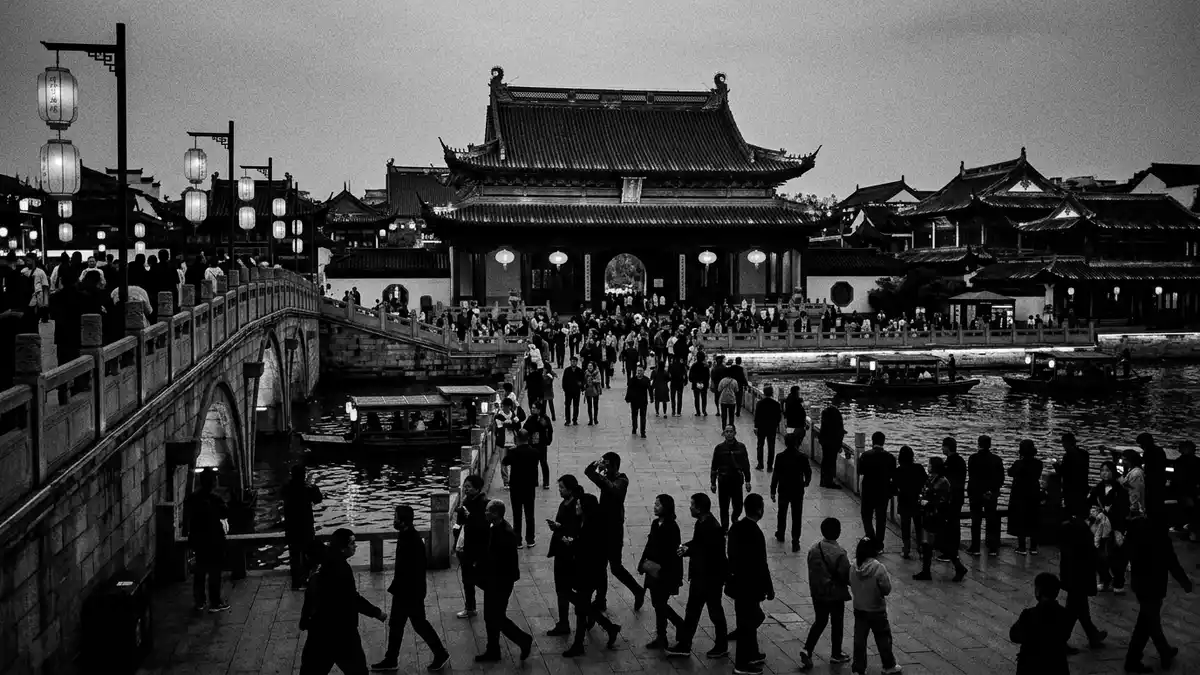
Fuzimiao in Nanjing is a Confucius Temple complex on the north bank of the Qinhuai River, where ritual architecture and former imperial examination halls stand beside riverside streets in Qinhuai District.Nanjing Fuzimiao was rebuilt in 1034 during the Song dynasty and has been repaired and expanded many times, so its present layout reflects centuries of Confucian worship and state education.The building of Nanjing Confucius Temple
Confucius Temple and examination halls beside the Qinhuai River
Fuzimiao is both a temple dedicated to Confucius and the former site of the imperial examination hall for southern China, bringing ritual and scholarship into one dense ensemble of halls and courtyards.Confucius Temple and examination hall The complex stands on Gongyuan Street on the north bank of the Qinhuai River, in Qinhuai District in the southern part of Nanjing.Location on Gongyuan Street The river forms a constant presence along the temple’s edge, with bridges, quays and waterfront streets framing views of tiled roofs, screen walls and gateway pavilions.
The main structures of Fuzimiao include Dacheng Hall, dedicated to Confucius, and the Jiangnan Imperial Examination Museum, which occupies former examination buildings that once hosted candidates for the imperial civil service.Imperial examination museum Within the complex, courtyards, covered walkways and halls are arranged parallel to the Qinhuai River, so the architecture and the waterway read as one continuous historic landscape when viewed from the embankment.Riverside world of Confucian tradition
From early foundations to a Qing-era riverside ensemble
The Confucius Temple at Fuzimiao has roots that reach back to the early centuries of imperial China, with foundations linked to Wang Dao in the fourth century and a formal temple and college established on the north bank of the Qinhuai River in 1034 under the Song dynasty.Song-era establishment in 1034 The complex has been destroyed and rebuilt several times, including fires during Southern Song wars and damage during fighting in 1937, so much of what visitors see belongs to reconstructions and additions from the nineteenth century onwards.Later rebuilds and Qing-era fabric
Among the most distinctive features is a long screen wall that dates from 1575 and runs for around 110 m (361 ft), forming an extended backdrop of brick and reliefs along one side of the complex.Screen wall dating from 1575 The temple buildings reflect styles associated with Ming and Qing architecture, with upturned eaves, timber frames and painted beams, while the later reconstructions from the late twentieth century follow these forms to maintain a continuous historic character along the Qinhuai waterfront.Fuzimiao riverside complex
A riverside urban quarter around ritual halls
Fuzimiao is not only a temple precinct but also an urban quarter whose streets, bridges and waterfront spaces have grown around the core of Confucian ritual and examination halls on the Qinhuai River.Walking Old China by the Qinhuai River Pedestrian streets lined with shopfronts, lanterns and small pavilions follow the curves of the river, and boats travel along the inner Qinhuai, passing under bridges that frame views of the temple roofs and the examination museum façades.Inner Qinhuai River scenery
The quarter belongs to Qinhuai District, a historic part of Nanjing associated for centuries with merchants, scholars and the cultural life clustered along the river’s inner course.Inner Qinhuai and historic dwellings Within short walking distance of the temple and examination halls lie residential streets, smaller shrines and parks such as Bailu Zhou Park, so a visit to Fuzimiao brings together religious architecture, the story of imperial education and a riverside cityscape shaped over many dynasties.Qinhuai district setting
Visiting Fuzimiao: what travellers from Western Europe should know
- Fuzimiao lies in Qinhuai District in the southern part of Nanjing, along Gongyuan Street on the north bank of the Qinhuai River, with metro stations named Fuzimiao and Sanshanjie nearby on city lines.
- The core temple and examination buildings are reached along paved streets and riverside walkways, with interior halls connected by courtyards and staircases that may involve several flights of steps.
- Fuzimiao is served by Nanjing Metro, including Line 3 to Fuzimiao Station and Line 1 to Sanshanjie Station, and by a dense network of city bus routes that stop close to the temple quarter.
- The official language is Chinese and the currency is the renminbi (yuan).
Searching for Fuzimiao on social platforms
These links open searches for Fuzimiao on each platform.Frequently asked questions about Fuzimiao
Where is Fuzimiao located in Nanjing?
Fuzimiao stands in Qinhuai District in southern Nanjing, along Gongyuan Street on the north bank of the Qinhuai River, in eastern China.
What can visitors expect when exploring Fuzimiao?
Visitors encounter Confucius Temple halls, former imperial examination buildings and riverside streets with bridges and boats along the inner Qinhuai River.
What makes Fuzimiao distinctive among Confucius Temples?
Fuzimiao is distinctive as both a Confucius Temple and a former imperial examination site, set within an extended riverside urban quarter on the Qinhuai River.


