
Fuzimiao in Nanjing, where Confucian ritual meets riverside streets
Published on 08/21/2026 at 08:43 | Editorial responsibility: Rafael Müller, Editor-in-Chief AD HOC NEWS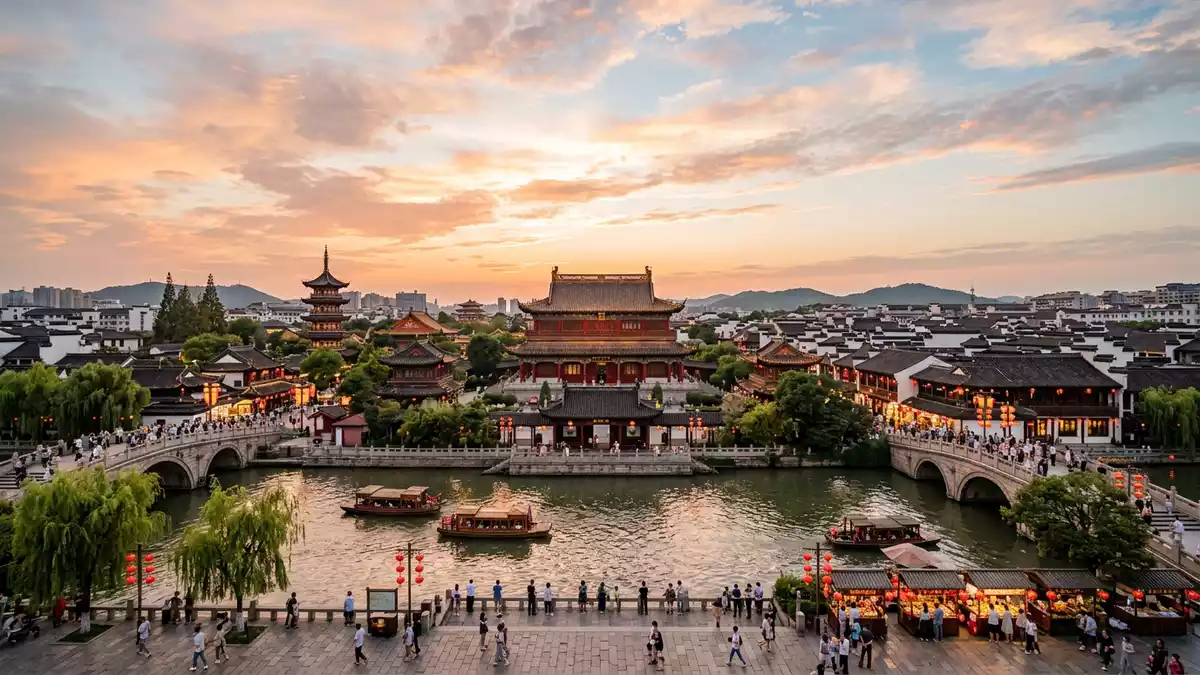
Fuzimiao in Nanjing is a Confucius Temple complex on the north bank of the Qinhuai River, where centuries of ritual, study and examination sit beside lanterns and shopfronts. Built as a Confucian temple and academy during the Song dynasty in 1034, and later rebuilt after fires and wars, it gathers halls, courtyards and gateways into a single dense ensemble that still carries the outline of imperial scholarship.
Temple, academy and examination hall in one riverside complex
Fuzimiao is both a Confucius Temple and the former site of the imperial examination hall for southern China, a rare combination of shrine and state institution in one place.Confucius Temple and former examination hall The complex stands in Qinhuai District on Gongyuan Street, with its main buildings arranged parallel to the Qinhuai River, which once brought scholars and officials to the temple quay.Qinhuai district location
The temple is dedicated to Confucius, the ancient philosopher and educator whose teachings shaped imperial government and personal ethics, and its main axis leads through gateways to Dacheng Hall, the central hall for ritual and commemoration.Dacheng Hall as main building Around this axis, the wider Fuzimiao area includes the Jiangnan Examination Hall and the Xuegong academy, where candidates once prepared for the civil service examinations that regulated entry to government posts across the empire.Jiangnan Examination Hall and Xuegong
Architecture shaped by dynasties and the imperial examination system
The origins of Fuzimiao are traced to the Eastern Jin dynasty in the fourth century, with its major reconstruction in 1034 under the Song dynasty giving the complex its role as a temple and educational centre.Eastern Jin and Song dynasty history Later rebuilding during the Ming and Qing dynasties refined the timber architecture, rooflines and decorative details, aligning the temple’s layout with wider imperial tastes and with the expanding Jiangnan examination system.Ming and Qing reconstructions The resulting ensemble has courtyards framed by painted columns and tiled roofs, stelae recording past scholars, and halls whose names recall Confucian virtues and literary study.
Within this setting, the Jiangnan Examination Hall once housed candidates for the imperial examinations, an arduous series of tests on Confucian classics that shaped official careers across late imperial China.Jiangnan examination system The halls and courtyards of Fuzimiao therefore carry both religious and administrative history: offerings to Confucius in Dacheng Hall on one side, and the memory of ranked examination cells and academies on the other, all within walking distance of the river.
Qinhuai River, live water pond and the surrounding streets
Fuzimiao stands directly beside the Qinhuai River, and the river’s curve and embankment form part of the experience of the complex, linking the temple courtyards to quays and bridges that mark the wider scenic belt.Fuzimiao–Qinhuai scenic belt In front of the temple, a natural water pond known as Pan Chi is fed directly from the Qinhuai River, making Fuzimiao the only recorded Confucian temple with a live water pond connected to a river channel.live water pond linked to Qinhuai River
Beyond the temple gates, the Fuzimiao area extends into pedestrian streets of shops, food stalls and smaller shrines, forming an urban district identified in official tourism material as an AAAAA-level scenic spot.AAAAA-level scenic spot The combination of ritual halls, examination history and riverside streets makes Fuzimiao a compact place to see how formal Confucian culture and everyday city life intersect in Nanjing.
Visiting Fuzimiao: what travellers from Western Europe should know
- Fuzimiao lies in Qinhuai District in southern Nanjing, on Gongyuan Street along the north bank of the Qinhuai River, with metro stations named Fuzimiao and Sanshanjie on nearby lines.
- The temple complex and examination halls are reached on foot along paved streets; inside the historic buildings, stone steps and raised thresholds separate courtyards and main halls.
- The official language is Chinese and the currency is the renminbi (yuan).
- Entry requirements depend on your nationality; UK travellers can check the FCDO travel advice at gov.uk/foreign-travel-advice, Irish travellers the Department of Foreign Affairs at ireland.ie.
Searching for Fuzimiao on social platforms
These links open searches for Fuzimiao on each platform.
Frequently asked questions about Fuzimiao
Where is Fuzimiao located within Nanjing?
Fuzimiao stands on Gongyuan Street in Qinhuai District in southern Nanjing, along the north bank of the Qinhuai River.
What can visitors expect when walking through Fuzimiao?
Visitors move through temple courtyards, Dacheng Hall and adjacent examination halls, then out into riverside pedestrian streets with shops and smaller shrines.
What makes Fuzimiao distinctive among Confucian temples?
Fuzimiao combines a Confucius Temple, an academy and major imperial examination halls beside the Qinhuai River, including a live water pond fed directly from the river.


