

Fuji-san and the volcanic cone above Fujinomiya
Published on 08/21/2026 at 08:06 | Editorial responsibility: Rafael Müller, Editor-in-Chief AD HOC NEWS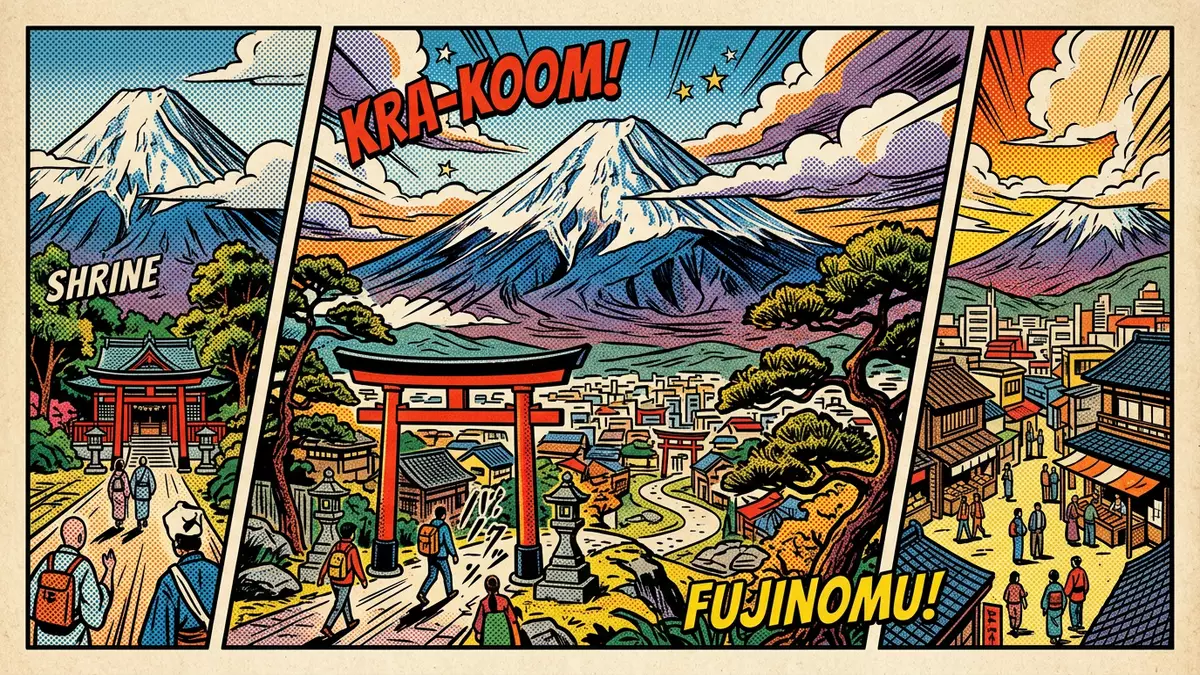
Fuji-san, known in English as Mount Fuji, rises on the island of Honshu as a near-symmetrical volcanic cone above the city of Fujinomiya in central Japan. In 2013, UNESCO inscribed the mountain and its associated sites under the title “Fujisan, sacred place and source of artistic inspiration”, recognising a cultural landscape shaped over many centuries.Fujisan, sacred place and source of artistic inspiration
A cone of ash and lava above the Suruga plain
Fuji-san is a solitary stratovolcano whose summit reaches 3,776 m (12,389 ft), making it the highest mountain in Japan.summit reaches 3,776 m The mountain stands on Honshu, west of Tokyo, rising where Shizuoka and Yamanashi prefectures meet and dominating the plains that run towards Suruga Bay.strato-volcano, around 100 km south-west of Tokyo On the southern side, Fujinomiya lies close to its foot, giving travellers from Western Europe a clear sense of how abruptly the land lifts from settled lowlands into volcanic slopes.
The overall form is that of a broad cone built from layers of ash, lava and other volcanic material, rising above a base that stretches towards the sea. Snow lingers on the upper slopes in colder months, tracing pale bands across the dark surface of the cone and accentuating the difference between the plain and the high summit zone. Around the base of the mountain, smaller hills and older volcanic features merge into fields, towns and forests that frame Fuji-san at a distance.
Sacred mountain and cultural landscape
Fuji-san has long been treated as a sacred mountain in Japanese religious practice. The UNESCO inscription recognises twenty-five component sites, including shrines, historic routes and natural features, that together express its role as a place of worship and as a source of artistic inspiration.twenty-five component assets The title of the inscription, “Fujisan, sacred place and source of artistic inspiration”, reflects this dual character.inscribed on the World Heritage List under the title
On the southern side of the mountain in Fujinomiya stands Fujisan Hongu Sengen Taisha, a Shinto shrine dedicated to the kami of Fuji-san.Fujisan Hongu Sengen Taisha is a Shinto shrine located on the south-western foot of Mount Fuji The shrine grounds include a main sanctuary and a precinct with water features, trees and subsidiary buildings, and it forms one of the key access points for those approaching the mountain from Fujinomiya. Historic ascetic practices once led from such shrines to the upper slopes, creating a link between ritual spaces in the lowlands and the volcanic summit far above.
Trails from Fujinomiya to the summit
Several ascent routes encircle Fuji-san, with the Fujinomiya trail providing a direct approach from the southern side.Yoshida, Subashiri, Gotemba, and Fujinomiya routes The Fujinomiya route connects by road to a high trailhead on the mountain’s flank, from which paths zigzag upwards through successive stations towards the crater rim.Fujinomiya trail is the highest of the five stations The southern slopes above Fujinomiya belong to the Fujisan component of the Fuji-Hakone-Izu National Park, combining protected volcanic terrain with managed access routes.Fuji-san, lokal als heiliger Berg verehrt, liegt in der Präfektur Shizuoka nahe Fujinomiya
Below the modern Fujinomiya trail, the older Omiya-Murayama route links Fujisan Hongu Sengen Taisha with Murayama Sengen Shrine and the southern side of the summit, tracing an earlier line of pilgrimage up the volcano.Omiya-Murayama trail is an old trail that starts at Fujisan Hongu Sengen Taisha Shrine Climbers using the modern paths progress through a landscape that shifts from forested lower slopes to open, rocky upper sections where weathered volcanic surfaces dominate. Simple mountain buildings at some of the stations provide shelter and landmarks between long stretches of exposed trail.
Visiting Fuji-san: what travellers from Western Europe should know
- Fuji-san stands on Honshu in central Japan, west of Tokyo and close to the city of Fujinomiya on its southern side; access from Fujinomiya uses roads that climb towards high trailheads on the volcanic slopes.Fuji-san stands on Honshu, the main island of Japan, west of Tokyo and close to Fujinomiya
- The Fujinomiya trail area rises from forested ground into exposed volcanic terrain, with paths that include long sections on loose rock and cinder underfoot.
- Fujisan Hongu Sengen Taisha lies in Fujinomiya at the south-western foot of Fuji-san and forms a convenient lowland focus for visits that combine shrine precincts and mountain views.south-western foot of Mount Fuji, in Fujinomiya City, Shizuoka prefecture
- The official language is Japanese and the currency is the Japanese yen.
- Entry requirements depend on your nationality; UK travellers can check the FCDO travel advice at gov.uk/foreign-travel-advice, Irish travellers the Department of Foreign Affairs at ireland.ie.
Searching for Fuji-san on social platforms
These links open searches for Fuji-san on each platform.
Frequently asked questions about Fuji-san
Where is Fuji-san in relation to Fujinomiya?
Fuji-san stands on Honshu in central Japan, west of Tokyo, with the city of Fujinomiya lying near its southern foot in Shizuoka Prefecture.
What should visitors expect when approaching Fuji-san from Fujinomiya?
Approaching from Fujinomiya brings a rapid transition from urban streets and lowland shrines into steep volcanic slopes, with forest giving way to open ash and rock higher up.
What makes Fuji-san distinctive among mountains in Japan?
Fuji-san combines a near-symmetrical volcanic cone, status as Japan’s highest peak and a UNESCO-recognised role as both a sacred mountain and a source of artistic inspiration.


