

Fuji-san and the broad cone above Fujinomiya
Published on 08/10/2026 at 15:20 | Editorial responsibility: Rafael Müller, Editor-in-Chief AD HOC NEWS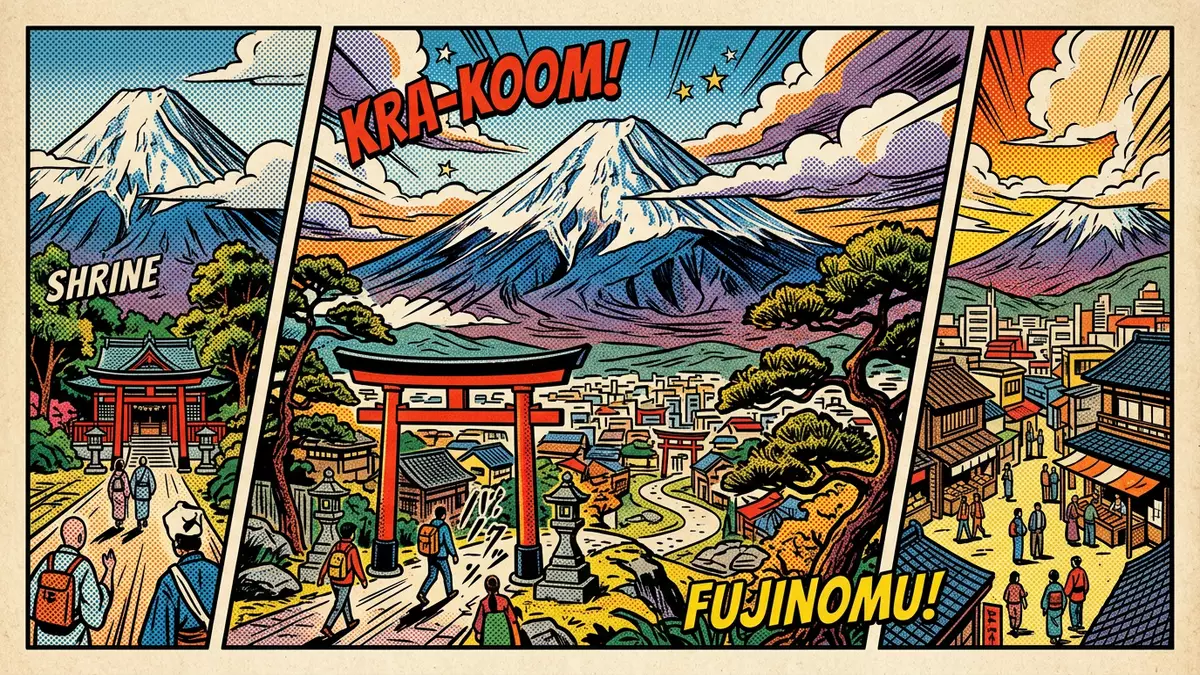
Fuji-san rises above Fujinomiya as a broad volcanic cone that dominates the horizon from the city and the surrounding plain. Mount Fuji has been a defining subject in Japanese art and pilgrimage for centuries, and its profile remains the place’s strongest visual feature.
Fuji-san above Fujinomiya
Viewed from Fujinomiya, Fuji-san reads first as a mountain of clean lines and large scale. Its flanks rise in long sweeps to the summit, and the symmetry is part of what makes the mountain instantly recognisable.
The mountain is a stratovolcano, formed by repeated eruptions over a long geological history. Its summit and upper slopes carry snow for much of the year, while the lower reaches shift between forest, volcanic ground and cultivated foothills.
A mountain shaped by worship and art
Fuji-san is closely tied to Japanese religious practice, especially mountain worship and pilgrimage traditions associated with Shinto and Buddhist communities. It has also become one of the central motifs in Japanese visual culture, from woodblock prints to modern photography.
The name appears in many works by Katsushika Hokusai and Utagawa Hiroshige, whose prints helped fix the mountain’s outline in the wider imagination. The mountain’s cultural standing comes from that long presence in ritual, literature and image-making rather than from any single monument on the slopes.
Volcanic landscape and seasonal change
The mountain’s geology is as important as its image. Fuji-san sits on a volcanic system with layers of lava, ash and older cones, and that structure gives the mountain its smooth outer form.
From the lower approaches around Fujinomiya, the mountain can appear to change character with light and weather. The snow line, the tree line and the dark bands of volcanic ground give each season a different balance of colour and texture.
Visiting Fuji-san: what travellers from Western Europe should know
- The site is reached from Fujinomiya and other towns in Shizuoka by road and by mountain trails.
- Admission arrangements and opening hours are set by the site's operator and change with the season; the official website is the only binding source.
- Late spring, summer and clear winter days offer different views of the mountain. Cloud and snow can hide the summit for long stretches.
- The upper routes involve altitude, uneven volcanic ground and long stretches on foot. Good shoes and warm layers matter on exposed sections.
- Most everyday transactions in towns around the mountain use Japanese payment systems, though cards are accepted in many visitor-facing places. Basic English is useful, and Japanese greetings go a long way.
- Entry requirements depend on your nationality. UK travellers should check the FCDO travel advice at gov.uk/foreign-travel-advice; Irish travellers the Department of Foreign Affairs at ireland.ie; EU and EEA citizens their own national foreign ministry.
Searching for Fuji-san on social platforms
These links open searches for Fuji-san on each platform.
Frequently asked questions about Fuji-san
Where is Fuji-san?
Fuji-san stands on Honshu, the main island of Japan, west of Tokyo and close to Fujinomiya on its southern side. It rises above the border area between Shizuoka and Yamanashi prefectures.
What should a visit involve?
Expect mountain scenery, changing weather and, on the higher routes, steep ground and thin air. Lower viewpoints around Fujinomiya offer wide views without the demands of the summit approaches.
What makes Fuji-san distinctive?
Its near-symmetrical volcanic cone, cultural importance and long presence in Japanese art set it apart. The mountain combines a clear physical shape with a deep historical role in national imagery.


