
Fo Guang Shan Fojitu Jinianguan and its hillside Buddha museum axis in Kaohsiung
Published on 09/12/2026 at 08:33 | Editorial responsibility: Rafael Müller, Editor-in-Chief AD HOC NEWS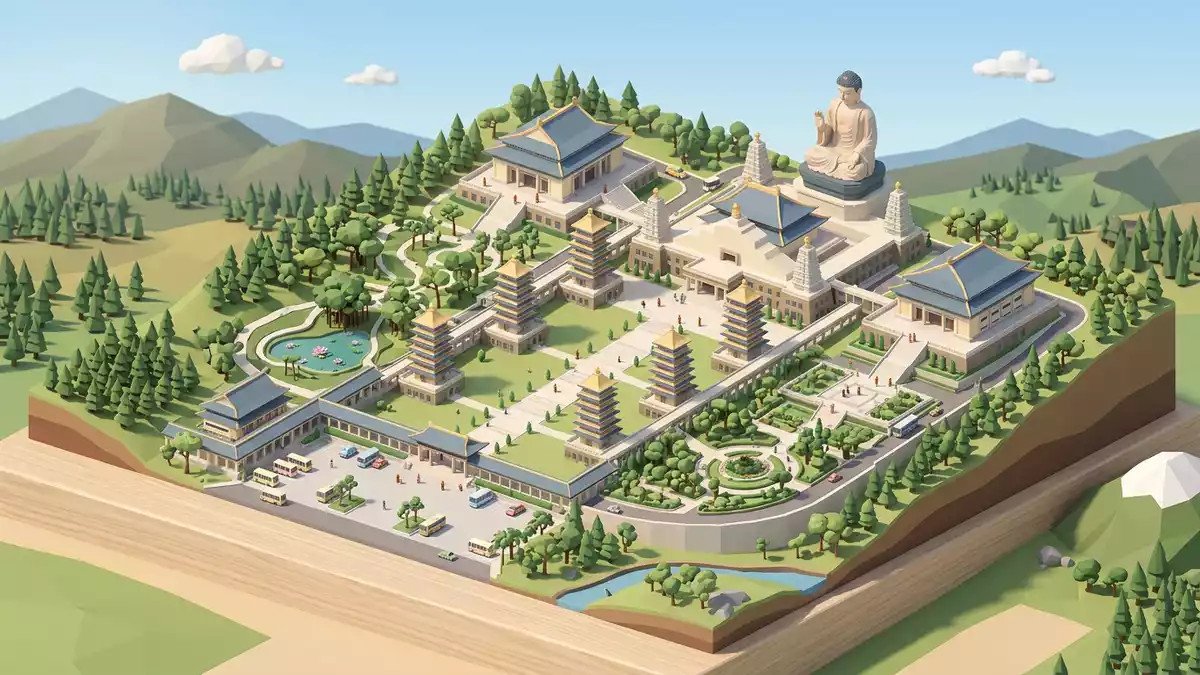
Fo Guang Shan Fojitu Jinianguan in Kaohsiung is the Chinese name for the Fo Guang Shan Buddha Museum, a modern Buddhist complex laid out along a long ceremonial axis on the low hills of Dashu District in southern Taiwan. Conceived as a cultural, religious and educational museum within the wider Fo Guang Shan Buddhist organisation founded by Venerable Master Hsing Yun in the twentieth century, it brings together formal temple architecture, museum galleries and a towering seated Buddha into one coherent landscape.Fo Guang Shan Buddha Museum
A hillside axis of courtyards, pagodas and a seated Buddha
Fo Guang Shan Fojitu Jinianguan occupies a broad site in Dashu District north-east of Kaohsiung’s urban core, where shallow hills slope towards the Gaoping River and the coastal plain beyond.Dashu District location The museum complex is arranged along a central axis: visitors move through a sequence of open plazas and courtyards lined with symmetrical pagodas that lead the eye towards a large seated Buddha figure rising on a higher terrace above the main halls.central axis of courtyards and pagodas
The long perspective from the lower approach up to the Buddha emphasises the scale of the site and the alignment of its buildings, with the pagodas framing views towards the main hall and the hillside beyond. At the higher end of the axis, terraces and platforms support the Buddha and its base structures, while museum galleries, shrines and other facilities occupy the lower and intermediate levels. The result is a landscape that reads as both a place of pilgrimage and a planned cultural precinct, with Buddhist imagery and architectural repetition giving rhythm to the walk along the axis.
A modern Buddhist museum founded around a relic
Fo Guang Shan Fojitu Jinianguan is part of Fo Guang Shan, the international Buddhist organisation established by Venerable Master Hsing Yun, whose headquarters monastery also stands in Dashu District.Fo Guang Shan organisation The Buddha Museum itself was founded to enshrine one of Sakyamuni Buddha’s tooth relics, which was gifted to Hsing Yun in 1998; construction then took place over several years and the museum opened to the public on 25 December 2011.opened to the public on 25 December 2011
This origin shapes the museum’s character as a modern Mah?y?na Buddhist cultural centre rather than only a traditional temple complex. Within its buildings, religious halls sit alongside exhibition spaces, educational facilities and areas for lectures or seminars, creating a setting where devotional practice and museum-style interpretation share the same grounds.Mah?y?na Buddhist cultural, religious and educational museum The tooth relic gives the site a clear focal point of veneration, while the broader layout, signage and facilities make it accessible to visitors who come for its architecture, its collections or an introduction to Buddhism.
Dashu’s landscape and the link to Fo Guang Shan Monastery
Fo Guang Shan Fojitu Jinianguan stands inland from Kaohsiung’s harbour, in foothills that form part of the Dashu landscape above the Gaoping River valley.Dashu hills overlooking the Gaoping River The site is closely connected to Fo Guang Shan Monastery, the large monastic complex that serves as the organisation’s headquarters in the same district;Fo Guang Shan Monastery in Dashu District roads and internal shuttle routes link the monastery area with the Buddha Museum, so the two together form an extended religious and cultural landscape.
The museum entrance stands on Tongling Road within this monastic zone, and the wider complex lies near the junction of National Highways and Provincial Highway 29 that serve Kaohsiung’s outskirts.Provincial Highway 29 to Fo Guang Shan From the elevated terraces around the main hall and Buddha, the surrounding hills and valley open out, making clear how the site occupies a transition between urban Kaohsiung and the more rural landscape upstream along the river. The arrangement of temple roofs, pagodas and the large Buddha against this backdrop has become one of the most recognisable hilltop silhouettes in southern Taiwan.
Visiting Fo Guang Shan Fojitu Jinianguan: what travellers from Western Europe should know
- Fo Guang Shan Fojitu Jinianguan is located in Dashu District north-east of central Kaohsiung in southern Taiwan and is reached by road along Tongling Road towards the Fo Guang Shan monastery area.
- The complex occupies hilly ground above the Gaoping River valley, and a visit involves walking across broad plazas and climbing gentle gradients and flights of steps between the lower courtyards and the upper Buddha terrace.
- Fo Guang Shan Buddha Museum is part of a larger monastic landscape: the museum complex adjoins Fo Guang Shan Monastery in Dashu District, so many visits combine shrine halls, museum galleries and the wider temple grounds in one itinerary.
- The official language is Chinese and the currency is the New Taiwan dollar.
- Entry requirements depend on your nationality; UK travellers can check the FCDO travel advice at gov.uk/foreign-travel-advice, Irish travellers the Department of Foreign Affairs at ireland.ie.
Searching for Fo Guang Shan Fojitu Jinianguan on social platforms
These links open searches for Fo Guang Shan Fojitu Jinianguan on each platform.
Frequently asked questions about Fo Guang Shan Fojitu Jinianguan
Where is Fo Guang Shan Fojitu Jinianguan located?
Fo Guang Shan Fojitu Jinianguan, known internationally as Fo Guang Shan Buddha Museum, stands in Dashu District in Kaohsiung City in southern Taiwan, inland from the coastal urban area.Location in Dashu, Kaohsiung, Taiwan
What should visitors expect on a visit?
A visit centres on walking along a long axis of plazas and pagodas towards a large seated Buddha, with museum galleries, shrines and cultural facilities housed within the surrounding buildings.axis towards the seated Buddha
What makes Fo Guang Shan Fojitu Jinianguan distinctive among Buddhist sites?
The complex combines an enshrined Buddha tooth relic and monastic connections with a planned museum landscape of pagodas, halls and a monumental Buddha aligned along a single hillside axis.relic and museum origin


