
Fo Guang Shan Fojitu Jinianguan and the avenue of pagodas in Kaohsiung
Published on 09/07/2026 at 19:10 | Editorial responsibility: Rafael Müller, Editor-in-Chief AD HOC NEWS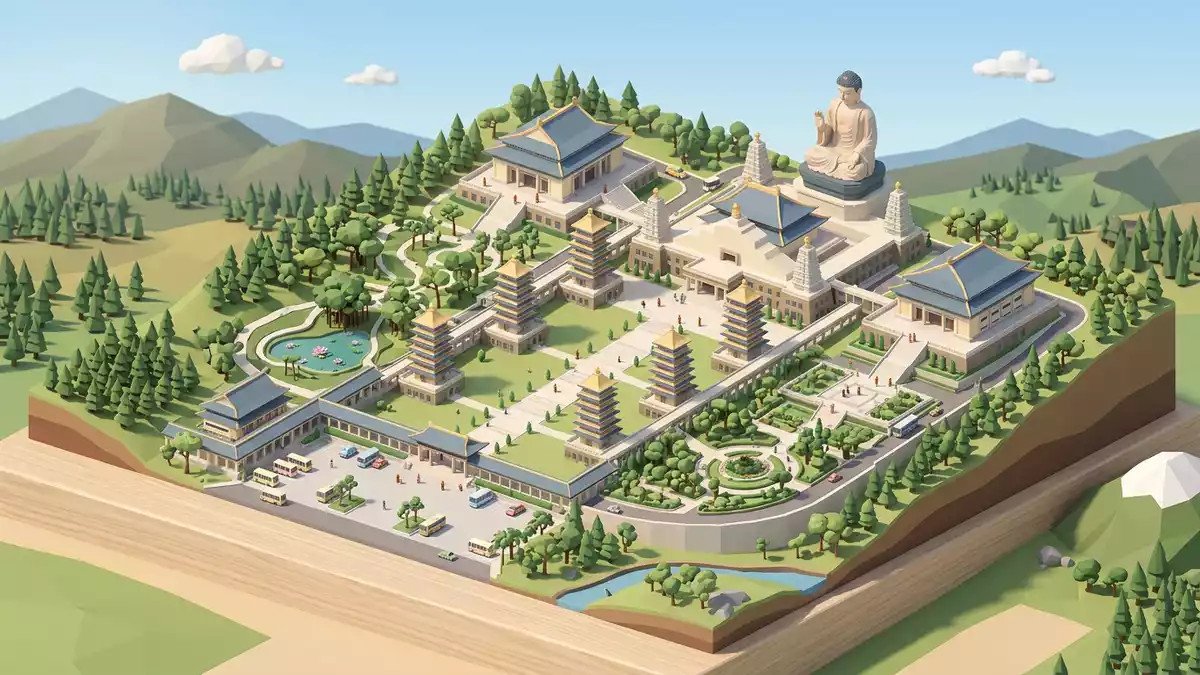
Fo Guang Shan Fojitu Jinianguan in Kaohsiung is a large Buddhist museum complex laid out along a central axis of courtyards and pagodas leading towards a towering seated Buddha on a hillside above Dashu District in southern Taiwan. It forms part of the wider Fo Guang Shan Buddhist organisation founded by Venerable Hsing Yun in the twentieth century and is linked directly to Fo Guang Shan Monastery in the same district.
A hillside Buddha museum overlooking Dashu District
Fo Guang Shan Fojitu Jinianguan stands in Dashu District on the north-eastern outskirts of Kaohsiung City, in a hilly landscape that drops towards the Gaoping River and the coastal plain beyond.Dashu District location The complex is widely known in English as the Fo Guang Shan Buddha Museum and occupies a broad site connected by road to the Fo Guang Shan Monastery a short distance away.Fo Guang Shan Buddha Museum name The museum’s Chinese name, rendered as “Fógu?ngsh?n Fótuó jìniàngu?n”, points directly to its function as a memorial hall focused on the Buddha.
The Buddha Museum is described as a Mah?y?na Buddhist cultural, religious and educational centre, placing exhibition galleries, ceremonial halls and teaching spaces in one continuous ensemble.Mah?y?na museum description Its layout spreads across an area reported to cover several tens of hectares on the slopes above Dashu, with the main hall and Buddha statue occupying the upper terrace and the avenue of pagodas defining the long lower approach.expansive hillside site The whole complex sits within the broader Fo Guang Shan grounds, making it part of a larger religious landscape rather than a stand-alone urban museum.
The central axis and the avenue of pagodas
Approaching Fo Guang Shan Fojitu Jinianguan from Tongling Road in Dashu, visitors first encounter a wide forecourt leading into a long ceremonial axis flanked by pagodas and gardens.avenue and forecourt This axial route, sometimes referred to as an avenue of pagodas, guides the eye towards the main hall terrace and the large seated Buddha figure rising above the roofline at the head of the composition.seated Buddha focus The pagodas are set symmetrically on either side, forming a pair of aligned rows that frame the central walkway and create a layered perspective as one moves uphill.
The architectural language along this axis blends forms associated with Chinese Buddhist temples and elements echoing Indian stupas, reflecting the transnational influences in Mah?y?na Buddhist architecture.Chinese and Indian influences Pagoda towers feature tiered roofs and ornamental details, while courtyard structures along the way provide space for educational facilities, reception halls and exhibition areas within rectilinear blocks. The main hall at the upper end of the axis is set behind a broad terrace, forming a platform beneath the Buddha statue and housing shrines, display spaces and ritual rooms arranged around central congregational areas.
Collections, relics and the role of Fo Guang Shan
Fo Guang Shan Fojitu Jinianguan is linked closely to the Fo Guang Shan Buddhist order, whose headquarters monastery also lies in Dashu District, making the museum an extension of the organisation’s religious and educational work.Fo Guang Shan organisation The complex is known for housing a tooth relic of the Buddha within its main hall, enshrined as a focal object of veneration for pilgrims and visitors.Buddha tooth relic Around this centre, the museum incorporates galleries displaying Buddhist art, sculptures and manuscripts alongside spaces for lectures, conferences and cultural programmes.
The wider Fo Guang Shan complex combines the Buddha Museum with monastic buildings, teaching institutes and service facilities, forming one of the largest Buddhist centres in Taiwan.Buddha Memorial Center description The museum itself is positioned as a place where religious practice and museum interpretation sit side by side: meditation halls and chapels neighbour curated exhibits, while outdoor plazas host ceremonies, cultural performances and educational activities tied to Humanistic Buddhism as promoted by Fo Guang Shan.
Visiting Fo Guang Shan Fojitu Jinianguan: what travellers from Western Europe should know
- Fo Guang Shan Fojitu Jinianguan stands in Dashu District north-east of central Kaohsiung and is reached by road along Tongling Road towards the Fo Guang Shan monastery area.
- The terrain within the Buddha Museum complex involves broad paved plazas and gentle slopes on the hillside; reaching the main hall terrace requires walking up the central axis past the pagodas.
- Fo Guang Shan Fojitu Jinianguan is connected to the wider Fo Guang Shan grounds, where shuttle services operate between the monastery and the Buddha Museum, making internal movement across the complex easier for visitors.
- The official language is Chinese and the currency is the New Taiwan dollar.
- Entry requirements depend on your nationality; UK travellers can check the FCDO travel advice at gov.uk/foreign-travel-advice, Irish travellers the Department of Foreign Affairs at ireland.ie.
Searching for Fo Guang Shan Fojitu Jinianguan on social platforms
These links open searches for Fo Guang Shan Fojitu Jinianguan on each platform.
Frequently asked questions about Fo Guang Shan Fojitu Jinianguan
Where is Fo Guang Shan Fojitu Jinianguan located?
Fo Guang Shan Fojitu Jinianguan is located in Dashu District in Kaohsiung City in southern Taiwan, connected to the Fo Guang Shan Monastery complex.
What should visitors expect on a visit to the Buddha Museum?
Visitors encounter a large Buddhist museum with a central avenue of pagodas, courtyard buildings, exhibition halls and a main terrace dominated by a seated Buddha statue.
What makes Fo Guang Shan Fojitu Jinianguan distinctive among Buddhist sites?
The combination of a Buddha tooth relic, extensive museum galleries, ceremonial spaces and the strong axial layout with pagodas and a hillside Buddha gives the complex a distinctive character.


