
Fenghuang Gucheng, riverside ancient town of western Hunan
Published on 09/18/2026 at 09:44 | Editorial responsibility: Rafael Müller, Editor-in-Chief AD HOC NEWS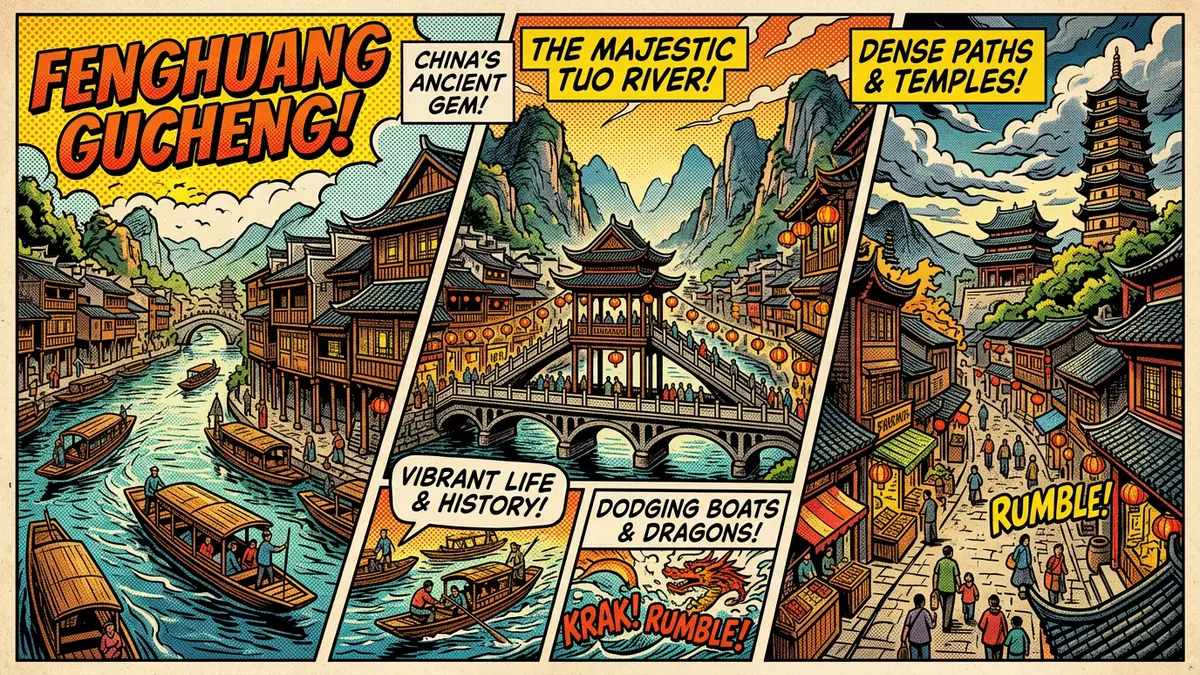
Fenghuang Gucheng in Fenghuang, western Hunan in China, is a compact riverside ancient town where wooden houses, stone lanes and the Tuojiang River form a tightly knit historic landscape. The present fabric of the old town is traditionally dated to 1704, during the Qing dynasty, giving its streets and riverfront dwellings more than three centuries of recorded history.
A Qing?era riverside town shaped by river and hills
Fenghuang Gucheng occupies the historic core of Fenghuang County in a mountainous valley of western Hunan Province, with the Tuojiang River running directly through the town. The ancient settlement lies within Xiangxi Tujia and Miao Autonomous Prefecture, where steep hills rise above the river and frame the old streets on both banks.Fenghuang Ancient Town Within this setting, Fenghuang Gucheng has the character of a small river port, its houses, docks and lanes oriented towards the Tuojiang as the town’s central axis.riverside old town
The present walled town is traditionally dated to 1704 in the reign of the Qing emperor Kangxi, and many of its buildings reflect architectural styles associated with both the Ming (1368–1644) and Qing (1644–1911) dynasties. Timber frames, tiled roofs and brick or stone foundations appear side by side, with courtyards and enclosed lanes forming a compact pattern behind the riverfront. Along the inner banks of the Tuojiang River, bands of stilted wooden houses rise directly above the water on timber supports, forming one of the most distinctive everyday views of Fenghuang Gucheng.stilted wooden houses
Ming and Qing architecture in timber, brick and stone
Behind the riverfront, stone?paved streets and alleys run between rows of traditional houses, many built in Ming and Qing styles with timber frames, internal courtyards and brick or stone walls. The urban fabric includes watchtowers, old walls, ancestral halls and temples, all woven into a network of streets and lanes that still follows a historic pattern. Chinese cultural authorities classify Fenghuang Gucheng as a national historical and cultural town, and the ancient city has been included on China’s list of preparatory World Cultural Heritage sites.Ancient Town of Fenghuang The UNESCO World Heritage Centre includes Fenghuang Ancient City on the Tentative List, describing an ancient town whose documented area and layout make it a notable historic landscape.UNESCO Tentative List
Within the old town, recognised historic residences and halls mark the social and cultural history of Fenghuang. Well?known sites include the Former Residence of Shen Congwen, whose novella “Border Town” drew on the life of small river settlements, and the Former Residence of Xiong Xiling, a figure associated with early twentieth?century Chinese politics.core attractions in the town Ancestral halls such as the Yang Family Ancestral Hall, along with the Hong (Rainbow) Bridge and historic gate towers, form part of a group of heritage buildings that reflect the mix of Han, Miao and Tujia influences documented in Fenghuang Gucheng.Fenghuang Ancient Town guide
Minority cultures along the Tuojiang River
The population of Fenghuang County includes significant numbers of Miao and Tujia people, and Fenghuang Gucheng reflects this diversity in its architecture, decoration and street life. More than half the residents of the ancient town are recorded as belonging to minority groups, with Miao and Tujia traditions visible in local housing forms, craftwork and ceremonial spaces.Miao and Tujia population Timber houses along the river often show carved wooden details and projecting balconies, while the streets behind them include small squares and halls used for family and community gatherings.
Fenghuang Ancient Town is described as one of the better?preserved historic towns of its scale in China, with its classification as a nationally protected historic and cultural town reinforcing its status.protected ancient town in Hunan The combination of riverside stilt houses, stone streets, city walls and towers gives Fenghuang Gucheng a layered character, in which official buildings, ancestral halls and ordinary dwellings sit within the same compact landscape.riverside ancient town of western Hunan
Visiting Fenghuang Gucheng: what travellers from Western Europe should know
- Fenghuang Gucheng lies in Fenghuang County, western Hunan Province, inland from China’s south?eastern coast, with regional links through cities such as Changsha and Zhangjiajie. Fenghuanggucheng Railway Station stands outside the old town as a modern rail access point.
- The historic core is built along the banks of the Tuojiang River, with narrow, stone?paved streets, stepped alleyways and timber houses rising above the water, so moving around involves frequent changes of level.
- The official language is Chinese and the currency is the renminbi (yuan).
- Entry requirements depend on your nationality; UK travellers can check the FCDO travel advice at gov.uk/foreign-travel-advice, Irish travellers the Department of Foreign Affairs at ireland.ie.
Searching for Fenghuang Gucheng on social platforms
These links open searches for Fenghuang Gucheng on each platform.
Frequently asked questions about Fenghuang Gucheng
Where is Fenghuang Gucheng located?
Fenghuang Gucheng is the historic riverside old town of Fenghuang County in western Hunan Province in China, set along the Tuojiang River in a mountainous valley.
What should visitors expect when walking through the old town?
Visitors encounter stilted wooden houses above the river, stone?paved streets and alleys, historic walls and towers, and a compact network of lanes lined with timber, brick and stone buildings.
What makes Fenghuang Gucheng distinctive among historic towns in China?
The combination of Qing?era riverside housing, Ming and Qing architectural styles, documented minority cultures and its recognised status as a nationally protected historic and cultural town gives Fenghuang Gucheng a distinctive character.


