
Dendera Temple Complex and its sandstone halls
Published on 09/23/2026 at 12:59 | Editorial responsibility: Rafael Müller, Editor-in-Chief AD HOC NEWS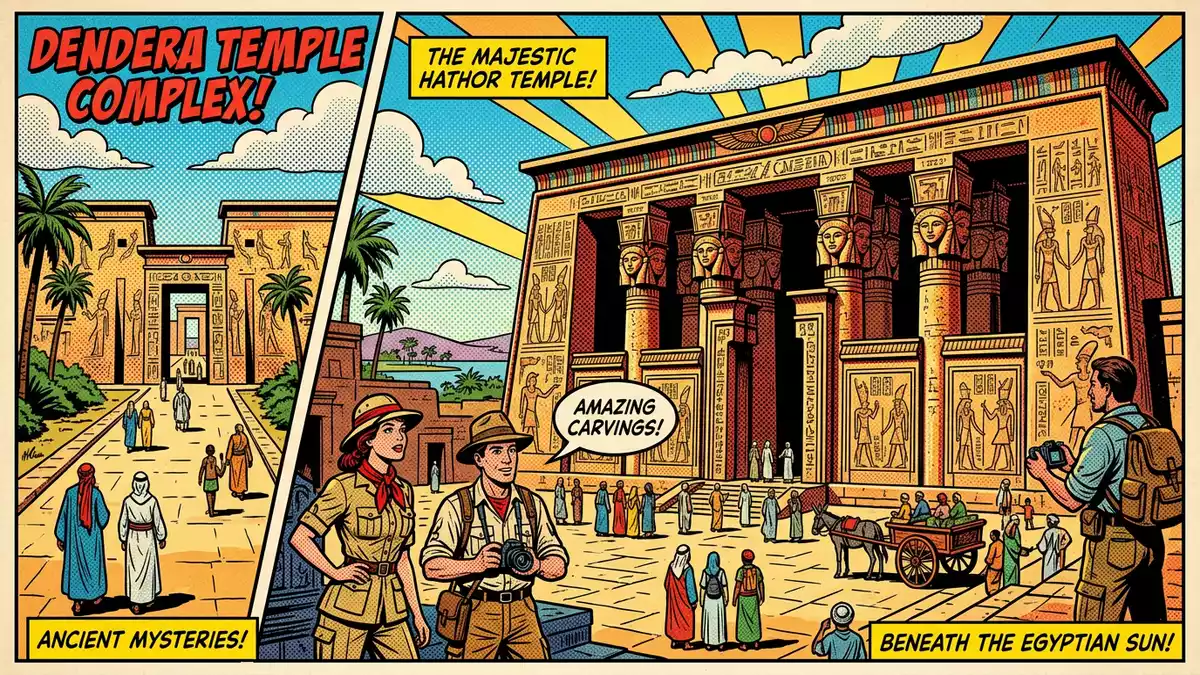
Dendera Temple Complex rises on the west bank of the Nile opposite Qena, where pale sandstone buildings occupy a walled sacred precinct. The Temple of Hathor forms the centre, and its columns, reliefs and ceilings preserve an architectural world shaped during the Ptolemaic and Roman periods.
Dendera’s sandstone sanctuary beside the Nile
The complex occupies a broad enclosure near the town of Dendera, at the meeting point of cultivated land and desert. A substantial mud-brick wall surrounds temples, chapels, a sacred lake and other structures within the religious precinct.
At the centre stands the Temple of Hathor, built mainly from pale sandstone blocks. Its surfaces carry hieroglyphs, royal cartouches, divine figures and scenes connected with Egyptian ritual. The building follows an east–west axis and presents a sequence of spaces from outer approaches to halls, chapels and sanctuary rooms.
The temple’s monumental façade is lined with columns bearing the head of Hathor, the goddess associated with music, joy, motherhood and the sky. Behind it, the hypostyle hall contains closely spaced columns and a decorated ceiling. A sandstone Temple of Hathor anchors the entire complex.
The Temple of Hathor across Ptolemaic and Roman Egypt
The present Temple of Hathor belongs chiefly to the late Ptolemaic period and the early centuries of Roman rule. Construction began in 54 BC under Ptolemy XII Auletes, and work continued under Roman emperors, including Tiberius.
The masonry records this political transition through royal names and imperial cartouches. Egyptian architectural forms remain dominant, while the dates and patrons belong to a period when Egypt was governed first by the Ptolemaic dynasty and then by Rome. The result is a temple whose decoration extends across changing regimes without losing its Egyptian religious language.
The interior contains halls, chapels, crypts and staircases leading towards roof-level spaces. Reliefs cover walls, columns and doorways, while painted scenes remain on parts of the ceilings. The temple’s rooms are arranged along a processional axis, with enclosed spaces becoming more restricted towards the sanctuary.
Dendera also preserves a long astronomical tradition. The famous Zodiac of Dendera once belonged to a ceiling in the Temple of Hathor and combines Egyptian religious imagery with zodiacal signs familiar from the Greco-Roman world. The relief is now in Paris, while the temple retains other celestial and ritual decoration. The Temple of Hathor’s construction began in the first century BC.
Birth houses, sacred water and older layers
Dendera was a religious centre long before the surviving sandstone temple. Evidence connects the site with earlier phases of Egyptian history, including the Old Kingdom and the Middle Kingdom. The standing complex therefore brings together buildings from different periods inside one enclosure.
The oldest surviving structure within the precinct is the mammisi associated with Nectanebo II, who ruled in the fourth century BC. A mammisi was a birth house connected with divine birth narratives and temple ritual. Its presence adds a smaller, separate building to the larger sanctuary devoted to Hathor.
Other parts of the enclosure include subsidiary chapels, crypts and a sacred lake. A later Coptic church also belongs to the site’s sequence of religious use. These buildings do not form a single architectural moment; they record different phases of worship, construction and adaptation across the ancient and late antique periods.
The complex’s reliefs preserve names including Ptolemy XII, Tiberius and other rulers. They also show gods, kings, offerings and ceremonial scenes. Dendera is therefore read through both its physical arrangement and its inscriptions, which connect individual rooms with the religious and political language of ancient Egypt.
Visiting Dendera Temple Complex: what travellers from Western Europe should know
- Dendera Temple Complex stands on the west bank of the Nile near Dendera, opposite Qena in Upper Egypt. It is reached by road from Qena or Luxor, and some Nile cruise itineraries include the site.
- The approach crosses level ground, while the temple interior includes stone paving, enclosed rooms and staircases leading towards roof-level spaces.
- The complex lies beside cultivated Nile Valley land, with desert terrain beyond the enclosure and exposed areas around the outer walls and sacred lake.
- The official language is Arabic and the currency is the Egyptian pound.
- Entry requirements depend on your nationality; UK travellers can check the FCDO travel advice at gov.uk/foreign-travel-advice, Irish travellers the Department of Foreign Affairs at ireland.ie.
Searching for Dendera Temple Complex on social platforms
These links open searches for Dendera Temple Complex on each platform.
Frequently asked questions about Dendera Temple Complex
Where is Dendera Temple Complex?
Dendera Temple Complex stands on the west bank of the Nile near Dendera, opposite Qena in Upper Egypt. The site lies within the Nile Valley, close to cultivated land and desert terrain.
What can visitors see inside the complex?
The enclosure contains the Temple of Hathor, hypostyle halls, chapels, crypts, staircases, a sacred lake and the mammisi associated with Nectanebo II.
What makes Dendera Temple Complex distinctive?
Its pale sandstone Temple of Hathor combines dense reliefs, Hathor-headed columns, decorated ceilings and Ptolemaic and Roman inscriptions within one walled precinct.


