
Dendera Temple Complex: Hathor’s sandstone sanctuary in Upper Egypt
Published on 09/15/2026 at 15:26 | Editorial responsibility: Rafael Müller, Editor-in-Chief AD HOC NEWS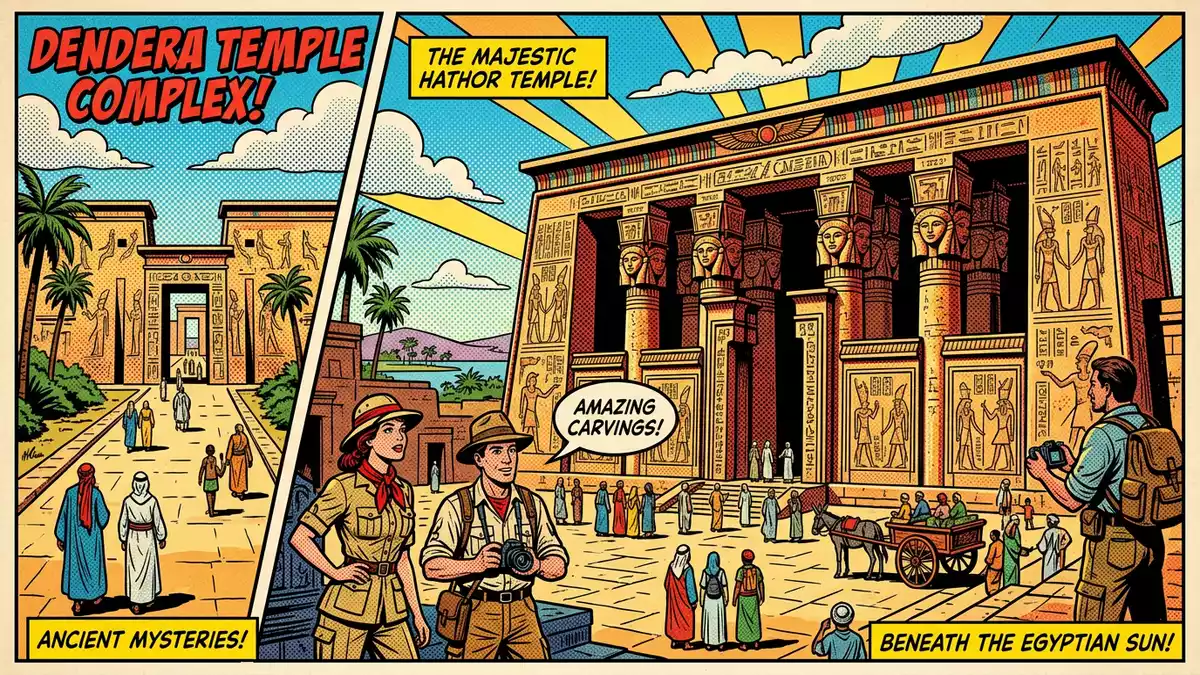
On the west bank of the Nile opposite Qena, Dendera Temple Complex gathers a cluster of ancient buildings around the great sandstone Temple of Hathor, set within a walled sacred precinct in Upper Egypt. The present temple belongs to the late Ptolemaic and early Roman periods, yet it stands on ground associated with Hathor for millennia and preserves some of the clearest surviving reliefs from that time.
Sandstone, symmetry and a vast sacred enclosure
Dendera Temple Complex occupies a large rectangle of ground enclosed by a substantial mud-brick wall, marking a boundary between the cultivated river plain and a carefully ordered sacred space.The whole complex covers some 40,000 square metres and lies close to the small town of Dendera, across the river from Qena in Upper Egypt.It sits at the edge of the desert on the Nile’s west bank where the temple enclosure rises slightly above surrounding fields.
At the heart of this space stands the Temple of Hathor, laid out along a principal east–west axis and built largely of pale sandstone blocks carved with dense bands of hieroglyphs and images of gods, kings and sacred rituals.The existing temple belongs to the late Ptolemaic Period, with additions under Roman rule, and its masonry carries cartouches of rulers such as Ptolemy XII and the emperor Tiberius.Work began in 54 BCE under Ptolemy XII Auletes and continued into Tiberius’s reign, giving the building a layered historical character within a single coherent architectural scheme.
Temple of Hathor: hypostyle halls, chapels and crypts
The Temple of Hathor presents visitors with a sequence of spaces that move from broad forecourts into enclosed halls and then into compact chapels and crypts, each lined with carefully carved reliefs and painted ceilings. The monumental façade bears Hathor-headed columns, while beyond it lies a hypostyle hall filled with further columns supporting a heavy roof whose underside preserves vivid scenes of gods and kings, despite centuries of darkening smoke and later cleaning campaigns.This hypostyle hall was completed during the Roman period under Emperor Tiberius, linking an Egyptian religious tradition with the architectural language of Rome.
Behind the main halls, a ring of chapels surrounds the sanctuary core, while staircases climb to the roof, where additional chapels and open spaces extend the ritual topography onto upper levels.Within the enclosure stand not only the Temple of Hathor but also subsidiary structures, including chapels, crypts, a sacred lake and a later Coptic church with Roman influence. These elements form a compact but varied sacred landscape, illustrating how one temple complex could accommodate different phases of worship and reuse over centuries within a single perimeter.
Layers of history: from Old Kingdom cult centre to Graeco-Roman showpiece
Dendera’s importance predates the present sandstone buildings by many centuries, and the complex reflects successive phases of Egyptian religion and politics inscribed superimposed on one another. Textual and archaeological evidence points to earlier temples here from the Old Kingdom onward, associated with rulers such as Pepi I and later pharaohs of the New Kingdom, including Thutmose III, Amenhotep III, Ramesses II and Ramesses III, whose names appear on fragments and foundation remains reused or referenced in the Graeco-Roman construction.There has been a temple dedicated to Hathor at this site for over four thousand years, making the present building a relatively recent layer in a long sacred tradition.
The earliest surviving structure within today’s enclosure is a birth house, or mammisi, raised by Nectanebo II in the fourth century BC.Nectanebo II’s mammisi stands as the oldest extant building in the compound, linking Dendera to the last native pharaohs before Macedonian and Roman rule. Later, under Ptolemaic and Roman patronage, the main temple acquired its present form, and the complex continued to be embellished with gateways and peripheral structures carrying the names of first-century emperors. This accumulation of phases within one bounded area makes Dendera a particularly clear example of continuity and change in Egyptian temple architecture.
Visiting Dendera Temple Complex: what travellers from Western Europe should know
- Dendera Temple Complex stands on the west bank of the Nile near the town of Dendera, opposite Qena in Upper Egypt; it is commonly reached by road from Qena or from Luxor, and also features as a stopping point on some Nile cruise itineraries.
- The complex lies slightly above the surrounding plain, with approaches across level ground leading into the enclosure; once inside, movement involves walking across stone paving and climbing staircases within the temple, including narrow flights up to the roof.
- The region forms part of the Nile Valley, with cultivated land close to the enclosure and desert terrain beginning beyond it; travellers encounter both shaded interior spaces and exposed exterior areas around the sacred lake and outer walls.
- The official language is Arabic and the currency is the Egyptian pound.
- Entry requirements depend on your nationality; UK travellers can check the FCDO travel advice at gov.uk/foreign-travel-advice, Irish travellers the Department of Foreign Affairs at ireland.ie.
Searching for Dendera Temple Complex on social platforms
These links open searches for Dendera Temple Complex on each platform.
Frequently asked questions about Dendera Temple Complex
Where is Dendera Temple Complex located?
Dendera Temple Complex stands on the west bank of the Nile near the town of Dendera, opposite Qena in Upper Egypt, within the wider Nile Valley region.
What should visitors expect inside the complex?
Visitors encounter a large walled precinct with the sandstone Temple of Hathor, hypostyle halls, chapels, crypts, staircases to roof-level spaces and a sacred lake alongside later structures such as a Coptic church.
What makes Dendera Temple Complex distinctive among Egyptian temple sites?
Dendera Temple Complex combines a long history of Hathor worship with a remarkably well preserved late Ptolemaic and Roman sandstone temple, extensive relief decoration and an enclosure where different sacred buildings share one carefully organised space.


