
De Dam, where Amsterdam took shape
Published on 09/10/2026 at 10:49 | Editorial responsibility: Rafael Müller, Editor-in-Chief AD HOC NEWS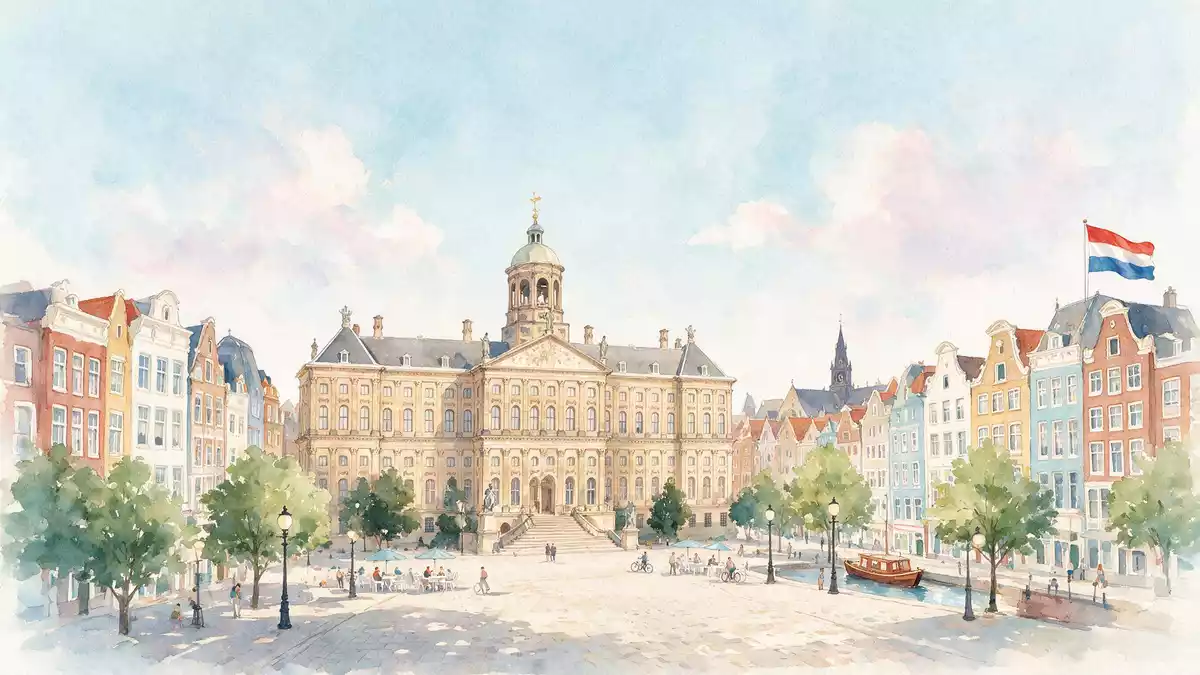
De Dam in Amsterdam is a city square built on the medieval dam that gave the Dutch capital both its name and its first foothold in the marshy Amstel valley. In its present form it is a paved open space in the historic centre, framed by the Royal Palace, the Nieuwe Kerk and the National Monument, and it has been a focal point of civic life since the late Middle Ages.
From river barrier to city square
The story of De Dam begins with a barrier thrown across the river Amstel in the thirteenth century, a structure that stopped tidal water from the Zuiderzee and allowed a permanent settlement to develop on either bank.barrier thrown across the river Amstel Over time, the top of this dam was widened and paved, gradually turning from hydraulic infrastructure into the town’s central square.turned from hydraulic infrastructure into the town’s central square
Medieval sources link Amsterdam’s name directly to this site, combining “Amstel”, the river, with “dam”, the barrier built around the year 1270.combining “Amstel” with “dam” By the fourteenth century, De Dam had taken on a clear urban role, hosting a weighing house for goods and becoming the administrative centre where the town hall rose on its western side.administrative centre where the town hall rose
Royal Palace and Nieuwe Kerk on the square
The west side of De Dam is dominated by the Royal Palace, a seventeenth-century building that began life as Amsterdam’s new town hall after an earlier hall burned down in 1652.new town hall after an earlier hall burned down Completed in the 1650s, this classical sandstone structure later became the residence of King Louis Napoleon in the early nineteenth century and continues to serve as a royal palace for ceremonial functions.continues to serve as a royal palace
On the north-western edge stands the Nieuwe Kerk, a Gothic church consecrated in 1409 as a second major parish church for the growing city.Gothic church consecrated in 1409 The building has survived several major fires and has been repeatedly restored, retaining its tall nave and stone vaults as a landmark beside the palace. Together, palace and church form a dense ensemble of civic and religious architecture that frames the open expanse of the square.
The National Monument and a square of remembrance
The eastern side of De Dam is marked by the National Monument, a white stone column with reliefs created as a war memorial for Dutch victims of the Second World War.war memorial for Dutch victims of the Second World War Unveiled in 1956 and rising about 22 m (72 ft), it is embedded with urns containing soil from provinces and former colonies and forms the visual centre of the eastern side of the square.embedded with urns containing soil
De Dam has long been used for ceremonies and gatherings, including the annual National Remembrance Day held on 4 May, when official commemorations focus on the monument and its surrounding low walls.annual National Remembrance Day held on 4 May Trams pass along the edges, commercial buildings line the perimeter and pigeons are drawn to the open paving, making the square both a place of reflection and an everyday city crossroads.
Visiting De Dam: what travellers from Western Europe should know
- De Dam lies in the Centrum district of Amsterdam, about south of Amsterdam Centraal railway station along Damrak, and is reached on foot or by tram from the station area.
- The square itself is level and paved, with broad surfaces, kerbs and tram tracks; crossing from one side to the other involves negotiating pedestrian crossings and occasional steps at the edges.
- Kalverstraat, a major shopping street, begins near the west side of De Dam, and Damrak and Rokin link the square to canals and commercial streets to the north and south.
- The official language is Dutch and the currency is the euro.
Searching for De Dam on social platforms
These links open searches for De Dam on each platform.
Frequently asked questions about De Dam
Where is De Dam in Amsterdam?
De Dam is a central square in the Centrum district of Amsterdam, located about 750 m south of the city’s main railway station along Damrak.
What should visitors expect when they arrive at De Dam?
Visitors encounter a broad paved square framed by the Royal Palace, the Nieuwe Kerk, commercial buildings and the National Monument, with trams and pedestrians moving around its edges.
What makes De Dam distinctive among Amsterdam’s squares?
De Dam is distinctive because it began as the dam that named Amsterdam, later gained the town hall that became the Royal Palace, and now hosts the National Monument and major commemorations.


