
De Dam, the historic heart of Amsterdam
Published on 09/16/2026 at 21:42 | Editorial responsibility: Rafael Müller, Editor-in-Chief AD HOC NEWS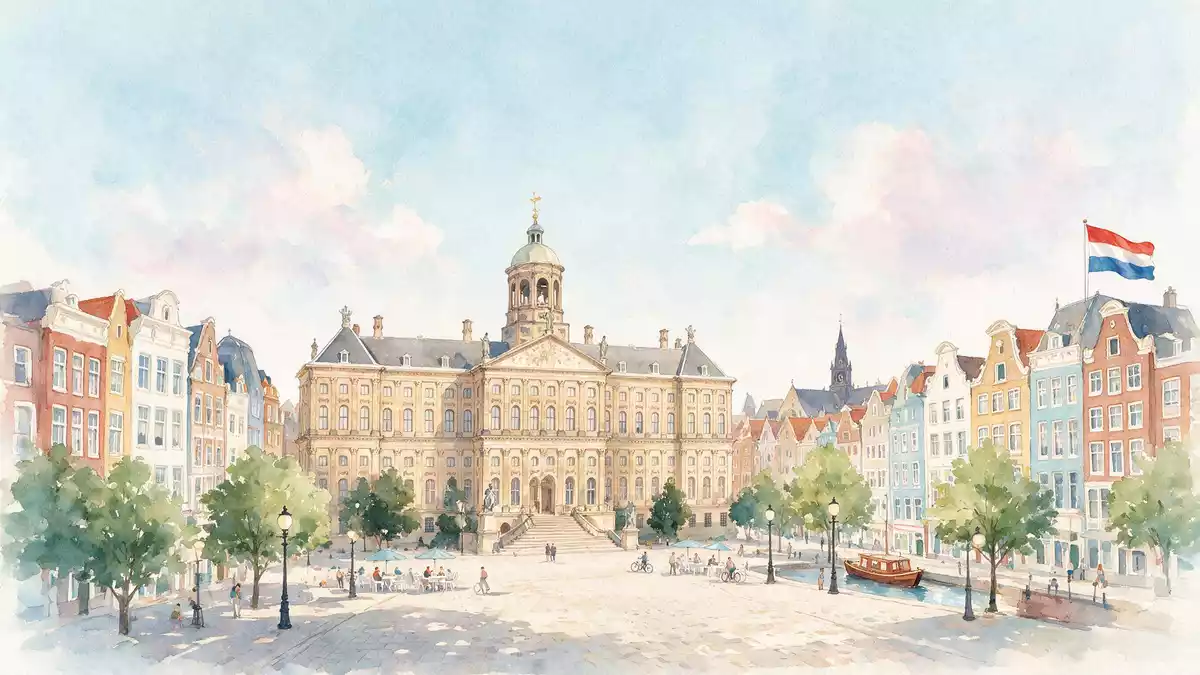
De Dam in Amsterdam is the central city square that grew from a medieval dam on the Amstel river into a civic space framed by the Royal Palace, the Nieuwe Kerk and the National Monument. In the thirteenth century a dam was built here to control the river and create dry ground, giving both the square and the city their shared name.
From river dam to city centre
The origins of De Dam lie in the thirteenth century, when settlers constructed a barrier across the Amstel to hold back water and shape a usable strip of land.A dam on the Amstel became the practical crossing point between early settlements and set the outline of the future square.The founding site on the river In time the top of the dam widened and evolved into a market area where ships on the Damrak unloaded goods and fish.
By the fourteenth century De Dam had become both the geographical and administrative centre of Amsterdam, with a weighing house and other civic buildings clustered around the square.A medieval trading square The city’s growth during the Dutch Golden Age in the seventeenth century brought grander architecture to the square as the town hall, later known as the Royal Palace, rose on its western side.A central public square The filling of parts of the Damrak in the nineteenth century left De Dam fully enclosed by streets rather than directly open to the harbour.
Royal Palace, Nieuwe Kerk and National Monument
Today three major structures define the character of De Dam: the Royal Palace, the Nieuwe Kerk and the National Monument. The Royal Palace, completed in the seventeenth century as Amsterdam’s town hall, occupies the western edge of the square and carries a classical stone façade and a prominent central tower.The former town hall on De Dam It later became a royal residence under King Louis Bonaparte in the early nineteenth century, but it still reads as a civic building rooted in the city’s mercantile past.
Beside the Royal Palace stands the Nieuwe Kerk, a historic church whose brick and stone mass anchors the north-west corner of the square.Dam Square as historic centre On the opposite, eastern side rises the National Monument, a tall stone pillar flanked by sculptural groups, dedicated to Dutch victims of the Second World War and inaugurated in the 1950s.The post-war National Monument Together these structures frame the open paving of De Dam and give the square a layered skyline of civic, religious and commemorative architecture.
A public square at the core of Amsterdam
De Dam functions as the central public square of Amsterdam, lying in the historic city centre between Amsterdam Centraal Station and the inner canal belt.The city’s historic and ceremonial centre Broad stone paving stretches across the space, with roads and tram tracks skirting its edges and linking the square to surrounding streets such as Damrak and Rokin.Dam Square in the heart of the city The square forms a flat, open plateau that contrasts with the vertical mass of the palace and the church.
As a civic space De Dam has hosted markets, parades, demonstrations and commemorations across the centuries, reflecting its role as a gathering point for the city’s residents.A long history of events Its position at the crossing of main streets means that trams and pedestrians continually pass along its edges, while the middle of the square remains an open surface punctuated by the National Monument and a few low structures.
Visiting De Dam: what travellers from Western Europe should know
- De Dam lies in Amsterdam’s historic centre, south of Amsterdam Centraal Station along Damrak, and is reached on foot or by tram services that stop at Dam.
- The square itself is level and paved, with broad surfaces of stone; crossing it involves walking on hard ground with kerbs and tram tracks at the margins.
- Nearby streets such as Damrak and Rokin connect De Dam with the canal belt and other parts of the old city, so the square often forms part of longer walks through central Amsterdam.
- The official language is Dutch and the currency is the euro.
Searching for De Dam on social platforms
These links open searches for De Dam on each platform.
Frequently asked questions about De Dam
Where is De Dam in Amsterdam?
De Dam is the central square of Amsterdam, situated in the historic city centre between Amsterdam Centraal Station and the inner canal ring, on the axis of Damrak and Rokin.
What should visitors expect on a visit to De Dam?
Visitors encounter a broad paved square bordered by the Royal Palace, the Nieuwe Kerk and commercial buildings, with trams and pedestrians moving around the edges of the open space.
What makes De Dam distinctive among Amsterdam’s squares?
De Dam is distinctive because it occupies the site of the original medieval dam on the Amstel, combines seventeenth-century civic architecture with a twentieth-century war memorial and remains the city’s historic centre.


