
De Dam in Amsterdam, from river barrier to civic stage
Published on 09/08/2026 at 14:34 | Editorial responsibility: Rafael Müller, Editor-in-Chief AD HOC NEWS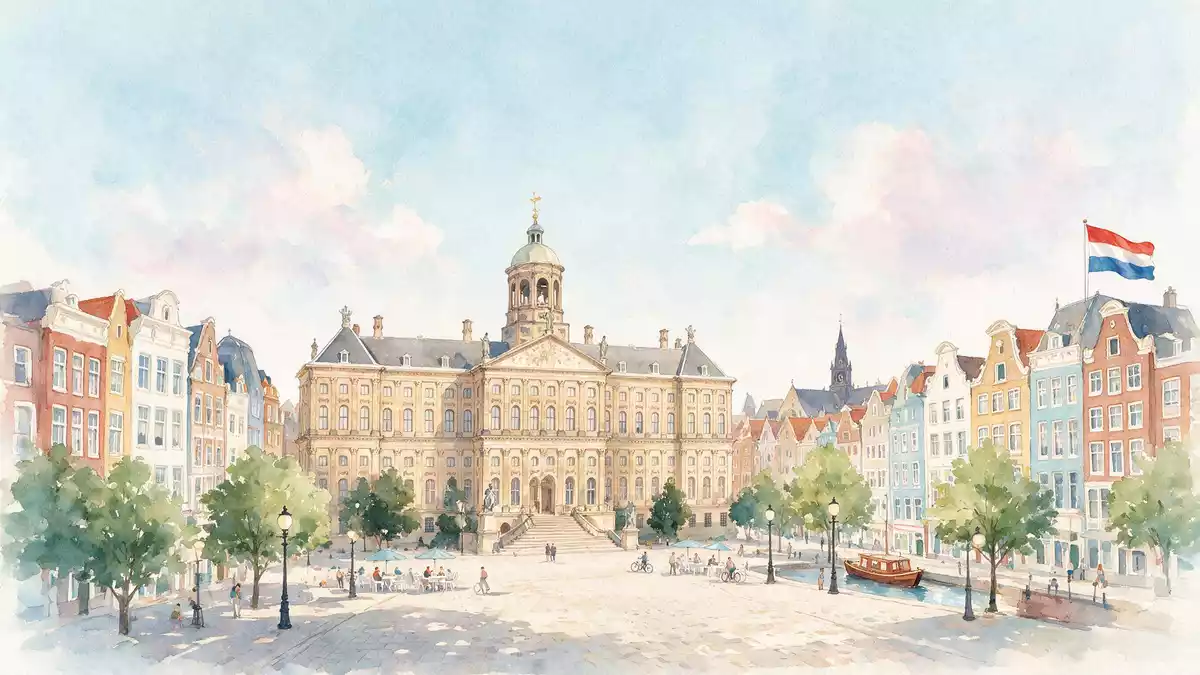
De Dam in Amsterdam is both a physical reminder of how the city began and the open urban square that has grown around that origin, framed by monumental stone buildings and the line of the former river.
From dam in the Amstel to city heart
The name De Dam goes back to its first function as a dam in the river Amstel, built in the thirteenth century to control water and connect settlements that faced each other across the river.its first function as a dam The barrier grew wide enough to form a square, and that square became the core around which Amsterdam developed into a trading city.
Early houses and streets gathered on both banks, linked by this new platform that carried traffic, markets and civic activity above the controlled water, turning a piece of hydraulic engineering into a shared urban space.linked by this new platform Over centuries the dam itself was gradually absorbed into a broader paved area, but the name and the role of De Dam as a focal point of the city remained.
Royal Palace and Nieuwe Kerk: stone landmarks on the square
The most dominant building on De Dam is the Royal Palace of Amsterdam, standing on the west side of the square in Dutch Classicist style and built as a grand city hall in the seventeenth century.Royal Palace of Amsterdam Architect Jacob van Campen was commissioned in 1648 to design this town hall, and the building opened in 1655 as the administrative centre of the city before later becoming a royal residence.Jacob van Campen was commissioned in 1648
Next to the palace stands the Nieuwe Kerk, a late medieval church that adds carved stone, stained glass and a tall ecclesiastical volume to the edge of the square, giving De Dam a strong contrast between civic and religious architecture. Opposite the palace, towards the centre of the space, rises the National Monument, a white stone memorial that anchors the long side of the square and faces the palace across the paved expanse.white stone memorial
A long tradition of trade, ceremony and demonstration
De Dam has for centuries acted as a market square, a place of civic administration and a setting for public gatherings, layered on the original infrastructure role of the dam itself.acted as a market square As Amsterdam grew through the Dutch Golden Age and beyond, the square remained a space where commerce, local government, commemorations and demonstrations shared the same open ground.
The Royal Palace carries traces of that multi-purpose civic past, having housed functions such as city administration, a court of justice and an exchange bank when it served as a town hall, before it was taken into use as a royal palace in 1808 under Napoleon and later by the Dutch monarchy.taken into use as a royal palace in 1808 Around it, De Dam’s broad paved surface continues to provide a stage for public events, with the square’s layout keeping sightlines clear between the palace, the church and the National Monument.
Visiting De Dam: what travellers from Western Europe should know
- De Dam lies in the historic centre of Amsterdam, south of the Damrak and close to the end of several central tram routes, and it is within walking distance of Amsterdam Centraal station.
- The terrain is level and paved, with broad pedestrian areas and kerbs separating tram tracks and traffic lanes from the main square.
- The official language is Dutch and the currency is the euro.
Searching for De Dam on social platforms
These links open searches for De Dam on each platform.
Frequently asked questions about De Dam
Where is De Dam in Amsterdam?
De Dam is a central square in Amsterdam, located where the Amstel was historically dammed and close to Amsterdam Centraal station at the end of the Damrak.
What can visitors expect when they reach De Dam?
Visitors find a wide paved square with the Royal Palace, the Nieuwe Kerk and the National Monument around it, as well as tram tracks and busy city streets.
What makes De Dam distinctive among Amsterdam’s squares?
De Dam is distinctive because the square grew directly out of the medieval dam that gave Amsterdam its name and because the seventeenth-century Royal Palace stands on its edge.


