
De Dam: a square shaped by Amsterdam’s history
Published on 09/23/2026 at 08:41 | Editorial responsibility: Rafael Müller, Editor-in-Chief AD HOC NEWS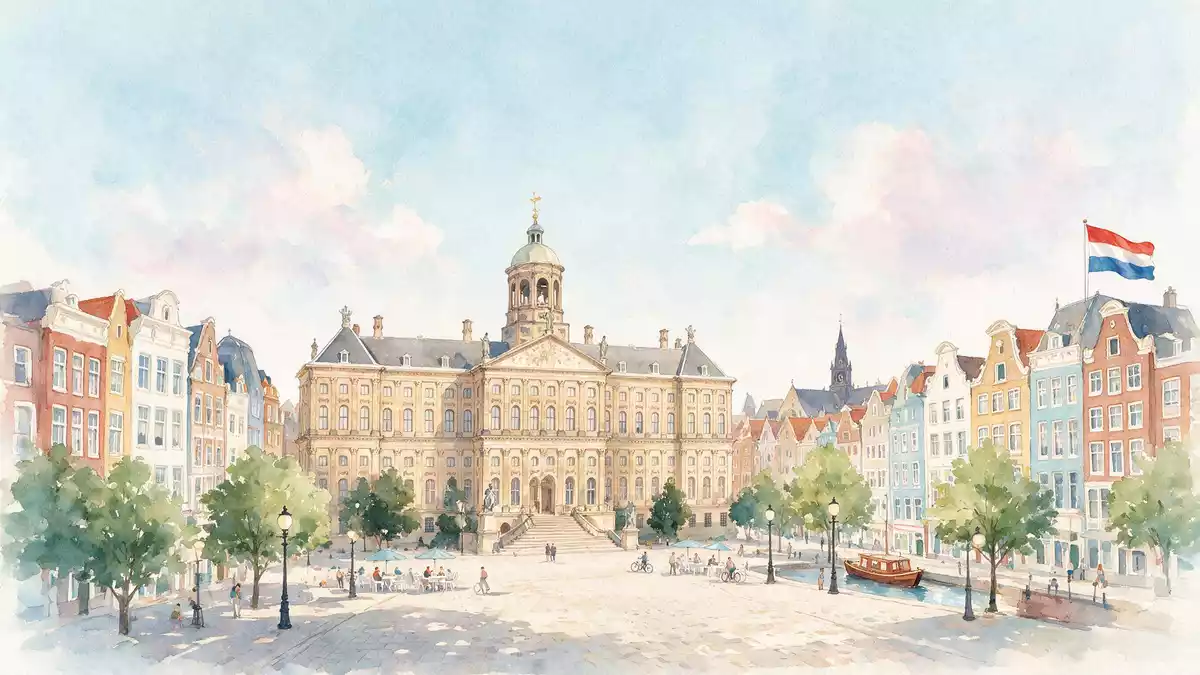
De Dam is an open city square in central Amsterdam, where a medieval water crossing, a royal palace, a Gothic church and a national memorial share one urban setting. The square’s name recalls the dam built across the Amstel in the thirteenth century, while its visible buildings trace later chapters of Amsterdam’s civic and national history.
De Dam began with a crossing over the Amstel
The settlement associated with De Dam formed around a dam across the Amstel in the late thirteenth century. The water barrier gave the growing community a crossing and a place for exchange, and its name survives in Amsterdam itself. the thirteenth-century dam remains the essential historical reference for understanding the square.
De Dam developed as a civic and commercial space. The open area connected routes through the old city and stood beside the Damrak, the waterway leading towards Amsterdam’s harbour. Markets and public activity formed part of the square’s long urban role, while the surrounding buildings gave it a formal architectural frame.
Royal power and Gothic stone face the square
The western side is dominated by the Royal Palace, a neoclassical building constructed as Amsterdam’s city hall between 1648 and 1655. Its sandstone exterior, ordered façade and monumental scale reflect the wealth of the seventeenth-century Dutch Republic. the Royal Palace dates from that period and became a royal residence in 1808.
Beside the palace stands the Nieuwe Kerk, whose name means New Church. The church is a medieval Gothic building with a history reaching back to the fourteenth and fifteenth centuries. Its interior is used for cultural exhibitions and royal ceremonies, giving the square a second major building with a distinct religious and civic identity.
The National Monument gives De Dam a modern centre
At the opposite side of the square rises the National Monument, a white stone memorial erected in 1956. Dutch architect J. J. P. Oud designed the column and sculptural composition as a place of remembrance for victims of the Second World War. the 1956 memorial gives De Dam a twentieth-century landmark alongside its older buildings.
The square therefore contains several kinds of public memory within a compact space. The palace represents municipal government and royal ceremony, the Nieuwe Kerk preserves a medieval religious foundation, and the National Monument marks wartime loss. Their materials, dates and functions differ, yet all face the same open urban ground.
Visiting De Dam: what travellers from Western Europe should know
- De Dam lies in central Amsterdam, between Damrak and Nieuwezijds Voorburgwal. Amsterdam Centraal railway station connects with the square through the Damrak route.
- The square is paved and broadly open, while surrounding streets carry trams, bicycles and road traffic. The palace, Nieuwe Kerk and National Monument stand around the same public space.
- The Royal Palace occupies the western side, with the Nieuwe Kerk immediately beside it. The National Monument stands across the square on its eastern side.
- The official language is Dutch and the currency is the euro.
Searching for De Dam on social platforms
These links open searches for De Dam on each platform.
Frequently asked questions about De Dam
Where is De Dam?
De Dam is in central Amsterdam, at the southern end of Damrak. The square is surrounded by historic buildings and connected streets in the old city.
What can visitors expect at De Dam?
Visitors encounter an open paved square framed by the Royal Palace, Nieuwe Kerk and National Monument. The surrounding area contains public streets, cultural buildings and urban transport routes.
What makes De Dam distinctive?
Its central space preserves the name of the medieval dam across the Amstel. The square also places seventeenth-century civic architecture, a medieval church and a 1956 war memorial within one view.


