
Daibutsu in Kamakura: a bronze Buddha under the open sky
Published on 09/07/2026 at 17:58 | Editorial responsibility: Rafael Müller, Editor-in-Chief AD HOC NEWS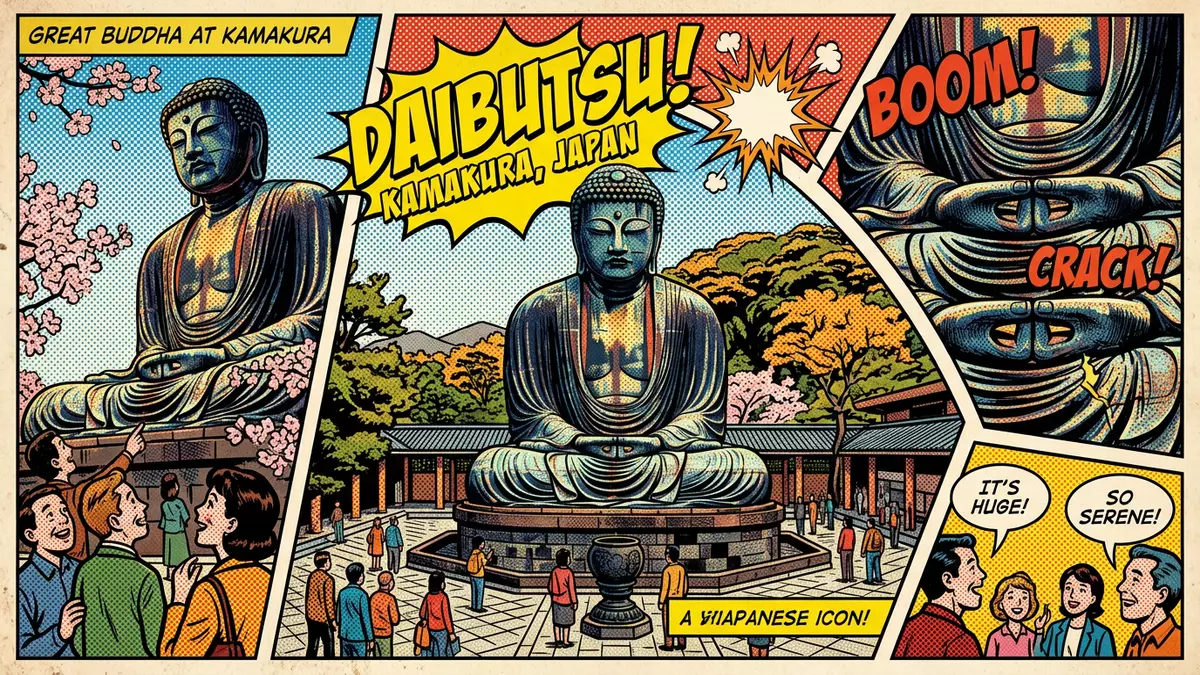
Daibutsu in Kamakura is a monumental bronze statue of Amida Buddha seated in the open air at K?toku-in, a J?do-sh? Pure Land Buddhist temple in coastal Kanagawa Prefecture.K?toku-in temple The Great Buddha has watched over the Hase district since the thirteenth century, its vast metal surface weathered by sea air and seasons.
A thirteenth-century Buddha in bronze
The Kamakura Daibutsu is cast in bronze and depicts Amida Buddha, known in Japanese as Amida Nyorai, seated in meditation on a lotus pedestal.cast in bronze The statue dates from the Kamakura period and was begun in 1252, anchoring it firmly in the era when Kamakura served as the seat of the shogunate.started in 1252 Over centuries the surrounding temple buildings changed, yet the Buddha itself remained outdoors, giving the figure its distinctive profile against the sky.
The bronze image reaches about 11.3 m (37 ft) for the statue alone and roughly 13.35 m (43.8 ft) including its stone base, with a weight in the region of 121 tonnes (133 tons).height and weight figures The Buddha’s head carries tight curls of bronze, while flowing robes fall over crossed legs, each fold emphasised by the casting. From the temple approach the calm facial expression is visible at a distance, framed by trees and low structures.
K?toku-in and the setting in Kamakura
Daibutsu stands within the grounds of K?toku-in, a temple of the J?do sect of Buddhism in the Hase neighbourhood of Kamakura.J?do sect temple The temple complex includes gates, smaller halls and stone paths that lead visitors towards the wide courtyard where the Buddha sits. Trees and low hills rise around the site, hinting at Kamakura’s mixture of wooded slopes and urban streets.
Kamakura itself lies south of central Tokyo, facing Sagami Bay and backed by hills, and K?toku-in sits in the western part of the city in Hase. The address given for the temple is 4-2-28 Hase, Kamakura, Kanagawa Prefecture, placing Daibutsu firmly within the urban fabric yet slightly set back from the main roads.address in Hase, Kamakura The open-air statue rises above its stone base so that the Buddha’s upper body clears nearby roofs and tree canopies.
Form, interior and national status
The Great Buddha of Kamakura is formally recognised as a National Treasure, described in official documentation as a copper seated statue of Amida Buddha at K?toku-in.National Treasure copper seated statue It is one of the most prominent Buddha figures in Japan and is second in height among bronze Buddhas in the country, after the great statue at T?dai-ji in Nara.second tallest bronze Buddha The statue’s large scale, combined with its outdoor placement, makes the proportions of head, torso and folded legs immediately noticeable on arrival.
The bronze shell of Daibutsu is hollow, and an interior space exists within the statue that visitors can enter, revealing the metal’s thickness and the structure of the casting.interior space From the outside, subtle details such as the positioning of the hands in the lap, the elongated earlobes and the lotus pedestal connect the figure to familiar iconography of Amida Buddha. Weathering has given the bronze a patina that varies across the surface, with darker shades in sheltered recesses and lighter tones on exposed areas.
Visiting Daibutsu: what travellers from Western Europe should know
- Daibutsu stands at K?toku-in in the Hase district of Kamakura, south of Tokyo, and is reached by local rail services that stop at Hase Station on the Enoshima Electric Railway.
- The temple approach involves walking along paved streets and through the temple grounds, with steps and stone paths leading to the courtyard where the Buddha sits.
- Kamakura lies in Kanagawa Prefecture on the Pacific coast of Japan; the official language is Japanese and the currency is the yen.
- Entry requirements depend on your nationality; UK travellers can check the FCDO travel advice at gov.uk/foreign-travel-advice, Irish travellers the Department of Foreign Affairs at ireland.ie.
Searching for Daibutsu on social platforms
These links open searches for Daibutsu on each platform.Frequently asked questions about Daibutsu
Where is Daibutsu in Kamakura located?
Daibutsu stands within K?toku-in temple in the Hase district of Kamakura in Kanagawa Prefecture, a coastal city south of Tokyo.
What should visitors expect when they see Daibutsu?
Visitors encounter a large outdoor bronze Buddha seated on a lotus pedestal in a temple courtyard, with surrounding paths, trees and low buildings framing the statue.
What makes Daibutsu distinctive among Buddha statues in Japan?
Its thirteenth-century origin, National Treasure status, substantial bronze height and weight, and open-air setting at K?toku-in together give the Kamakura Daibutsu a distinctive presence.


