
Cristo Redentor and the open-armed skyline above Rio de Janeiro
Published on 09/16/2026 at 22:45 | Editorial responsibility: Rafael Müller, Editor-in-Chief AD HOC NEWS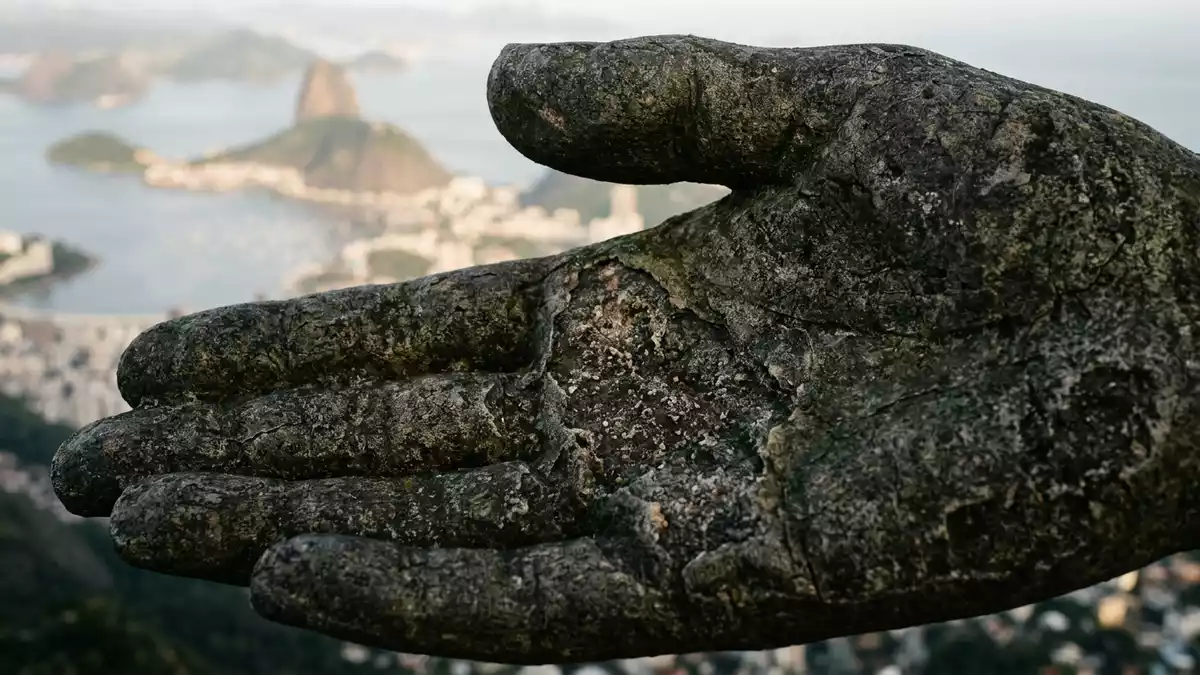
Cristo Redentor, the monumental statue of Christ the Redeemer above Rio de Janeiro, stands as an Art Deco figure with arms spread wide over the granite summit of Corcovado and the forested slopes of Tijuca National Park. Completed in 1931 and built from reinforced concrete clad in pale soapstone tiles, it has become a fixed element of Brazil’s coastal mountain skyline and a point where the city’s bays, hills and urban districts seem to gather beneath one towering figure.Completed in 1931
Art Deco figure above Corcovado
The figure of Cristo Redentor rises about 30 m (98 ft) from its own base, and the stone pedestal beneath its feet adds roughly 8 m (26 ft), bringing the total height of monument and base together to around 38 m (125 ft). The horizontally outstretched arms span about 28 m (92 ft) from fingertip to fingertip, forming a clear cross-like line when seen from a distance across Guanabara Bay and the surrounding mountains.Height and arm span The statue stands more than 700 m (2,300 ft) above sea level on the granite peak of Corcovado, a steep summit within the protected landscape of Tijuca National Park, and terraces around the monument provide broad views over Rio de Janeiro’s bays, ocean inlets and urban neighbourhoods.Location on Corcovado within Tijuca National Park
Beneath its pale surface, Cristo Redentor is constructed from reinforced concrete, with an outer skin formed by thousands of small soapstone tiles that give the figure a slightly textured, light-coloured finish.Reinforced concrete clad in soapstone This combination of modern structural material and stone cladding anchors the tall figure to the ridge while keeping the crisp lines and stylised surfaces associated with the Art Deco period in which the project took shape.Art Deco character of the monument
Designers and construction in the early twentieth century
The project that produced Cristo Redentor belongs to the first decades of the twentieth century, when Rio de Janeiro served as the capital of Brazil and large civic monuments were being planned for the city’s hills and waterfronts. Brazilian engineer Heitor da Silva Costa is recorded as the principal figure behind the project, developing the structural design and overseeing the work on the mountain, while French sculptor Paul Landowski created the sculptural form of the figure, including the head and hands.Heitor da Silva Costa and Paul Landowski Further engineering contributions came from French engineer Albert Caquot, and Romanian sculptor Gheorghe Leonida is associated with the modelling of the statue’s face.Engineering and sculptural team
Work on Cristo Redentor is recorded as spanning much of the 1920s. The foundation stone was laid in 1922, and construction on the summit of Corcovado took place across several years in the second half of the decade, with the concrete structure and soapstone cladding assembled on site in segments. The statue was inaugurated on 12 October 1931, a date that appears consistently across Brazilian and international accounts as the moment when the monument entered the skyline of Rio de Janeiro as a completed work.Foundation stone in 1922 and inauguration in 1931
Mountain setting and views over Rio de Janeiro
Cristo Redentor stands on the summit of Corcovado, a steep granite peak that rises above the southern districts of Rio de Janeiro and the forested interior of Tijuca National Park. The mountain’s ridge forms a natural platform for the statue, and the terraces cut into the summit provide a sequence of vantage points from which visitors can look out across Guanabara Bay, the Atlantic coastline and the urban fabric spread between the hills.Position above Rio de Janeiro From these platforms the outstretched arms of Cristo Redentor line up with different parts of the horizon, and the figure appears against varying backdrops of sea, city and mountains as one moves around the summit.
The statue’s position within Tijuca National Park means that its immediate surroundings are characterised by dense Atlantic forest, deep valleys and other peaks that frame the views. From the terraces around Cristo Redentor, the rock faces and slopes of Corcovado fall away towards districts such as Botafogo and Flamengo, while further inlets of Guanabara Bay and the outline of Sugarloaf Mountain form part of the wider panorama.Setting above Tijuca forest and views over the bay
Visiting Cristo Redentor: what travellers from Western Europe should know
- Cristo Redentor stands on the summit of Corcovado in Rio de Janeiro, within Tijuca National Park in south-eastern Brazil; the Corcovado rack railway runs from the city up towards the monument on the mountain.
- The summit area combines terraces and platforms with steps and short ramps, and reaching the higher viewing points involves climbing stairways over the uneven rock of the peak.
- The mountain lies within a protected forest landscape, and the surroundings include steep slopes, dense woodland and exposed vantage points over Guanabara Bay and nearby hills.
- The official language is Portuguese and the currency is the Brazilian real (BRL).
- Entry requirements depend on your nationality; UK travellers can check the FCDO travel advice at gov.uk/foreign-travel-advice, Irish travellers the Department of Foreign Affairs at ireland.ie.
Searching for Cristo Redentor on social platforms
These links open searches for Cristo Redentor on each platform.
Frequently asked questions about Cristo Redentor
Where is Cristo Redentor located?
Cristo Redentor stands on the summit of Corcovado, a granite peak within Tijuca National Park in Rio de Janeiro, Brazil, overlooking Guanabara Bay and the city’s coastal districts.
What should visitors expect on a visit to Cristo Redentor?
Visitors encounter a tall Art Deco statue of reinforced concrete clad in soapstone, standing on terraces with steps and platforms that provide wide views over Rio de Janeiro’s bays, hills and urban neighbourhoods.
What makes Cristo Redentor distinctive among monuments in Brazil?
The combination of its 1931 completion date, its 30 m (98 ft) high figure with outstretched arms and its position more than 700 m (2,300 ft) above sea level on Corcovado has made Cristo Redentor a defining feature of Brazil’s mountain skyline.


