
Cristo Redentor above Rio de Janeiro’s Tijuca forest
Published on 09/12/2026 at 20:38 | Editorial responsibility: Rafael Müller, Editor-in-Chief AD HOC NEWS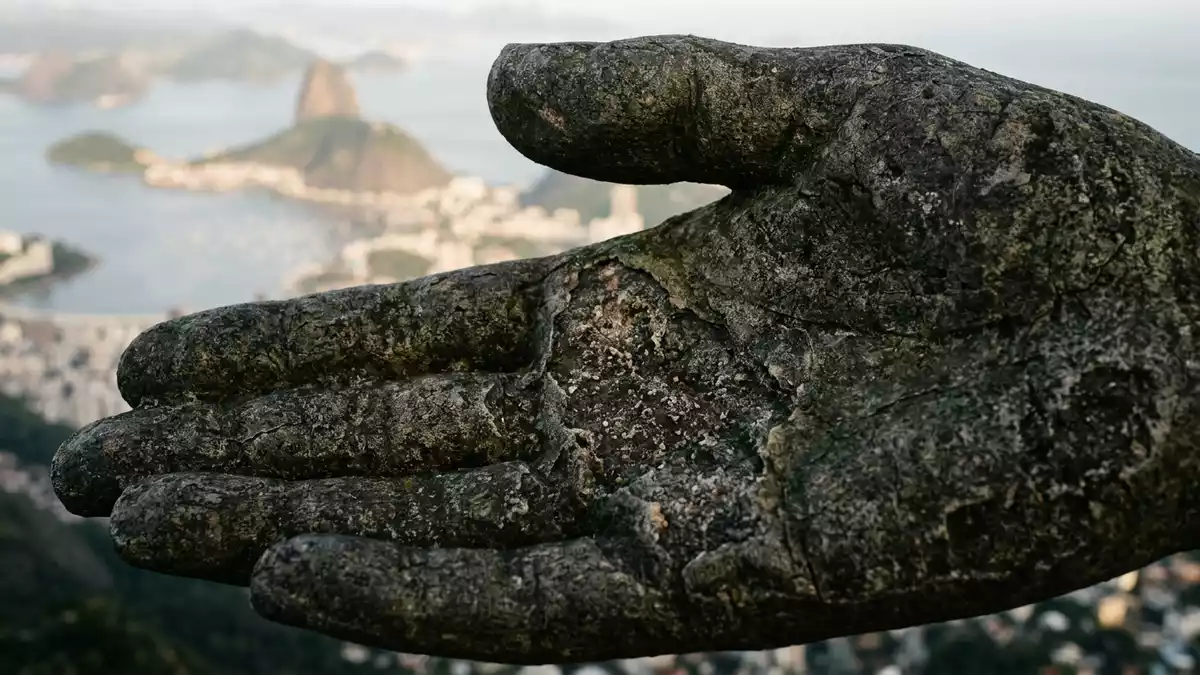
Cristo Redentor, known in English as Christ the Redeemer, is the colossal Art Deco statue of Jesus Christ that dominates the skyline of Rio de Janeiro from the summit of Corcovado in Brazil. Completed in 1931 and rising above the forested slopes of the Tijuca National Park, it combines reinforced concrete structure with a surface of soapstone, giving the monument both its pale colour and its durability in the humid Atlantic climate.
An Art Deco figure on Corcovado
The statue of Cristo Redentor stands at about 30 m (98 ft) in height, not counting the pedestal beneath its feet, and its open arms extend roughly 28 m (92 ft) from fingertip to fingertip.colossal statue of Jesus The entire monument reaches a total height of around 38 m (125 ft) once the pedestal is included, forming a vertical accent that stands out against the rounded profile of Corcovado mountain.38 metres including its pedestal
Cristo Redentor is an example of Art Deco applied at monumental scale, with simple, flowing planes and a focus on outline rather than intricate sculptural detail.Art Deco statue of Jesus Christ The core is built from reinforced concrete, a material that allowed the engineers to project the arms outward while keeping the structure stable, and the outer cladding uses soapstone, chosen for its smooth texture and resistance to weathering.reinforced concrete and soapstone From the viewing terraces around the base, visitors stand almost directly beneath the arms, seeing both the vertical mass of the figure and the expanse of Rio de Janeiro spread out below.
Engineers, sculptors and a decade of construction
The project that produced Cristo Redentor brought together Brazilian and European specialists over nearly a decade. Brazilian engineer Heitor da Silva Costa is credited as the principal designer and project leader, working with French-Polish sculptor Paul Landowski, whose studio created many of the sculptural components.Heitor da Silva Costa and Paul Landowski French engineer Albert Caquot contributed to the structural calculations, and Romanian sculptor Gheorghe Leonida is associated with the modelling of the statue’s face, which visitors can see at an angle from the terraces and platforms cut into the mountain top.
Construction on Corcovado began in the early 1920s and continued through to completion in 1931, with prefabricated sections and materials moved up the steep slopes by the Corcovado rack railway.construction ran from 1922 to 1931 The monument was inaugurated on 12 October 1931, marking the end of this extended engineering effort and introducing a new landmark high above Guanabara Bay.inaugurated on October 12, 1931 In the decades since, Cristo Redentor has become one of the most recognisable silhouettes associated with Rio de Janeiro and with Brazil more broadly, combining religious symbolism with a strong presence in the city’s visual identity.709 metres above sea level in Tijuca
Tijuca National Park and the views over Rio de Janeiro
Cristo Redentor stands at the peak of Corcovado, a mountain rising to around 700 m (2,300 ft) above sea level inside the Tijuca National Park, a protected area of Atlantic rainforest within the urban fabric of Rio de Janeiro.peak of the 700-metre Corcovado mountain The sanctuary complex at the top, including terraces and chapels, sits among dense vegetation, with the pale figure of the statue emerging above dark green slopes and the outlines of the city’s districts below.situated on Morro do Corcovado within the park
From the platforms around Cristo Redentor, the panorama takes in Guanabara Bay, the Atlantic coast, and city landmarks such as the Sugarloaf and the built-up districts stretching along the beaches. The monument faces east, so the statue looks over the city towards the ocean, and the arrangement of terraces gives visitors space to move around the base, view the figure from different angles and take in the open horizon over Rio de Janeiro.statue situated on the summit of Corcovado
Visiting Cristo Redentor: what travellers from Western Europe should know
- Cristo Redentor stands on Corcovado in the Tijuca National Park, within the city of Rio de Janeiro. Access routes converge from neighbourhoods such as Cosme Velho and Alto da Boa Vista.
- The summit area is reached by transport that climbs the mountain slopes and then by stairways and ramps around the terraces. The approaches include sections with gradients and flights of steps.
- Tijuca National Park combines paved access points with natural forest terrain. Weather conditions on the exposed summit can feel different from the streets of central Rio de Janeiro.
- Portuguese is the official language of Brazil and the national currency is the Brazilian real.
- Entry requirements depend on your nationality; UK travellers can check the FCDO travel advice at gov.uk/foreign-travel-advice, Irish travellers the Department of Foreign Affairs at ireland.ie.
Searching for Cristo Redentor on social platforms
These links open searches for Cristo Redentor on each platform.
Frequently asked questions about Cristo Redentor
Where is Cristo Redentor located?
Cristo Redentor stands on the summit of Corcovado mountain in the Tijuca National Park, within the city limits of Rio de Janeiro in Brazil.
What should visitors expect on a trip to Cristo Redentor?
Visitors reach the sanctuary on Corcovado by transport that climbs the mountain and then by walking around terraces and stairways, with wide views over Rio de Janeiro and Guanabara Bay.
What makes Cristo Redentor distinctive among monuments?
Its combination of Art Deco styling, open-armed figure and placement above Tijuca’s forest on Corcovado creates a monumental silhouette closely associated with Rio de Janeiro.


