
Chateau de Fontainebleau, the royal residence of eight centuries
Published on 09/03/2026 at 13:20 | Editorial responsibility: Rafael Müller, Editor-in-Chief AD HOC NEWS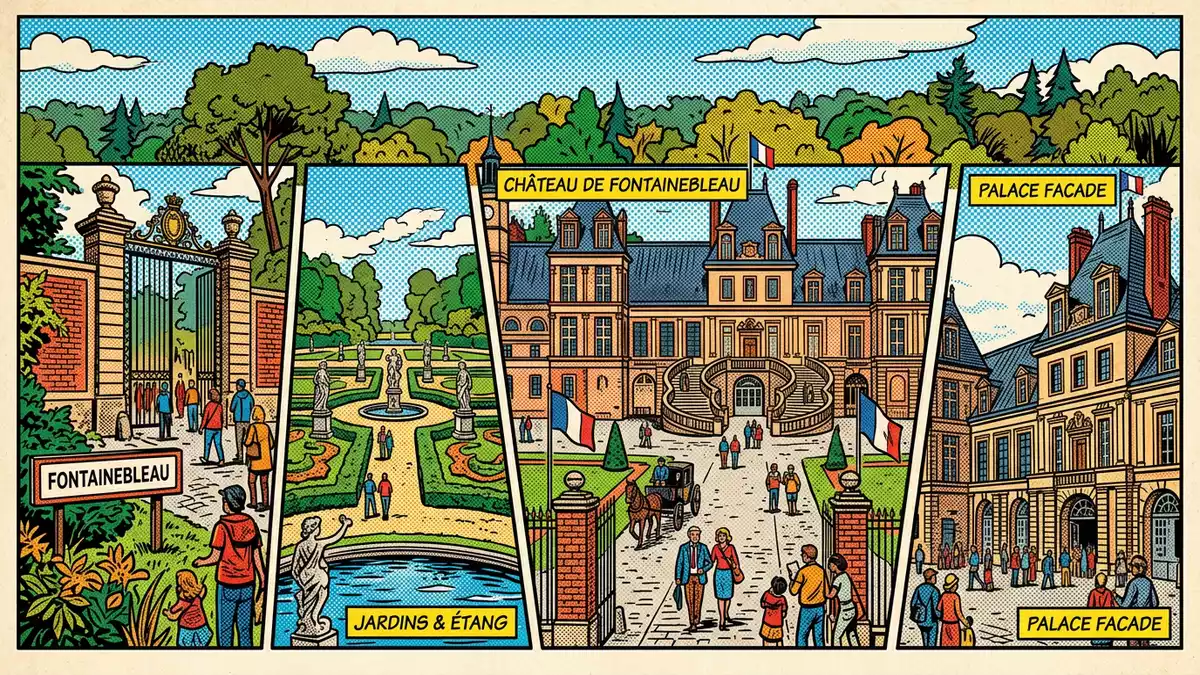
Chateau de Fontainebleau in Fontainebleau is one of France’s great royal residences, a vast ensemble where eight centuries of architecture and decoration stand side by side in stone, stucco and gilded wood. Built as a medieval hunting lodge and enlarged into a palace under Francis I, it later became a national museum and a UNESCO World Heritage Site, preserving layers of French history from the Middle Ages to the Second Empire.
From medieval lodge to Renaissance palace
Fontainebleau stands at the edge of a large forest in Île-de-France, south-east of Paris, on a site first used as a royal hunting residence in the twelfth century.royal hunting lodge in the twelfth century Kings including Louis VII used the location as an autumn retreat, long before the present palace took shape.earliest reference under Louis VII in 1137 The medieval core gave the complex its starting point, but what visitors see today owes most to the building campaigns of the sixteenth century.
Under Francis I, Fontainebleau was transformed from fortified residence into a Renaissance palace that brought Italian artistic ideas to France.transformed into a Renaissance masterpiece under Francis I The king invited Italian painters, sculptors and stucco workers, giving rise to the first School of Fontainebleau, whose ornamental panels, mythological scenes and carved frames still line galleries and chambers.Italianate palace combines Renaissance and French traditions This sixteenth-century layer introduced elongated figures, rich strapwork and complex allegories into the interiors, setting a model for court art across France.
Courtyards, staircases and grand apartments
The palace at Fontainebleau is organised around several courtyards, each framed by wings built or rebuilt under different rulers, and linked by passages, galleries and ceremonial staircases.five courtyards, grand apartments and galleries The Oval Courtyard on the eastern side preserves the memory of the early donjon, while later wings stretch out towards the town and the park.first building around the donjon between 1528 and 1540 Stone façades show a mixture of medieval remnants, Renaissance decoration and classical rhythm, reflecting the long sequence of additions and refurbishments.
One of the most recognisable exterior features is the Horseshoe Staircase, a ceremonial access route dating from the early seventeenth century and curving out from the façade towards the courtyard.Horseshoe Staircase built between 1632 and 1634 Inside, the grand apartments contain richly furnished chambers, audience rooms and galleries associated with monarchs such as Henry II, Louis XIII, Louis-Philippe, Napoleon I and Napoleon III.residence for many French monarchs Tapestries, painted ceilings, carved panelling and historic furniture turn the sequence of rooms into an extended survey of French court taste from the Renaissance through the nineteenth century.
Gardens, canals and the UNESCO landscape
Beyond the palace walls, the estate of Fontainebleau extends into formal gardens, water features and a large park framed by the surrounding forest.palace and park of Fontainebleau In the seventeenth century, André Le Nôtre designed an extensive parterre on the east side, laying out geometric lawns and ornamental beds at a scale that matched the long façades.largest Parterre in Europe created between 1660 and 1664 A Grand Canal, dug in the early seventeenth century, lengthens the axes of the garden and connects the palace visually to the wider landscape of the domain.
The ensemble of palace, gardens and park is recognised on the UNESCO World Heritage List, reflecting both its architectural variety and its long role as a royal residence.designated a UNESCO World Heritage Site since 1981 Styles from the medieval period, the Renaissance and classical architecture are all present, integrated into a single site that remained inhabited by French sovereigns from the twelfth to the nineteenth century.royal château of medieval, Renaissance and classical styles The continuity of occupation over centuries, combined with major artistic programmes under rulers such as Francis I and Napoleon I, gives Fontainebleau a particular place in the history of French royal architecture.
Visiting Chateau de Fontainebleau: what travellers from Western Europe should know
- Chateau de Fontainebleau stands in the town of Fontainebleau in Île-de-France, south-east of Paris, and is reached by regional rail services and local buses from the capital.
- The palace complex has multiple courtyards, long galleries and historic staircases, so a visit involves walking over stone surfaces and using steps inside and outside the buildings.
- The park and formal gardens extend over a broad area with lawns, tree-lined paths and the Grand Canal, making sturdy footwear useful for exploring the grounds on foot.
- Fontainebleau lies in France, where the official language is French and the currency is the euro.
Searching for Chateau de Fontainebleau on social platforms
These links open searches for Chateau de Fontainebleau on each platform.Frequently asked questions about Chateau de Fontainebleau
Where is Chateau de Fontainebleau located?
Chateau de Fontainebleau is in the town of Fontainebleau in the Île-de-France region of France, south-east of Paris, beside a historic royal forest.
What can visitors expect inside the palace?
Visitors encounter sequences of richly decorated apartments, galleries and chapels, with Renaissance stucco, painted ceilings, tapestries and historic furnishings accumulated over eight centuries of royal occupation.
What makes Chateau de Fontainebleau distinctive among French royal residences?
Fontainebleau combines medieval, Renaissance and classical architecture, has been a royal residence from the twelfth to the nineteenth century, and includes major gardens such as the Grand Parterre and Grand Canal within a UNESCO-listed estate.


