
Chan Chan’s earthen capital near Trujillo
Published on 09/10/2026 at 06:00 | Editorial responsibility: Rafael Müller, Editor-in-Chief AD HOC NEWS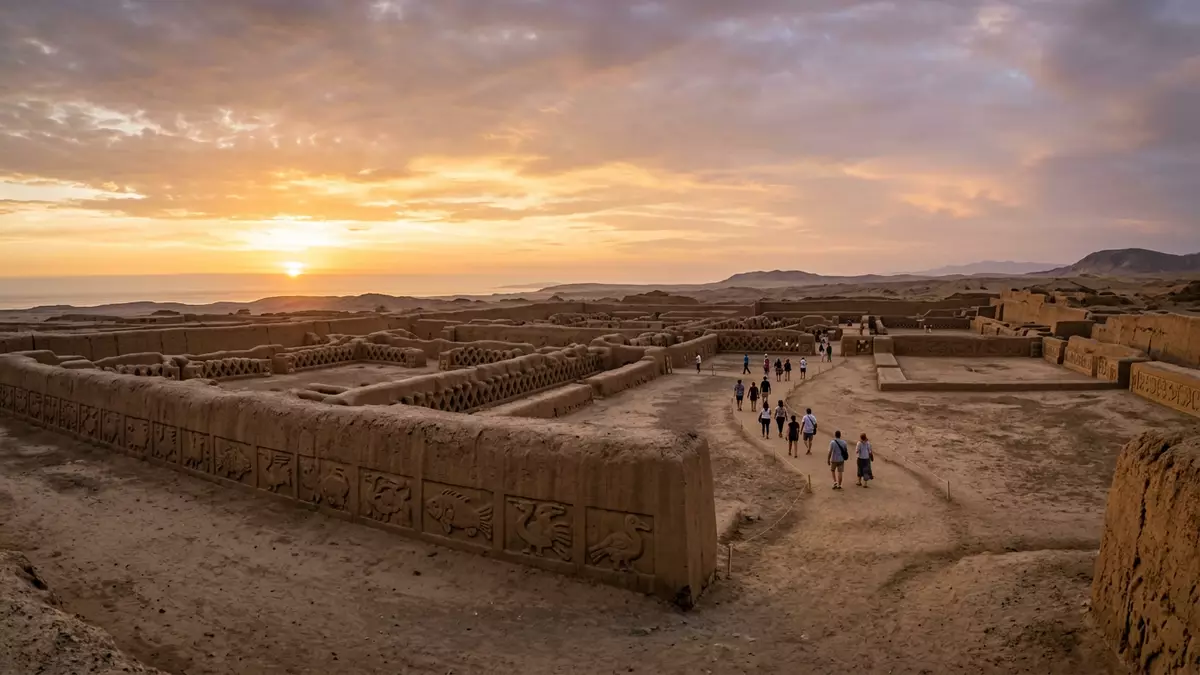
On the coastal plain west of Trujillo in northern Peru, Chan Chan stretches across the desert as an extensive pre-Columbian city built largely from adobe, the sun-dried mud that gives its walls their characteristic colour and texture. As the former capital of the Chimú kingdom in the late pre-Hispanic period, the site preserves a planned urban landscape where courtyards, long corridors and relief-decorated surfaces still mark an earthen metropolis shaped between the Pacific shoreline and the Moche valley.
Chan Chan in the Chimú world
Chan Chan stands between the modern city of Trujillo and the Pacific Ocean in the La Libertad region, occupying part of a broader adobe city that once covered about 20 km² (7.7 sq mi).Chan Chan stands between Trujillo and the ocean The city formed the political and ceremonial centre of the Chimú kingdom, also known as Chimor, which dominated long stretches of Peru’s northern coast until its territories were absorbed into the expanding Inca Empire in the fifteenth century.capital of the Chimor kingdom Archaeological and historical studies place the foundation of Chan Chan in the late first millennium AD, with its apogee in the thirteenth and fifteenth centuries as the Chimú rulers consolidated power along the coast.Chimú apogee in the fifteenth century
Within this wider expanse, the monumental core of Chan Chan is defined by a group of large, rectilinear compounds sometimes described as citadels or palaces. The central monumental zone covers around six square kilometres inside the broader twenty square kilometre city, and includes nine major complexes laid out as independent units behind high earthen walls.nine citadels in the monumental zone Each of these units contains its own sequence of ceremonial courts, storage areas and internal passages, reflecting a strict spatial ordering that mirrors Chimú social and political hierarchies without needing a written record on site.
An adobe metropolis on Peru’s northern coast
The defining material of Chan Chan is adobe, shaped from local earth and water and dried under the coastal sun to form bricks and structural masses. Across the site, long walls outline corridors that channel movement between open courts and more enclosed spaces, their surfaces carrying geometric and figural reliefs impressed into the still-damp mud. These reliefs include repetitive bands of abstract motifs and representations that echo the coastal setting, carved into earthen surfaces that retain their crispness where erosion has been limited.earthen walls, plazas and reliefs
Viewed from above, the planned nature of the city becomes clear in the repeated rectangular forms of the compounds and the straight alignment of major walls across the desert floor. In the monumental zone these high earthen walls form outer enclosures that shelter sequences of courtyards, smaller chambers and axial routes aligned broadly parallel to the coastline. The overall urban plan of Chan Chan has been recognised as an outstanding example of pre-Hispanic earthen architecture and city-making, with its division into nine large citadels understood as a physical expression of Chimú administrative organisation.earthen city planned around citadels
World Heritage status and present-day visit
Chan Chan’s importance has been formally recognised through its inscription as the “Chan Chan Archaeological Zone” on the UNESCO World Heritage List. In 1986 the property was added to the List as a cultural site, with the documentation emphasising both its exceptional earthen architecture and its status as one of the largest pre-Columbian cities in the Americas.inscribed as Chan Chan Archaeological Zone in 1986 In the same year, concerns about the vulnerability of the adobe fabric to rainfall and environmental change along this part of Peru’s coast led to Chan Chan being listed among the World Heritage properties in danger, a status that highlights the continuing challenges of conserving large-scale earthen structures.World Heritage in Danger listing
For visitors, Chan Chan presents a landscape of preserved and partially conserved adobe architecture set against the flat coastal terrain. The site lies on the coastal plain in the lower Moche valley, a short distance north-west of Trujillo and along the road towards Huanchaco, taking advantage of the relatively dry climate of Peru’s northern coast.archaeological site near the highway to Huanchaco Within the monumental zone, one of the citadels known as Palacio Nik An or Tschudi is arranged for visitors to walk through a sequence of restored and stabilised spaces, passing earthen walls, patterned panels and open courts that convey the scale and organisation of the original Chimú capital.visitor access to Palacio Nik An
Visiting Chan Chan: what travellers from Western Europe should know
- Chan Chan lies in the La Libertad region of northern Peru on the coastal plain, between the city of Trujillo and the Pacific shoreline in the lower Moche valley. It stands near the road that links Trujillo with the seaside district of Huanchaco, which makes the site accessible from the city by road transport.
- The monumental zone consists of extensive earthen compounds, and visiting involves walking along packed-earth paths through adobe corridors and courtyards. Surfaces are uneven in places, with low steps and ramps inside the citadel area.
- Chan Chan is on Peru’s northern coast, where daytime conditions can be dry and exposed. There is limited shade inside the adobe compounds themselves, so a visit involves time in open courtyards and along uncovered routes.
- The official language is Spanish and the currency is the Peruvian sol.
- Entry requirements depend on your nationality; UK travellers can check the FCDO travel advice at gov.uk/foreign-travel-advice, Irish travellers the Department of Foreign Affairs at ireland.ie.
Searching for Chan Chan on social platforms
These links open searches for Chan Chan on each platform.
Frequently asked questions about Chan Chan
Where is Chan Chan located?
Chan Chan is on Peru’s northern coast in the La Libertad region, between the city of Trujillo and the Pacific Ocean in the lower Moche valley.
What should visitors expect when exploring Chan Chan?
Visitors walk through an archaeological zone of adobe architecture, moving along earthen paths between high mud-brick walls, open courtyards and relief-decorated surfaces inside a planned monumental compound.
What makes Chan Chan distinctive among archaeological sites in Peru?
Chan Chan is a former Chimú capital whose vast planned adobe city, with its nine large citadels and extensive earthen architecture, represents one of the largest pre-Columbian urban centres in the Americas and is recognised as a World Heritage Site.


