Chan Chan, Peru’s vast earthen capital near Trujillo
Published on 08/28/2026 at 19:53 | Editorial responsibility: Rafael Müller, Editor-in-Chief AD HOC NEWS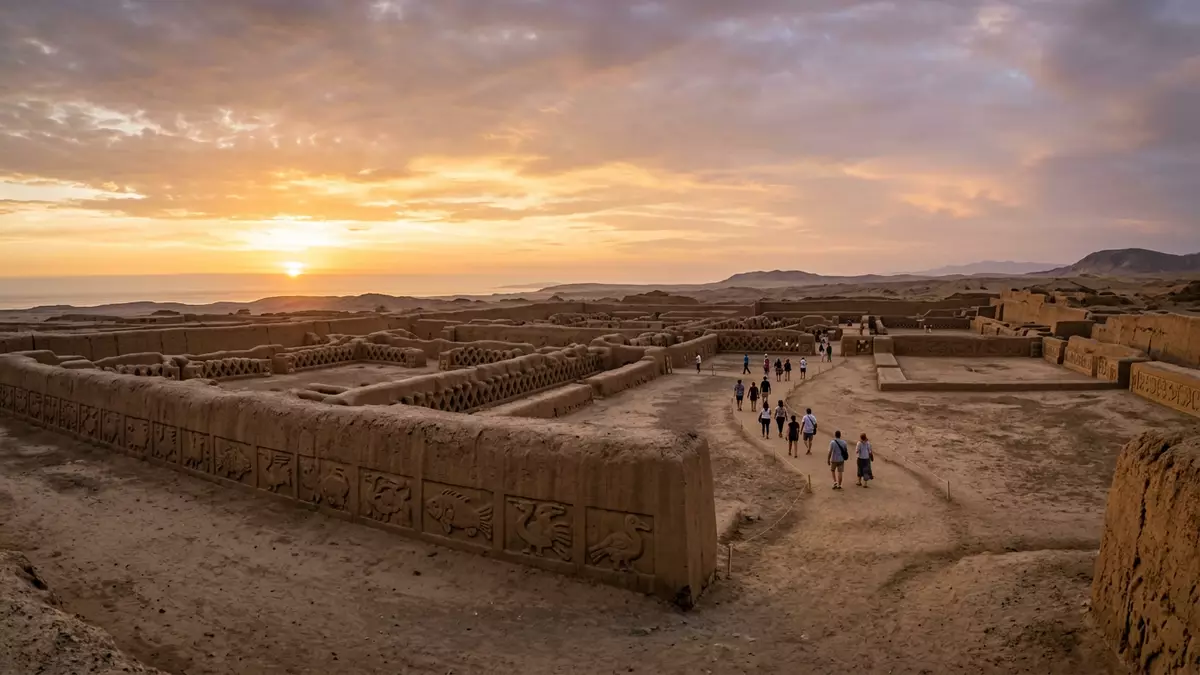
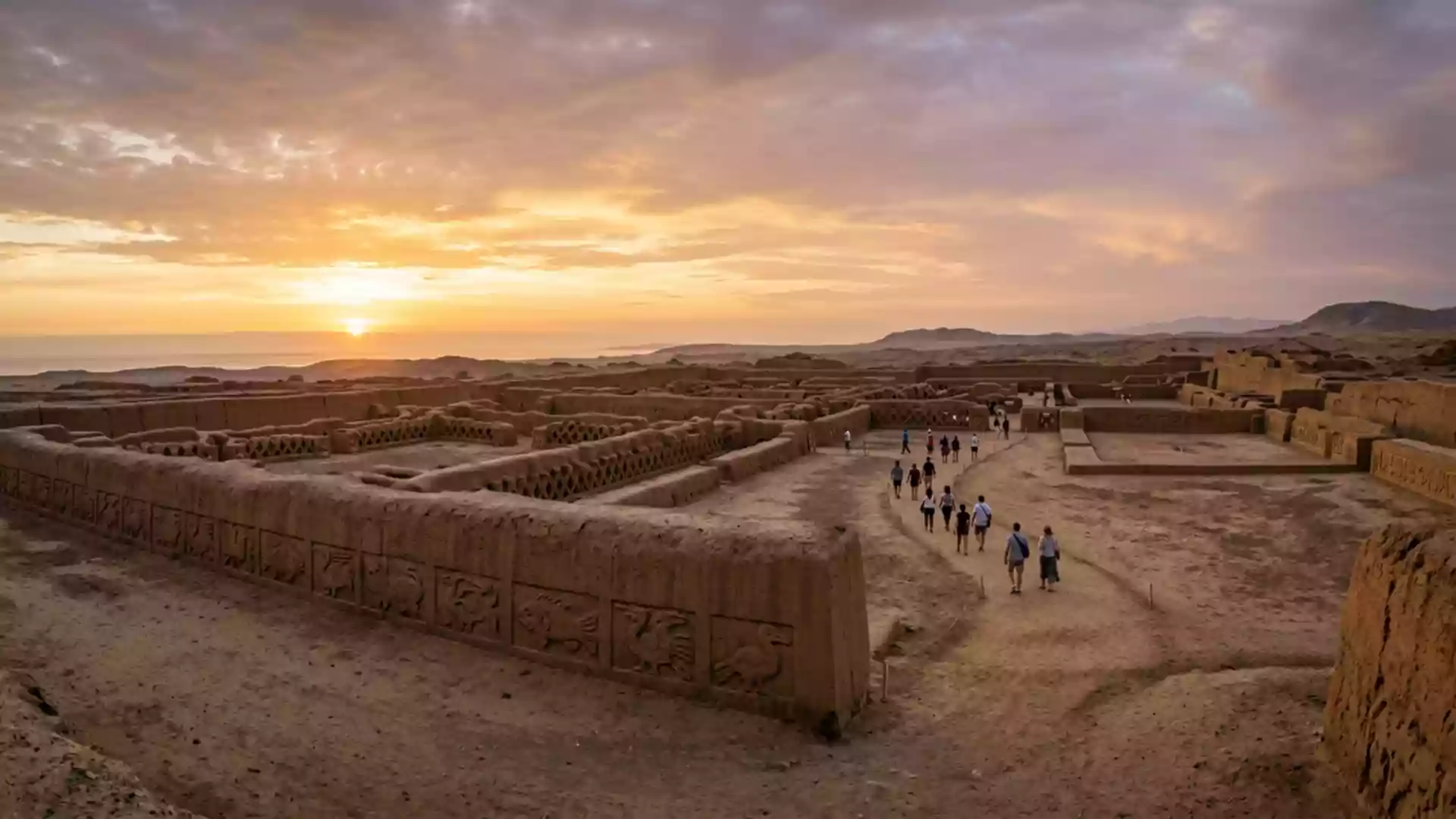
On the coastal plain west of Trujillo in northern Peru, Chan Chan spreads across the desert as a vast earthen city built almost entirely of adobe. The former capital of the Chimú kingdom in the pre-Columbian era, it survives as an archaeological zone where long walls, plazas and reliefs in sun-dried mud still define a planned urban landscape from the past.
An earthen metropolis between desert and sea
Chan Chan lies in the Moche valley on Peru’s northern coast, between the modern city of Trujillo and the Pacific shoreline, in the La Libertad region. The site occupies part of a broader adobe city that once covered about 20 square kilometres (7.7 sq mi), making it one of the largest pre-Hispanic urban centres built in earthen materials in the Americas. Its setting on a flat coastal plain means that the remains rise gently from the desert surface rather than from a hill, giving the place a horizontal, expansive character where the main lines are the high mud-brick walls and open courts rather than towers.
Walking into Chan Chan leads through sequences of long corridors, broad plazas and enclosed courtyards formed by these adobe walls, some of them several metres high. The city’s fabric is defined not by freestanding buildings but by large rectangular compounds whose walls create sheltered interiors away from the wind that crosses the coastal plain. The earthen surfaces take on subtle tones in dry light, from pale beige to deeper browns, and the absence of vegetation in many zones underlines how the architecture itself shapes the landscape.
Capital of the Chimú kingdom and UNESCO World Heritage Site
Chan Chan served as the political and administrative centre of the Chimú kingdom, a coastal power that flourished on Peru’s northern shore before the expansion of the Inca empire in the fifteenth century. The city is generally dated to around the eleventh century, with its period of greatest development between about 1100 and 1470, when Chimú rulers presided over a network of coastal valleys from this adobe capital. Historical accounts and archaeological work indicate that the Inca incorporated the Chimú territories around 1470, marking the end of Chan Chan’s role as a living capital and the beginning of its existence as a place of ruins. As a result, today’s visitor encounters a city shaped by both its deliberate construction and the long process of abandonment and erosion that followed.
The importance of Chan Chan has been recognised formally since 1986, when the “Chan Chan Archaeological Zone” was inscribed as a UNESCO World Heritage Site. The World Heritage listing emphasises its outstanding earthen architecture and its value as a record of Chimú urban planning, within a property where a monumental core of about six square kilometres (2.3 sq mi) preserves nine large rectangular complexes often referred to as citadels or palaces. UNESCO has also identified Chan Chan as one of the major pre-Hispanic earthen cities in the Americas, a place where the scale of adobe construction and the complexity of its layout stand out among archaeological sites on the continent. Chan Chan Archaeological Zone is the formal name used in the World Heritage documentation, linking the ruined city to international conservation frameworks.
Citadels, reliefs and the experience of space
At the heart of Chan Chan, the monumental zone is organised around a series of large compounds defined by thick adobe walls, commonly called citadels or palaces. Each of these complexes follows a broadly rectangular plan and contains internal spaces such as ceremonial plazas, audience rooms, storerooms and areas interpreted as burial facilities, reflecting the administrative and ritual functions of the Chimú state. The citadels’ layouts reveal a repeated pattern of entry corridors leading into wider courts, with narrower passages connecting to more secluded zones deeper inside. Archaeological mapping has shown that this monumental core occupies roughly six square kilometres within the larger city, indicating how much of Chan Chan’s urban life concentrated around these compounds.
Within the walls, many surfaces bear decorative reliefs moulded in adobe, including geometric bands and motifs that evoke elements such as stylised fish, birds and waves, tying the imagery to the coastal environment and the maritime focus of Chimú society. These reliefs appear along corridors and around courtyards, where repeated patterns run horizontally across the walls, giving some sectors a distinctly textured character compared with the plain expanses elsewhere. The combination of high walls, controlled access routes and decorated surfaces makes moving through a citadel feel like passing through a sequence of defined stages, from more public plazas towards sections that read as more restricted spaces. One of the best-known compounds accessible to visitors is the Nik An (also referred to as Tschudi) complex, where restored sections help convey the original spatial organisation of a Chimú palace at Chan Chan. Descriptions of Chan Chan’s scale and layout are supported by archaeological surveys and travel accounts that note its approximate 20 square kilometre extent and the concentration of monumental compounds in a central band, as summarised in sources such as encyclopaedia entries on Chan Chan and profiles of the Chan Chan Archaeological Zone.
Visiting Chan Chan: what travellers from Western Europe should know
- Chan Chan lies in the La Libertad region of northern Peru, on the coastal plain a short distance north-west of Trujillo and on the road towards the seaside district of Huanchaco.
- The archaeological zone is largely flat, with long stretches on foot through sandy ground and earthen corridors; inside the citadels, some passages are narrow and surfaces can be uneven.
- Peru’s official language is Spanish and the currency is the Peruvian sol.
- Entry requirements depend on your nationality; UK travellers can check the FCDO travel advice at gov.uk/foreign-travel-advice, Irish travellers the Department of Foreign Affairs at ireland.ie.
Searching for Chan Chan on social platforms
These links open searches for Chan Chan on each platform.
Frequently asked questions about Chan Chan
Where is Chan Chan located in relation to Trujillo?
Chan Chan lies on Peru’s northern coast in the La Libertad region, on the coastal plain just north-west of Trujillo between the city and the Pacific shoreline.
What can visitors expect when exploring Chan Chan?
Visitors encounter long adobe walls, plazas and courtyards within large citadels, moving through flat sandy terrain and earthen corridors that reveal the planned urban layout of the Chimú capital.
What makes Chan Chan distinctive among archaeological sites in Peru?
Chan Chan is an extensive earthen metropolis built in adobe, once covering about 20 square kilometres and recognised as the former capital of the Chimú kingdom and a UNESCO World Heritage Site.