
Cerro Rico, the rich mountain above Potosi
Published on 09/12/2026 at 19:24 | Editorial responsibility: Rafael Müller, Editor-in-Chief AD HOC NEWS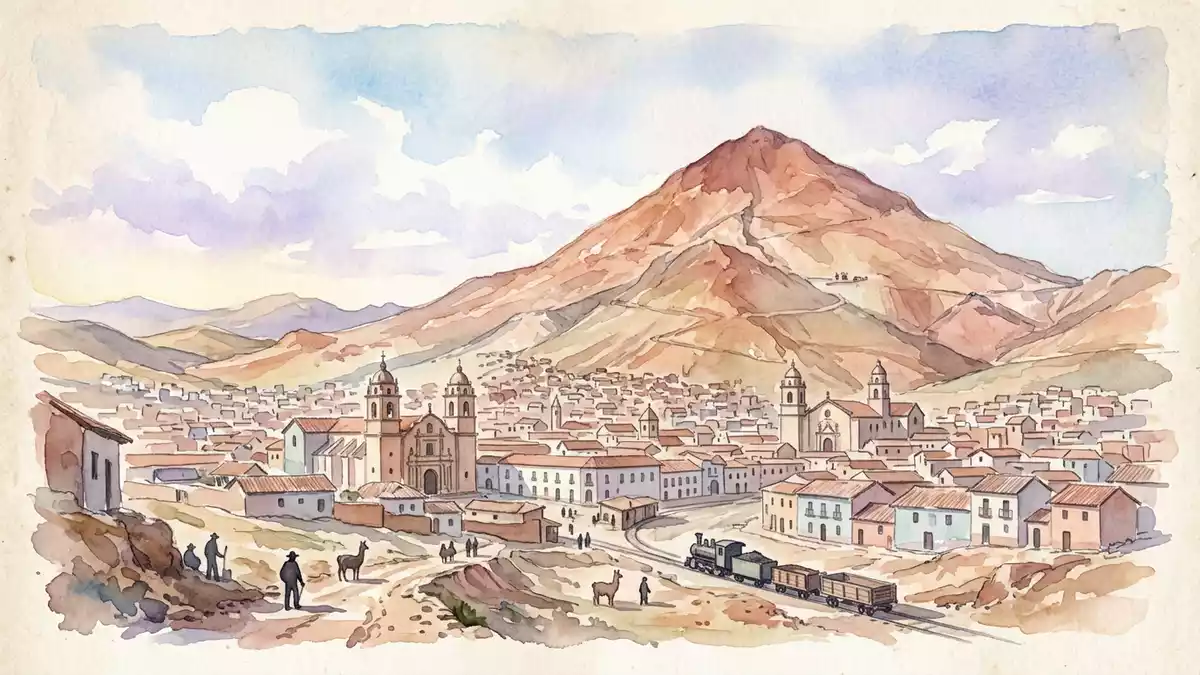
Cerro Rico, the “Rich Mountain” above the Bolivian city of Potosi, is an Andean peak whose silver deposits shaped colonial history and left a distinctive industrial landscape on the high plateau. Rising to an elevation of around 4,782 m (15,689 ft), the mountain dominates the skyline and anchors the story of Potosi as a mining city in the Andes of Bolivia.Andean peak near Potosi
A conical Andean summit above a high plateau city
Cerro Rico stands just south of Potosi in Bolivia’s southern highlands, its conical mass rising directly above the urban grid and forming a constant backdrop to streets and squares laid out beneath its slopes.stands just south of Potosi The mountain’s Spanish name, meaning “rich mountain”, refers to its remarkable concentrations of silver and other metals embedded in volcanic rock that forms part of Bolivia’s tin belt on the high plateau.meaning rich mountain in Spanish
On clear days the upper slopes stand as bands of bare rock and spoil above the roofs of Potosi, while access roads, mining structures and scattered openings mark the transition from city to mountain. The summit area lies at well over 4,700 m (15,400 ft), placing Cerro Rico among the higher peaks of the region and contributing to the stark, high-altitude character that travellers encounter when they approach the city from the surrounding plateau.altitude around 4,782 m
Silver, mining tunnels and an industrial cultural landscape
Mining on Cerro Rico began in the sixteenth century after rich silver veins were identified in its slopes, and the foundation of Potosi followed shortly afterwards in 1546 as a settlement at the foot of the mountain.foundation of Potosi in 1546 During the Spanish colonial era, Cerro Rico became one of the principal sources of silver for the empire, with ore extracted from extensive underground workings and processed in refining installations around the city.silver deposit that bankrolled the Spanish empire
Centuries of mining have left Cerro Rico honeycombed with tunnels, chambers and shafts, many entered from portals along rough tracks that climb across the slopes from Potosi. The industrial landscape extends beyond the mountain itself into an intricate system of aqueducts and artificial lakes around the city that supplied water to ore-processing installations, forming part of the wider heritage area recognised by UNESCO.industrial monuments of Cerro Rico Within Potosi, structures such as the Casa de la Moneda and churches like San Lorenzo stand as architectural reminders of the wealth generated by Cerro Rico’s silver.
Cerro Rico and the World Heritage city of Potosi
The City of Potosi, including the industrial monuments linked to Cerro Rico, was inscribed on the UNESCO World Heritage List in 1987, recognising the close relationship between the mountain’s mines and the colonial urban fabric below.inscribed on the World Heritage List in 1987 The recognition covers the mining installations on Cerro Rico, the water-supply system with artificial lakes, the colonial townscape and the barrios where workers lived, together forming a cultural landscape shaped around the extraction and processing of silver.industrial monuments and barrios mitayos
Technical assistance programmes have focused on preserving Cerro Rico as part of the wider World Heritage property, as portions of the summit area have experienced collapses linked to the intense concentration of underground workings over centuries.technical assistance for preservation The mountain’s visible scars, spoil heaps and openings therefore carry not only the story of mineral wealth and colonisation but also ongoing concerns about stability, making Cerro Rico a place where geological form and industrial heritage intersect directly with questions of conservation.
Visiting Cerro Rico: what travellers from Western Europe should know
- Cerro Rico rises immediately south of the city of Potosi in Bolivia’s southern highlands, and the mountain is reached from urban streets that transition into access tracks and mine roads on its lower slopes.
- The terrain on Cerro Rico is steep and at high altitude, with rough tracks, spoil heaps and mining structures on the slopes, and any visit involves movement on uneven ground above 4,000 m (13,123 ft).
- Potosi lies in Bolivia, where the official language is Spanish and the currency is the boliviano.
- Entry requirements depend on your nationality; UK travellers can check the FCDO travel advice at gov.uk/foreign-travel-advice, Irish travellers the Department of Foreign Affairs at ireland.ie.
Searching for Cerro Rico on social platforms
These links open searches for Cerro Rico on each platform.
Frequently asked questions about Cerro Rico
Where is Cerro Rico?
Cerro Rico is a mountain in the Andes of Bolivia, standing just south of the city of Potosi on the country’s southern high plateau.
What can visitors expect when they see Cerro Rico?
Visitors encounter a high, conical mountain above Potosi with visible mining structures, tracks and openings on its slopes, set within a stark high-altitude landscape.
What makes Cerro Rico distinctive compared with other Andean peaks?
Cerro Rico is distinctive for its historic silver deposits, extensive mining tunnels and its close integration with the World Heritage city of Potosi below.


