
Cerro Rico, the mountain that made Potosi
Published on 09/01/2026 at 11:14 | Editorial responsibility: Rafael Müller, Editor-in-Chief AD HOC NEWS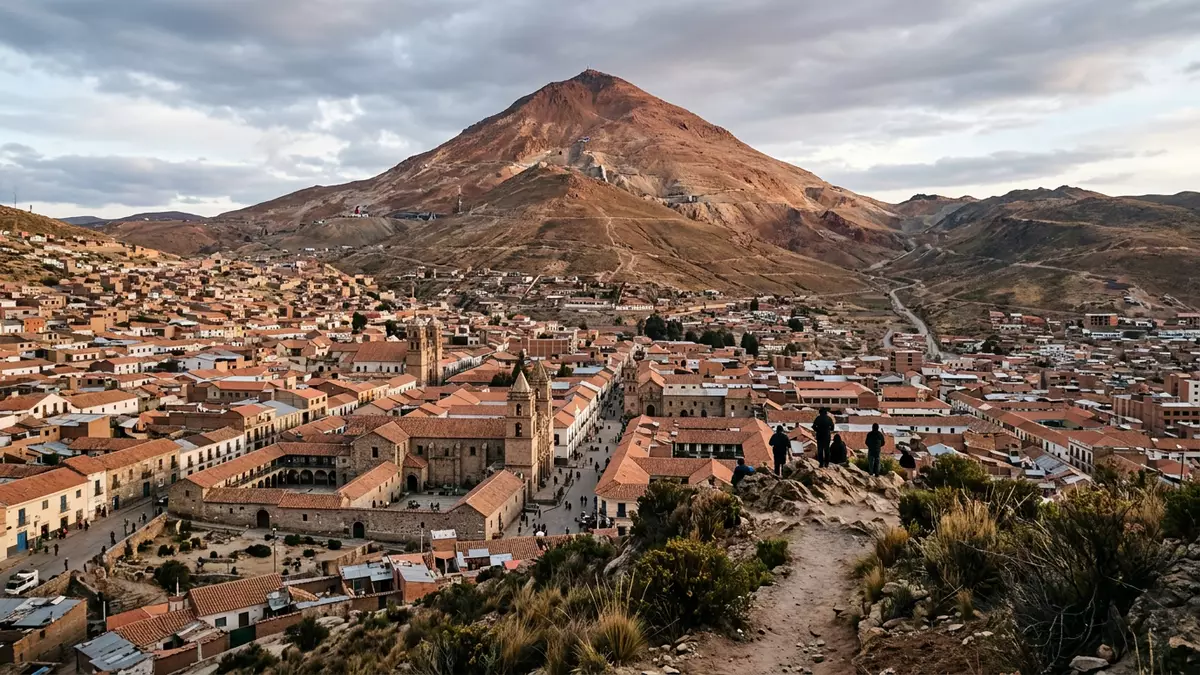
Cerro Rico above Potosi in Bolivia is a mountain shaped as much by human hands as by geology, its flanks pierced by mine entrances and its summit looming over the city that grew at its base in the mid?sixteenth century.
A rich mountain above a high Andean city
Cerro Rico stands just south of the high?altitude city of Potosi on the Bolivian plateau, its cone dominating the skyline and forming the backdrop to streets laid out beneath the mountain’s shadow.Potosi stands on a cold plateau The mountain’s name, meaning “rich mountain” in Spanish, refers to its extraordinary deposits of silver, tin and other metals that have been extracted for centuries from the volcanic rock of its slopes.Located in the Bolivian tin belt
Mining at Cerro Rico began in 1545 after the discovery of rich silver veins, a moment that led directly to the foundation of Potosi at the foot of the mountain in 1546 and to its rapid growth as a centre of the Spanish Empire.Mining began in 1545 Diego Huallpa, an indigenous prospector, is traditionally credited with discovering the deposit that would become famous as one of the richest sources of silver ever mined.Diego Huallpa is traditionally credited
Cerro Rico in colonial and industrial history
From the sixteenth century onwards, Cerro Rico supplied vast quantities of silver to the Spanish Empire, with production peaks recorded in the late sixteenth and eighteenth centuries as ore was extracted and processed in the surrounding valley.Colonial production rose and fell three times The veins close to the surface carried silver of remarkable purity, and colonial writers described ore so rich that it could be smelted with relatively simple technology compared with deeper workings.Veins of up to 25 percent pure metal
After Bolivia’s independence in 1825, Cerro Rico’s focus shifted progressively towards tin and other metals as silver production waned, with industrial mining of tin deposits expanding from the late nineteenth century onwards under state and private operators.Tin ores were exploited from the late nineteenth century Over nearly five centuries of mining, Cerro Rico has yielded tens of thousands of tonnes of silver and other metals, leaving the mountain honeycombed with tunnels and chambers that bear witness to changing mining technologies and labour systems.Mining depended on colonial labour drafts
The mountain landscape and contemporary visits
The slopes of Cerro Rico are cut by tracks and terraced workings, with mine entrances marked by structures of brick, concrete and timber that cluster at different levels on the cone, giving the mountain a distinctive industrial texture against the high Andean sky.The upper part of the mountain is riddled with tunnels From Potosi, roads and tracks wind up towards the mining areas, passing shrines, workshops and ore?loading points that show how closely the city and mountain remain linked.
Cerro Rico forms part of the wider historic landscape recognised through the World Heritage inscription of the City of Potosi, a designation that reflects both the mining structures on the mountain and the urban fabric shaped by silver extraction.City of Potosi is a World Heritage Site Visitors encounter a setting where colonial?era remains, twentieth?century industrial installations and present?day cooperatives share the same slopes, making Cerro Rico a conspicuous example of a landscape transformed by mining over centuries.
Visiting Cerro Rico: what travellers from Western Europe should know
- Cerro Rico rises immediately south of Potosi in southern Bolivia, and the mountain is reached from the city by roads that climb towards the mining zones.
- The terrain on Cerro Rico is steep and high?altitude, with rough tracks, terraced workings and mine approaches that can involve walking on loose, uneven ground.
- In winter, cold conditions extend across the plateau around Potosi, and snow can lie on higher parts of Cerro Rico, affecting paths and the exposed slopes.
- The official language is Spanish and the currency is the Bolivian boliviano.
- Entry requirements depend on your nationality; UK travellers can check the FCDO travel advice at gov.uk/foreign-travel-advice, Irish travellers the Department of Foreign Affairs at ireland.ie.
Searching for Cerro Rico on social platforms
These links open searches for Cerro Rico on each platform.
Frequently asked questions about Cerro Rico
Where is Cerro Rico located?
Cerro Rico is a mountain immediately south of the city of Potosi in southern Bolivia, rising above the plateau of the central Andes.
What should visitors expect on a visit to Cerro Rico?
Visitors encounter steep, high?altitude terrain, mining installations and tracks on the mountain’s slopes, with roads from Potosi connecting the city to the various mining levels.
What makes Cerro Rico distinctive compared with other mining landscapes?
Cerro Rico is distinctive for its long mining history since 1545, its role in silver extraction for the Spanish Empire and the dense network of tunnels and workings within a single mountain.


