
Centro Historico de San Jose and the plazas of the capital
Published on 09/14/2026 at 11:54 | Editorial responsibility: Rafael Müller, Editor-in-Chief AD HOC NEWS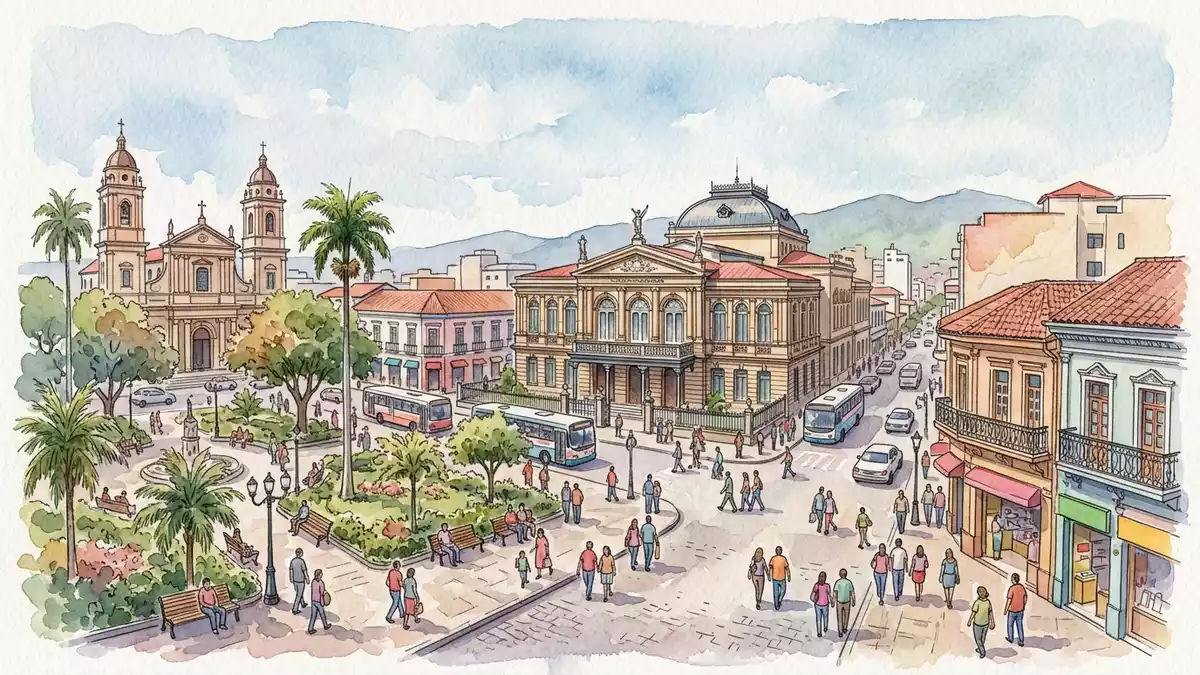
Centro Historico de San Jose is the historic downtown core of San Jose, the capital of Costa Rica. Its streets gather plazas, civic buildings and commercial passages into a compact urban grid in the Central Valley. It includes the National Theater and the Metropolitan Cathedral.
Plazas, streets and the capital’s civic core
The centre gathers around Avenida Central and the main public squares. Plaza de la Cultura, Parque Central and nearby streets form the district’s most legible pattern, with pedestrian routes tying the main monuments to shops and offices.
The urban fabric mixes neoclassical and eclectic façades with later commercial fronts. That combination gives the area its layered character without separating the monumental buildings from the everyday city around them.
Coffee-era architecture beside public life
Several of the best-known buildings belong to the late nineteenth century, when San Jose’s affluent coffee society left a visible mark on the capital. The National Theater is the most prominent of them, and its ornate interior contrasts with the simpler geometry of the surrounding streets.
The Metropolitan Cathedral adds a different tone with its neoclassical front and long ecclesiastical presence in the centre. Together with the surrounding plazas, it anchors a district where religious, civic and cultural functions meet in a short walk.
From formal district to walkable historic centre
The historic centre was formally delimited in 2015 as an interdistrital zone of around ten blocks by ten blocks. That boundary gives the area a clear shape on the map and keeps its main landmarks within a walkable frame.
Within that frame lie the principal squares, the cathedral, the theatre and the old commercial corridors. Barrio Amón and Barrio Otoya extend the historic atmosphere beyond the core, with residential streets that belong to the same broader city story.
Visiting Centro Historico de San Jose: what travellers from Western Europe should know
- The centre lies in downtown San Jose, in Costa Rica’s Central Valley. Avenida Central and the surrounding grid provide the clearest orientation.
- The district is flat and laid out on city streets rather than on a hillside. Pedestrian crossings connect the plazas, while the main blocks can be read in a straightforward grid.
- The National Theatre, Metropolitan Cathedral, Plaza de la Cultura and Parque Central form the main cluster of places. The Central Market and nearby museums sit within the same urban core.
- English is not the official language in Costa Rica. The official language is Spanish and the currency is the Costa Rican colón.
- Entry requirements depend on your nationality; UK travellers can check the FCDO travel advice at gov.uk/foreign-travel-advice, Irish travellers the Department of Foreign Affairs at ireland.ie.
Searching for Centro Historico de San Jose on social platforms
These links open searches for Centro Historico de San Jose on each platform.
Frequently asked questions about Centro Historico de San Jose
Where is Centro Historico de San Jose?
It sits in downtown San Jose, the capital of Costa Rica, within the Central Valley. Avenida Central and the main plazas provide the clearest points of orientation.
What does a visit bring together?
The core combines civic squares, the National Theatre, the Metropolitan Cathedral and the Central Market. Its streets also connect to museums and older commercial corridors.
What makes it distinctive?
The district brings a formal historic centre, late nineteenth-century architecture and everyday city life into one compact grid. The National Theatre and cathedral give it its strongest landmarks.


