
Centro Historico de San Jose and the coffee-era heart of Costa Rica’s capital
Published on 09/03/2026 at 06:19 | Editorial responsibility: Rafael Müller, Editor-in-Chief AD HOC NEWS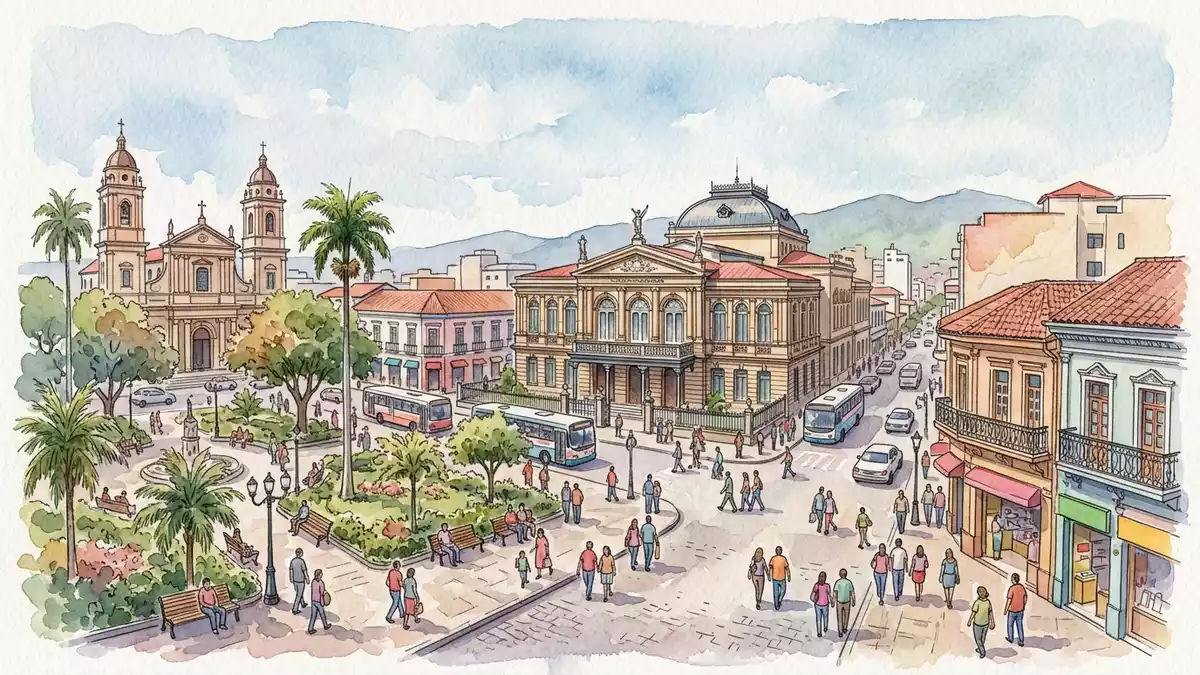
Centro Historico de San Jose is the historic downtown core of San Jose, the capital of Costa Rica, where civic plazas, markets and coffee-era neighbourhoods sit within a compact urban grid in the Central Valley.historic downtown core At its heart stand the National Theater of Costa Rica and the Metropolitan Cathedral of San Jose, facing pedestrian streets that link the main plazas with the city’s traditional commercial corridors.
Civic squares, theatres and churches in the historic grid
The historic centre of San Jose was formally delimited in 2015 as an interdistrital zone of around ten blocks by ten blocks, concentrating the city’s oldest and most significant civic buildings and plazas.centre delimited in 2015 Within this grid, centred on Avenida Central, lie the Plaza de la Cultura, Parque Central and other public spaces framed by neoclassical and eclectic façades that reflect the liberal architectural currents of the nineteenth century.
The National Theater of Costa Rica, opened in the late nineteenth century, anchors Plaza de la Cultura with a neoclassical Renaissance-style façade and interior sculpture and painting celebrating music, dance and drama.National Theater of Costa Rica Nearby, the Metropolitan Cathedral of San Jose stands as the principal Catholic church of the city, facing Parque Central and forming a visible axis of religious and civic life within the Centro Historico.
Coffee-era neighbourhoods at the edge of downtown
North-east of the main plazas, the historic centre shades into Barrio Amón and neighbouring quarters such as Otoya and Escalante, which grew out of Costa Rica’s coffee boom in the late nineteenth and early twentieth centuries.coffee boom neighbourhoods Barrio Amón was founded in 1890 by the French-born coffee businessman Amón Fasileau-Duplantier, who developed a planned residential quarter for San Jose’s elite on land linked to coffee plantations.founded in 1890
Many houses in Barrio Amón and the wider historic centre are low wooden or masonry buildings with verandas, ornamental ironwork and timber details, often described as examples of a tropical “neo-Victorian” style adapted to San Jose’s climate.tropical neo-Victorian style Over time, numerous properties in these neighbourhoods have been recognised as historic-architectural heritage of Costa Rica, reinforcing the role of Centro Historico de San Jose as a living record of the capital’s coffee-era prosperity.historic-architectural heritage
A compact centre of museums and everyday street life
Centro Historico de San Jose lies within San Jose’s downtown, a maze of streets and avenues where most of the city’s museums, markets and civic institutions are concentrated.downtown maze of streets Within walking distance of the main plazas are the National Museum, the Pre-Columbian Gold Museum and the Jade Museum, which trace Costa Rican history from pre-Columbian cultures through the periods of tobacco and coffee production.National, Gold and Jade museums
The historic centre is also the city’s traditional shopping and market area, with the Central Market spread across several buildings and side streets west of the core, offering local produce, food stalls and everyday goods.Central Market downtown Along pedestrian avenues such as Avenida Central, buses, taxis and foot traffic weave between small shops, department stores and cafés, giving Centro Historico de San Jose a dense, urban character that contrasts with the more residential feel of the surrounding coffee-era neighbourhoods.
Visiting Centro Historico de San Jose: what travellers from Western Europe should know
- Centro Historico de San Jose occupies the traditional downtown of San Jose in Costa Rica’s Central Valley, centred on Avenida Central and the main plazas around the Metropolitan Cathedral and National Theater. It is reached by city buses, taxis and urban roads that converge on the core of the capital.
- The historic centre consists of an urban grid with crossings, pavements and some pedestrian streets, and movement on foot involves negotiating kerbs, street crossings and occasional steps around plazas and public buildings.
- San Jose lies in the Central Valley of Costa Rica at an elevation of around 1,160 m (3,800 ft) above sea level, so the historic centre combines urban walking with a mild highland climate.
- The official language is Spanish and the currency is the Costa Rican colón.
- Entry requirements depend on your nationality; UK travellers can check the FCDO travel advice at gov.uk/foreign-travel-advice, Irish travellers the Department of Foreign Affairs at ireland.ie.
Searching for Centro Historico de San Jose on social platforms
These links open searches for Centro Historico de San Jose on each platform.
Frequently asked questions about Centro Historico de San Jose
Where is Centro Historico de San Jose located?
Centro Historico de San Jose lies in downtown San Jose in Costa Rica’s Central Valley, within a grid of streets and avenues centred on Avenida Central and the main civic plazas.
What can visitors expect on a visit to Centro Historico de San Jose?
Visitors encounter a dense urban centre with plazas, the National Theater of Costa Rica, the Metropolitan Cathedral, museums, markets and coffee-era residential streets in nearby neighbourhoods such as Barrio Amón.
What makes Centro Historico de San Jose distinctive among city centres?
Its combination of nineteenth-century civic architecture, coffee-era residential quarters and a formally defined historic zone from 2015 gives San Jose’s centre a layered character where Costa Rica’s political and economic history remains visible in the everyday cityscape.


