
Centro Historico de San Jose and its coffee-era barrios
Published on 09/07/2026 at 10:45 | Editorial responsibility: Rafael Müller, Editor-in-Chief AD HOC NEWS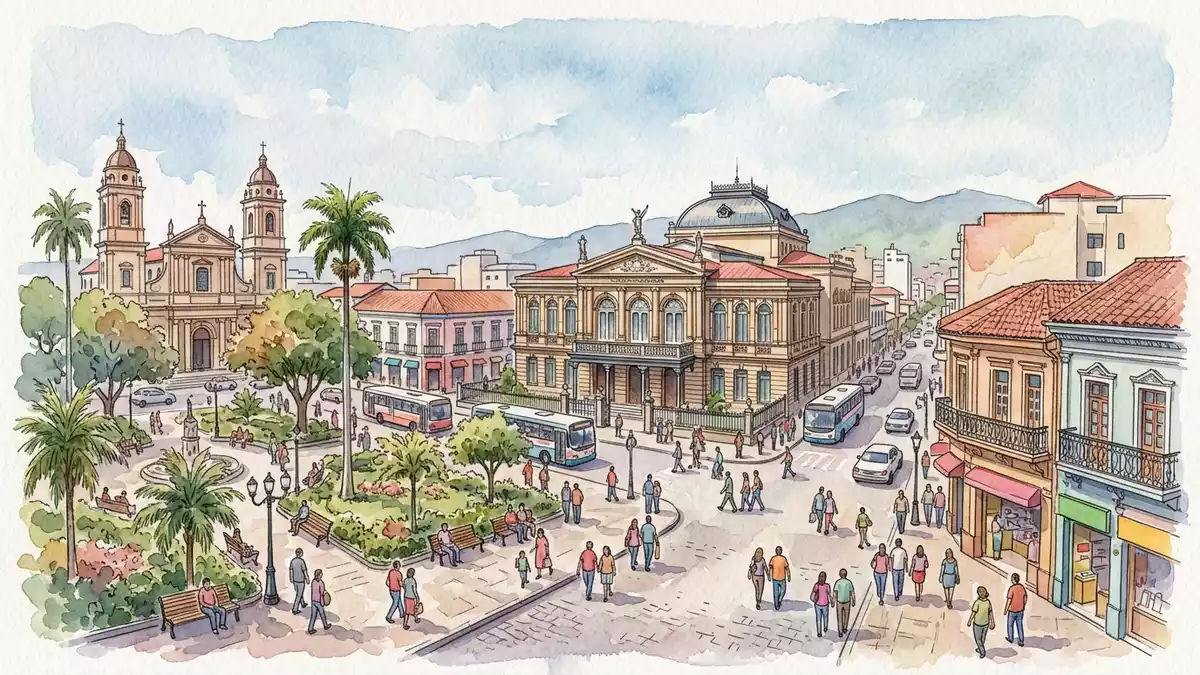
Centro Historico de San Jose in San Jose, Costa Rica, forms a compact historic core where civic plazas, markets and coffee-era neighbourhoods lie within a short walk of one another. Centred on the capital’s traditional downtown grid around Avenida Central and the main plazas, it brings together institutional buildings, everyday commercial streets and hillside residential barrios that took shape in the late nineteenth century.
Civic heart around plazas, cathedral and theatre
At the centre of Centro Historico de San Jose stand key civic spaces, with plazas, the Metropolitan Cathedral of San Jose and the National Theater of Costa Rica arranged along and around Avenida Central in the city’s central district.Metropolitan Cathedral of San Jose and the National Theater This downtown strip has long been the spine of institutional and commercial life, with the plazas forming open spaces between dense blocks of mid-rise buildings.
Close to these plazas lies Mercado Central, the traditional central market of San Jose, housed in an enclosed block whose internal passages hold stalls selling foodstuffs and everyday goods.Centro Historico de San Jose is the historic core of San Jose Around the market, narrow streets carry buses, taxis and pedestrians through a grid that dates from the period when San Jose expanded as the political and administrative centre of Costa Rica’s Central Valley. The juxtaposition of monumental facades and everyday shopfronts makes the downtown feel both institutional and lived-in.
Museums and cultural institutions in the historic centre
Within easy walking distance of the main plazas, Centro Historico de San Jose contains several museums that introduce visitors to the country’s history and material culture.Pre-Columbian Gold Museum and the National Museum Beneath Plaza de la Cultura sits the Pre-Columbian Gold Museum, which focuses on indigenous goldwork and artefacts from the pre-Hispanic period, while the National Museum occupies a former military barracks whose ramparts and courtyards frame exhibitions on Costa Rican history.
The proximity of these institutions to the cathedral, theatre and central market gives Centro Historico de San Jose a dense cultural cluster. Streets that lead away from Avenida Central reveal smaller galleries and cultural centres housed in adapted buildings, reflecting the layering of uses typical of a capital city where nineteenth-century structures have been reused rather than cleared. Taken together, the plazas, museums and civic buildings make this part of San Jose a natural starting point for understanding Costa Rica’s urban and national story.Plaza de la Cultura as cultural and physical centre
Coffee-era streets of Barrio Amón and the hillside barrios
North-east of the commercial centre, Centro Historico de San Jose rises towards Barrio Amón and Barrio Otoya, hillside districts laid out in the late nineteenth century as residential quarters for coffee growers and the emerging bourgeoisie.Barrio Amón and Barrio Otoya Barrio Amón in particular is associated with the French coffee entrepreneur Amón Fasileau Duplantier, who promoted the transformation of plantation land into an area of villas and houses for San Jose’s elite in the late nineteenth century.designed at the end of the nineteenth century by Amón Fasileau Duplantier
Barrio Amón is bounded to the north by the Río Torres and avenida 13, to the south by avenida 7, to the east by calle 9 and to the west by calle Alfredo Volio Jiménez, forming a clearly delimited hillside neighbourhood above the downtown core.Barrio Amón boundary description Within these limits, low wooden houses with verandas and iron railings line streets that still follow the original grid between Central and 9th Streets and between 7th and 13th Avenues in the El Carmen district.architecture tropical neo-victorienne Many of these houses are cited as examples of Costa Rica’s tropical “neo-Victorian” architecture, adapted to local climate conditions while retaining decorative elements associated with late nineteenth-century styles.
Centro Historico de San Jose as a walkable historic landscape
Taken together, the plazas, markets and hillside barrios make Centro Historico de San Jose a walkable historic landscape rather than a single monument. The downtown grid in the central district, centred on Avenida Central and the main civic plazas, connects directly with the streets of Barrio Amón and Barrio Otoya, allowing a continuous walk from institutional facades to residential verandas.Centro Historico de San Jose occupies the traditional downtown
From Plaza de la Cultura and the Metropolitan Cathedral, streets lead north-east towards Parque España and the tree-lined avenues that mark the transition into the coffee-era barrios.Barrios Amón and Otoya description The change in topography, from the flatter central blocks to the slopes above the Río Torres, is mirrored by a shift in architectural scale, as mid-rise commercial buildings give way to freestanding houses and smaller institutional structures. This sequence makes Centro Historico de San Jose a place where the evolution of San Jose from a coffee-centred town to a national capital is legible in the fabric of its streets and buildings.
Visiting Centro Historico de San Jose: what travellers from Western Europe should know
- Centro Historico de San Jose lies in the central district of San Jose in Costa Rica’s Central Valley, with the main plazas, cathedral and Teatro Nacional arranged along Avenida Central and surrounding streets of the downtown grid.
- From the downtown plazas, the terrain rises towards Barrio Amón and Barrio Otoya on the hillside above the Río Torres, so walks into these barrios involve gradual slopes and some short stairways between streets and terraces.
- Centro Historico de San Jose is reached by urban streets from Juan Santamaría International Airport, with buses and taxis running into the downtown area; once there, most historic sights in the core lie within walking distance of one another.
- The official language is Spanish and the currency is the Costa Rican colón.
- Entry requirements depend on your nationality; UK travellers can check the FCDO travel advice at gov.uk/foreign-travel-advice, Irish travellers the Department of Foreign Affairs at ireland.ie.
Searching for Centro Historico de San Jose on social platforms
These links open searches for Centro Historico de San Jose on each platform.
Frequently asked questions about Centro Historico de San Jose
Where is Centro Historico de San Jose located?
Centro Historico de San Jose occupies the traditional downtown core of San Jose, the capital of Costa Rica, centred on Avenida Central and the main civic plazas in the central district.
What can visitors expect on a visit to Centro Historico de San Jose?
Visitors encounter civic plazas, the Metropolitan Cathedral, the National Theater, Mercado Central and nearby museums such as the Pre-Columbian Gold Museum and the National Museum, all within a compact grid of streets.
What makes Centro Historico de San Jose distinctive among Costa Rican urban areas?
The combination of dense downtown civic spaces with the coffee-era residential architecture of Barrio Amón and Barrio Otoya above the Río Torres makes Centro Historico de San Jose a rare example of a capital whose nineteenth-century urban layers remain legible in everyday city life.


