
Centro Historico de Puebla and its tiled colonial streets
Published on 09/21/2026 at 06:45 | Editorial responsibility: Rafael Müller, Editor-in-Chief AD HOC NEWS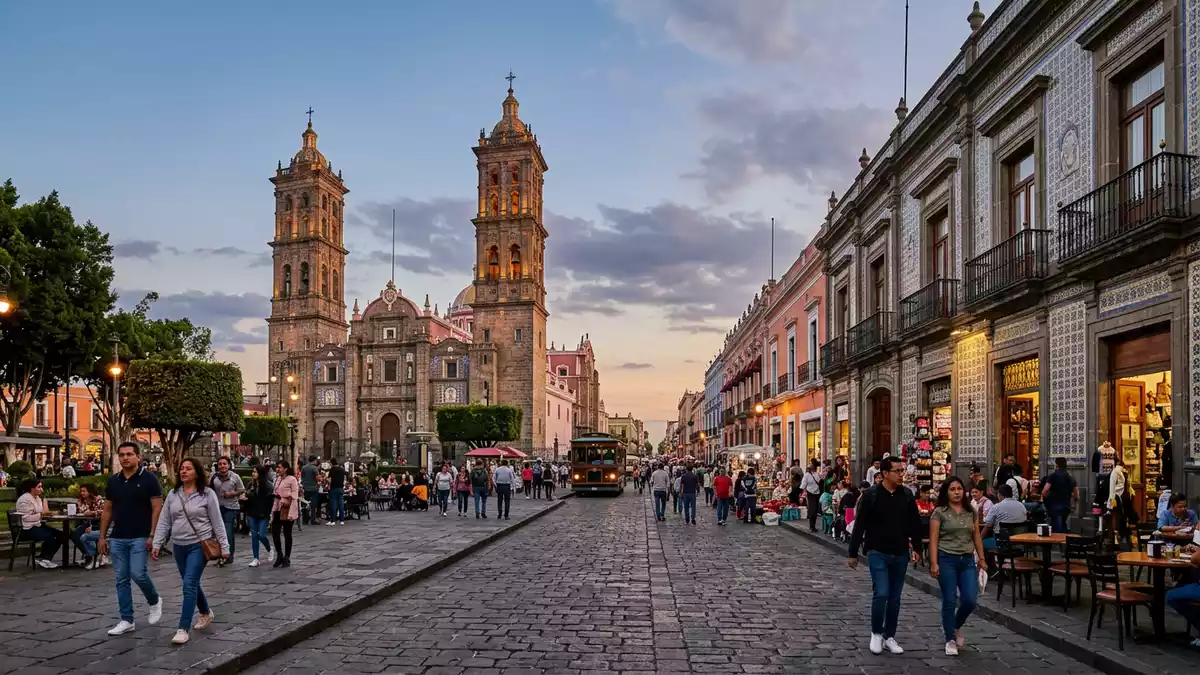
Centro Historico de Puebla in the Mexican city of Puebla is a planned colonial core where a Renaissance-inspired street grid meets richly decorated churches, palaces and tiled townhouses. Recognised internationally as the Historic Centre of Puebla and inscribed on the UNESCO World Heritage List in 1987, it preserves an early colonial urban plan together with a dense concentration of religious and civic architecture from the sixteenth to nineteenth centuries.
A colonial grid at the foot of Popocatépetl
The historic centre occupies a broad plateau in central Mexico, in the State of Puebla, with the Popocatépetl volcano rising to the west beyond the urban fringe. The city itself was founded as a new colonial settlement in 1531, laid out as a deliberate urban project rather than an extension of an older town, and its original grid remains legible in the streets of Centro Historico de Puebla.Historic Centre of Puebla The plan organises straight streets into rectangular blocks, converging on a central square that functions as the zócalo, framed by civic buildings and arcaded walkways.
Within this layout the protected zone defined as the Historic Centre of Puebla extends across a large number of city blocks and includes thousands of properties with documented historical value.World Heritage Site area The UNESCO inscription under cultural criteria recognises both the urban fabric and the architecture it holds, describing a coherent colonial city plan that has remained largely intact since the sixteenth century.Zona de Monumentos Históricos
Baroque churches, civic palaces and tiled façades
Religious architecture forms a visible backbone to Centro Historico de Puebla, with churches and convent complexes rising at short intervals along the grid. The Catedral de Puebla, built from the sixteenth into the seventeenth century, stands on one side of the main square and is one of the most prominent baroque churches in the historic centre, its twin towers rising above the surrounding roofs.Catedral de Puebla and its towers Nearby, church complexes such as Santo Domingo and the Capilla del Rosario display elaborate interior decoration and altarpieces associated with Puebla’s baroque tradition.
Civic architecture matches this religious presence, with palaces and administrative buildings lining several of the principal streets. The former archbishop’s palace and other civil structures demonstrate how stonework and plaster were used to articulate façades over multiple storeys. A distinctive feature of Centro Historico de Puebla is the widespread use of glazed ceramic tiles, known as Talavera, to clad exterior walls and details, producing façades where brick, stone and brightly coloured ceramics combine.Talavera tiles and baroque façades This mix of European baroque elements and local craftsmanship has been described as a baroque of Puebla, visible in church fronts, townhouses and arcaded commercial buildings.
UNESCO recognition and the living historic core
The Mexican government designated the area as a Historic Monuments Zone in 1977, recognising the concentration of colonial-era buildings across the central districts of Puebla. Ten years later, on 11 December 1987, UNESCO added the Historic Centre of Puebla to the World Heritage List as a cultural property, citing criteria that highlight both the preserved urban plan and the architectural ensembles it contains.World Heritage inscription date The inscription covers the historic centre in the municipality of Puebla and neighbouring municipalities, reflecting its wider urban and historical significance.Historic Centre of Puebla site information
The zócalo and surrounding streets remain an active civic and commercial focus, with arcades, shops and cafés occupying ground floors beneath upper-level residences and offices. Market halls, former convents adapted to new uses and long terraces of townhouses contribute to the sense of continuity, as colonial structures accommodate contemporary life while retaining their baroque and neoclassical fronts. The overall impression in Centro Historico de Puebla is of a district where the original grid, religious complexes, civic palaces and tiled façades still define the character of the city’s historic core.
Visiting Centro Historico de Puebla: what travellers from Western Europe should know
- Centro Historico de Puebla lies in the city of Puebla in central Mexico, with the historic streets and main square reached from other districts by urban roads and local transport within the city.
- Many of the streets in the historic centre are laid out in a regular grid, and walking between churches, plazas and tiled townhouses involves covering several blocks along paved surfaces and crossing road junctions.
- The elevation of Puebla in Mexico’s highlands gives the historic centre a setting above sea level, and reaching viewpoints in church towers involves climbing staircases that may be narrow and extended.
- The official language is Spanish and the currency is the Mexican peso.
- Entry requirements depend on your nationality; UK travellers can check the FCDO travel advice at gov.uk/foreign-travel-advice, Irish travellers the Department of Foreign Affairs at ireland.ie.
Searching for Centro Historico de Puebla on social platforms
These links open searches for Centro Historico de Puebla on each platform.
Frequently asked questions about Centro Historico de Puebla
Where is Centro Historico de Puebla located?
Centro Historico de Puebla is the historic centre of the city of Puebla in central Mexico, on a highland plateau east of Mexico City in the State of Puebla.
What can visitors expect when walking through the historic centre?
Visitors encounter a regular grid of streets lined with churches, convents, civic palaces and townhouses, many with façades clad in glazed Talavera tiles and baroque architectural detail.
What makes Centro Historico de Puebla distinctive among historic city centres?
Its combination of an early colonial grid plan, dense concentration of sixteenth- to nineteenth-century religious and civic architecture, and widespread use of Talavera tiles on façades gives it a distinct architectural character.


