
Centro Historico de Puebla and its tiled baroque streets
Published on 09/12/2026 at 13:20 | Editorial responsibility: Rafael Müller, Editor-in-Chief AD HOC NEWS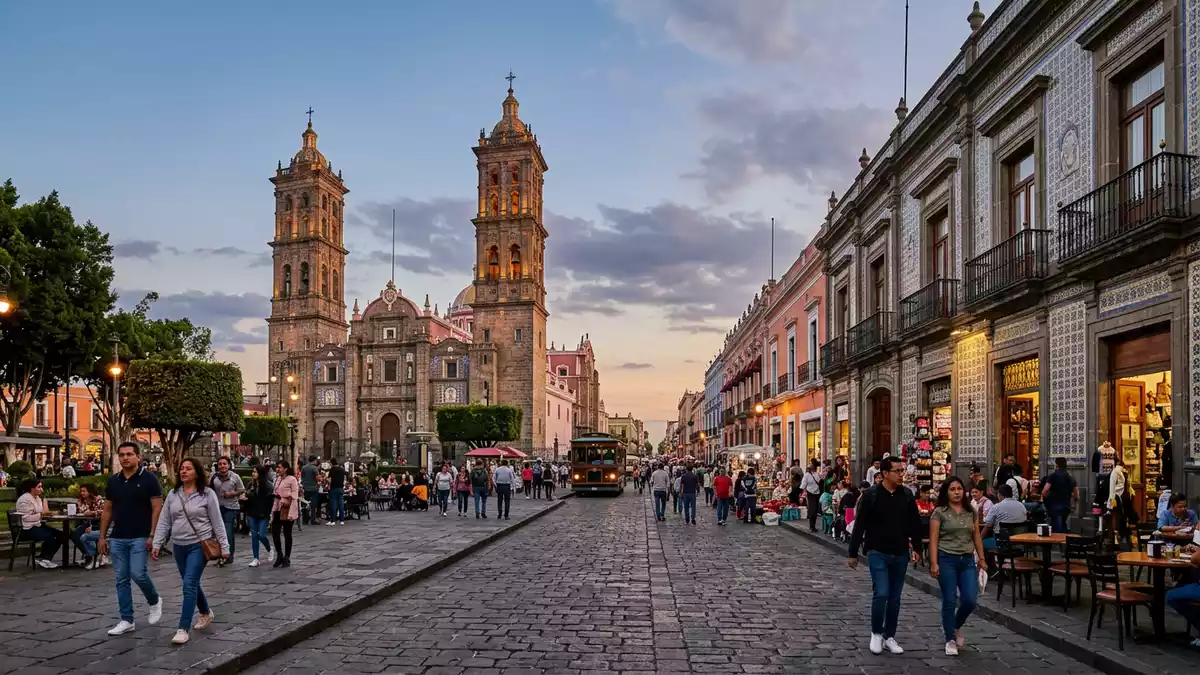
Centro Historico de Puebla in the city of Puebla is a Spanish colonial grid of streets lined with churches, palaces and tiled townhouses that has grown into a dense open-air gallery of architecture from several centuries. Founded as a planned colonial city in 1531 at the foot of the Popocatépetl volcano, its historic core is now recognised internationally as the Historic Centre of Puebla and inscribed as a UNESCO World Heritage Site for its preserved urban plan and baroque and neoclassical buildings.Historic Centre of Puebla
A Renaissance grid at the foot of Popocatépetl
The heart of Centro Historico de Puebla is its regular street pattern, laid out on a grid soon after the city’s foundation in 1531 and aligned around the central square known as the Zócalo.trazo reticular renacentista The plaza opens as a broad space framed by arcaded buildings and the cathedral, setting the scale for the surrounding streets. The city stands in central Mexico, east of Mexico City, where the valley floor drops away towards the volcano and distant views of Popocatépetl form a backdrop to many streets.founded ex nihilo in 1531
Within this grid, the protected zone extends across many blocks of low-rise buildings whose façades line continuous streets rather than isolated monuments. Official designation as a Historic Monuments Zone came in 1977, followed by inscription on the World Heritage List on 11 December 1987 under cultural criteria that recognise both the urban plan and the architecture.Zona de Monumentos Históricos The World Heritage property covers hundreds of hectares, with an area around 300 ha defined for the core zone, encompassing thousands of buildings of recognised historical value.World Heritage Site area
Baroque churches and tiled townhouses
Centro Historico de Puebla is distinguished by its concentration of religious and civic architecture from the sixteenth to the nineteenth century, much of it built in baroque and later neoclassical styles. The Cathedral of Puebla rises beside the Zócalo, its construction spanning the sixteenth and seventeenth centuries and forming one of the city’s most prominent religious structures.16th-17th-century cathedral Nearby, the Church of Santo Domingo houses the Rosario Chapel, a richly decorated example of Mexican baroque in which surfaces are covered with gilded detail.
Beyond these major churches, the streets are lined with houses and palaces whose walls are clad in ceramic tiles known as azulejos and in locally produced Talavera tiles, creating patterned façades of colour and relief.houses with walls covered in tiles Many buildings combine masonry with tile panels around windows and balconies, and courtyards are set behind heavy doorways. The mix of European and American influences that accompanied the colonial period resulted in an architectural language described as baroque of Puebla, linking grand religious complexes, civil buildings like the former archbishop’s palace and long rows of townhouses into a coherent historic district.fusion of European and American styles
UNESCO recognition and layered urban life
The international recognition of Centro Historico de Puebla focuses on the way its fabric preserves colonial town planning and architecture while remaining a lived-in urban centre. UNESCO lists the site as the Historic Centre of Puebla and notes its value under cultural criteria, emphasising both the exchange of human values in architecture and the representation of an exceptional urban ensemble.inscripción en la Lista del Patrimonio Mundial The designation reflects the way the reticular grid, plazas and streets hold together churches, educational buildings and palaces in a continuous historic landscape.
Within this landscape, different quarters have distinct characters. Around the Zócalo, civic buildings and the cathedral face onto the main square, while nearby streets contain artisans’ workshops, markets and more modest townhouses. Districts such as the Barrio del Artista bring together spaces where local art is produced, linking creative activity with the historic setting.Barrio del Artista Together, these areas show how the colonial grid has accommodated different uses over centuries, without losing the architectural forms that prompted its protection.
Visiting Centro Historico de Puebla: what travellers from Western Europe should know
- Centro Historico de Puebla lies in the city of Puebla in central Mexico, east of Mexico City, and is reached overland from Mexico City and by transport links from Puebla’s airport.
- The historic centre consists of many contiguous blocks of low-rise buildings on a street grid, and exploring the area involves walking along paved streets and crossing squares.
- The official language is Spanish and the currency is the Mexican peso.
- Entry requirements depend on your nationality; UK travellers can check the FCDO travel advice at gov.uk/foreign-travel-advice, Irish travellers the Department of Foreign Affairs at ireland.ie.
Searching for Centro Historico de Puebla on social platforms
These links open searches for Centro Historico de Puebla on each platform.
Frequently asked questions about Centro Historico de Puebla
Where is Centro Historico de Puebla?
Centro Historico de Puebla is the historic centre of the city of Puebla in central Mexico, east of Mexico City at the foot of the Popocatépetl volcano.
What can visitors expect when walking through the historic centre?
Visitors encounter a planned grid of streets with squares, churches, palaces and townhouses, many of them faced with ceramic tiles and baroque or neoclassical façades.
What makes Centro Historico de Puebla distinctive among historic cities?
It combines a Renaissance-inspired street grid with a dense concentration of colonial religious and civil architecture and has been recognised as a UNESCO World Heritage Site since 1987.


