
Centro Historico de Lima and its colonial grid around Plaza Mayor
Published on 09/15/2026 at 22:17 | Editorial responsibility: Rafael Müller, Editor-in-Chief AD HOC NEWS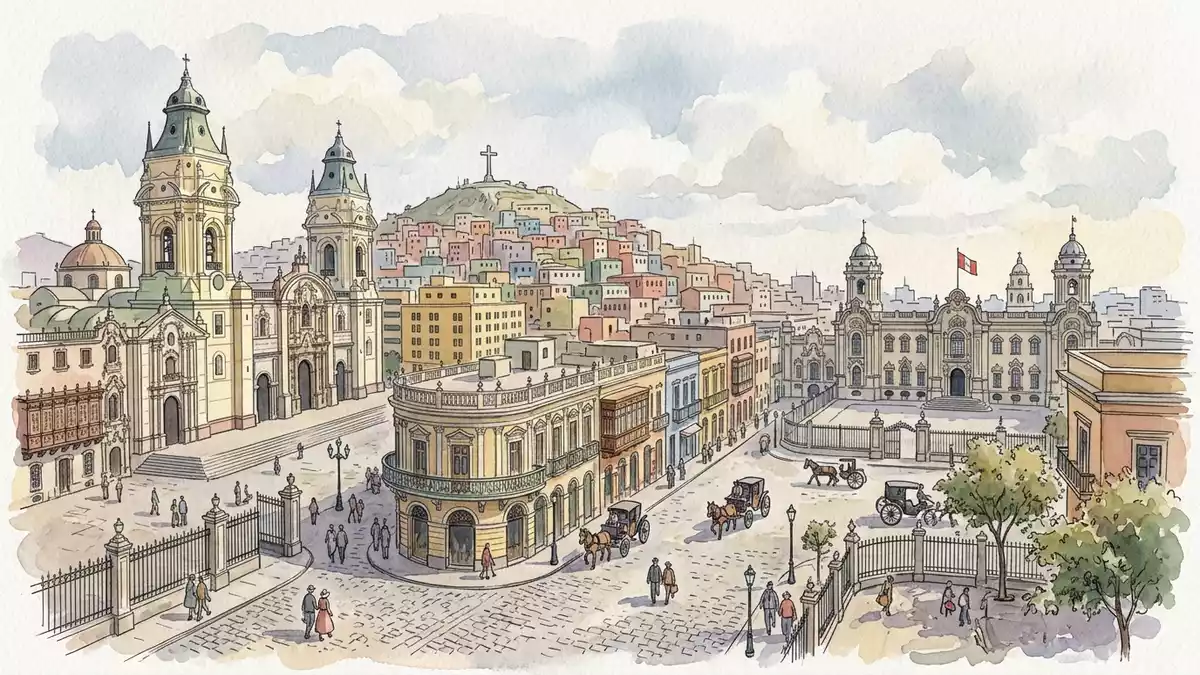
Centro Historico de Lima is the historic core of Lima, a planned colonial grid centred on Plaza Mayor and recognised as a World Heritage Site for its dense concentration of viceregal monuments. Founded as the “Ciudad de los Reyes” by Francisco Pizarro in January 1535, the district preserves the street pattern and many of the buildings that grew from that sixteenth-century origin.
A checkerboard city in the Rímac valley
Centro Historico de Lima occupies the historic centre of Peru’s capital in the Rímac valley, extending across the districts of Lima and Rímac along the banks of the Rímac river.Historic Centre of Lima The core follows a regular checkerboard street plan laid out under Spanish rule, with straight streets meeting at right angles and forming compact blocks referred to as the Damero de Pizarro.colonial grid around Plaza Mayor
Within this grid, plazas, religious complexes and civic buildings sit close together, so a walk along almost any street passes churches, convents and administrative façades in quick succession. Many of these structures display timber balconies projecting over the pavement, arcaded ground floors and stuccoed façades painted in strong colours, giving the historic centre a distinctive streetscape based on layered colonial and republican architecture.
UNESCO recognition and monumental fabric
The historic centre holds formal recognition as a cultural World Heritage Site, inscribed by UNESCO under cultural criterion (iv) as an outstanding example of a Spanish colonial town of political and economic importance in Latin America.UNESCO World Heritage listing In 1988 the convent ensemble of San Francisco de Lima was first recognised, and in 1991 this protection was extended to the wider Centro Historico de Lima with hundreds of historic monuments from the viceregal period.extension of World Heritage status
The World Heritage core covers a defined area of central Lima, marked in places by plaques bearing the UNESCO emblem at the entrances to protected buildings.Centro histórico de Lima Within this zone stand churches such as the Cathedral of Lima, convents including San Francisco, and civic institutions housed in long two- and three-storey buildings along the main streets. Together they form a continuous urban fabric where religious, administrative and commercial functions share the same blocks, and where architectural details like carved woodwork, iron railings and colonnades appear repeatedly along the façades.
Plaza Mayor and the surrounding streets
At the heart of Centro Historico de Lima lies Plaza Mayor, also known as Plaza de Armas, the square where Francisco Pizarro sited the city’s foundation in 1535.Plaza Mayor foundation site The plaza is framed on one side by the Government Palace, on another by the Cathedral of Lima, and along its edges by arcaded municipal and commercial buildings that define a strong urban enclosure.
From Plaza Mayor, streets such as Jirón de la Unión lead out through blocks lined with balconied houses and shops, linking smaller squares and churches deeper within the grid.balcony-lined colonial streets Crossing the Rímac river, bridges connect this core with the older part of the present-day Rímac district, where further historic buildings stand on the opposite bank and contribute to the wider sense of a continuous colonial centre.
Visiting Centro Historico de Lima: what travellers from Western Europe should know
- Centro Historico de Lima lies in central Lima on Peru’s Pacific coast, reached by road from the wider metropolitan area and linked across the Rímac river to the district of Rímac.
- Many of the streets around Plaza Mayor and the main churches are flat but paved, with arcaded walkways and some narrow pavements, and interior visits can involve staircases and uneven stone or tile floors.
- The historic centre stands close to the Rímac river, so short crossings by bridge connect the core around Plaza Mayor with historic streets and buildings on the opposite bank in the Rímac district.
- The official language is Spanish and the currency is the Peruvian sol.
- Entry requirements depend on your nationality; UK travellers can check the FCDO travel advice at gov.uk/foreign-travel-advice, Irish travellers the Department of Foreign Affairs at ireland.ie.
Searching for Centro Historico de Lima on social platforms
These links open searches for Centro Historico de Lima on each platform.
Frequently asked questions about Centro Historico de Lima
Where is Centro Historico de Lima located?
Centro Historico de Lima forms the historic centre of Lima in the Rímac valley on Peru’s central coast, spread across the districts of Lima and Rímac along the Rímac river.
What should visitors expect on a visit?
Visitors encounter a dense colonial grid of streets, plazas and churches, with balconied façades, arcades and major institutions gathered around Plaza Mayor and nearby blocks.
What makes Centro Historico de Lima distinctive?
The district combines a sixteenth-century checkerboard street plan with World Heritage protection for its many viceregal monuments, preserving a continuous urban fabric of colonial and republican architecture.


