
Centro Historico de Lima and its balcony-lined colonial streets
Published on 09/01/2026 at 20:15 | Editorial responsibility: Rafael Müller, Editor-in-Chief AD HOC NEWS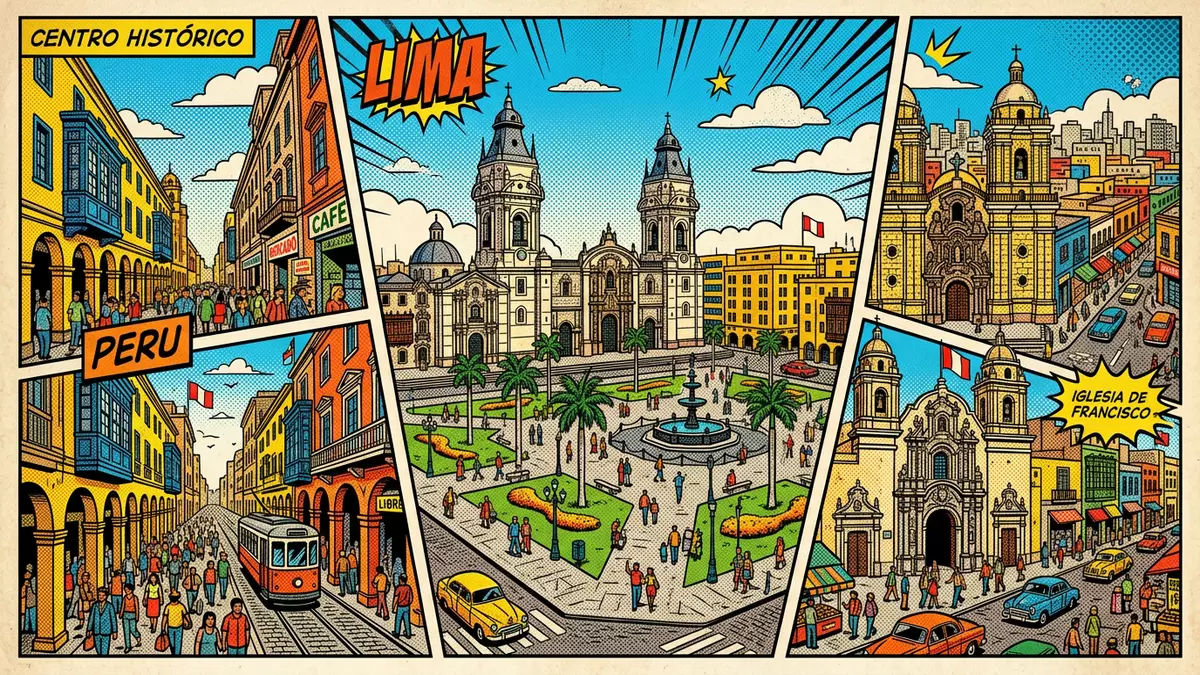
Centro Historico de Lima is the colonial core of Lima, a planned grid of plazas and streets where long balconies, church towers and civic façades form a dense historic cityscape recognised on the World Heritage List.
The colonial grid at the heart of Lima
Centro Historico de Lima occupies the historic centre of Lima in the Rímac valley on Peru’s central coast, structured around a checkerboard street plan laid out under Spanish rule in the sixteenth century.checkerboard street plan The area forms part of a monumental zone defined by the Peruvian state and extends across districts on both banks of the Rímac river.
The historic centre is inscribed on the UNESCO World Heritage List as a cultural property, first recognised in 1988 for the convent ensemble of San Francisco and extended in 1991 to encompass a wider swathe of the old city.World Heritage List Within this grid lie hundreds of historic monuments constructed during the viceregal period, many aligned along streets laid out in straight blocks that are still referred to as the Damero de Pizarro.
Plaza Mayor and the seat of power
At the centre of Centro Historico de Lima lies Plaza Mayor, also known as Plaza de Armas, a rectangular public square that has served as Lima’s main plaza since the city’s foundation by Francisco Pizarro on 18 January 1535.foundation by Francisco Pizarro The square is framed by streets such as Carabaya and Jirón de la Unión and forms the focus from which the surrounding grid of blocks radiates.
The north side of Plaza Mayor is taken by the Government Palace, official residence of the President of Peru, while the east side is lined by the Metropolitan Cathedral of Lima and the Archbishop’s Palace, a set of ecclesiastical buildings whose origins reach back to the sixteenth and seventeenth centuries.Government Palace and Cathedral On the west stands the Municipal Palace housing the city administration, completing an ensemble in which civil and religious authorities occupy adjoining blocks around a shared ceremonial space.
Balcony-lined streets and convent ensembles
Moving away from Plaza Mayor, the straight streets of Centro Historico de Lima are lined with town houses and institutional buildings whose projecting wooden balconies form one of the most recognisable features of the historic centre.projecting wooden balconies Many of these balconies are enclosed and supported on carved brackets, adding a continuous upper-storey rhythm above the pavements along corridors such as Jirón de la Unión.
Among the religious complexes, the convent ensemble of San Francisco stands out as a substantial group of cloisters, church spaces and ancillary buildings from the colonial period.convent ensemble of San Francisco Within the wider historic centre several hundred monuments from the viceregal era survive, including baroque and neoclassical façades, civic buildings and churches whose towers and domes rise above the regular grid of streets.
Visiting Centro Historico de Lima: what travellers from Western Europe should know
- Centro Historico de Lima lies in the central districts of Lima on the banks of the Rímac river and is reached by city transport from the wider metropolitan area.
- Many of the streets in the historic centre are level but paved, with long stretches on foot between plazas and churches.
- Within Centro Historico de Lima, Plaza Mayor, the Government Palace, the Cathedral of Lima and the convent of San Francisco all sit within walking distance of one another.
- The official language is Spanish and the currency is the Peruvian sol.
Searching for Centro Historico de Lima on social platforms
These links open searches for Centro Historico de Lima on each platform.
Frequently asked questions about Centro Historico de Lima
Where is Centro Historico de Lima located?
Centro Historico de Lima is in the historic centre of Lima, in districts on both sides of the Rímac river on Peru’s central Pacific coast.
What should travellers expect on a visit?
A visit centres on walking through a planned grid of streets linking Plaza Mayor, churches, convents and civic buildings, many with projecting wooden balconies.
What makes Centro Historico de Lima distinctive?
Its combination of a sixteenth-century colonial street plan, balcony-lined façades and major viceregal institutions clustered around Plaza Mayor gives the district a dense historic character.


