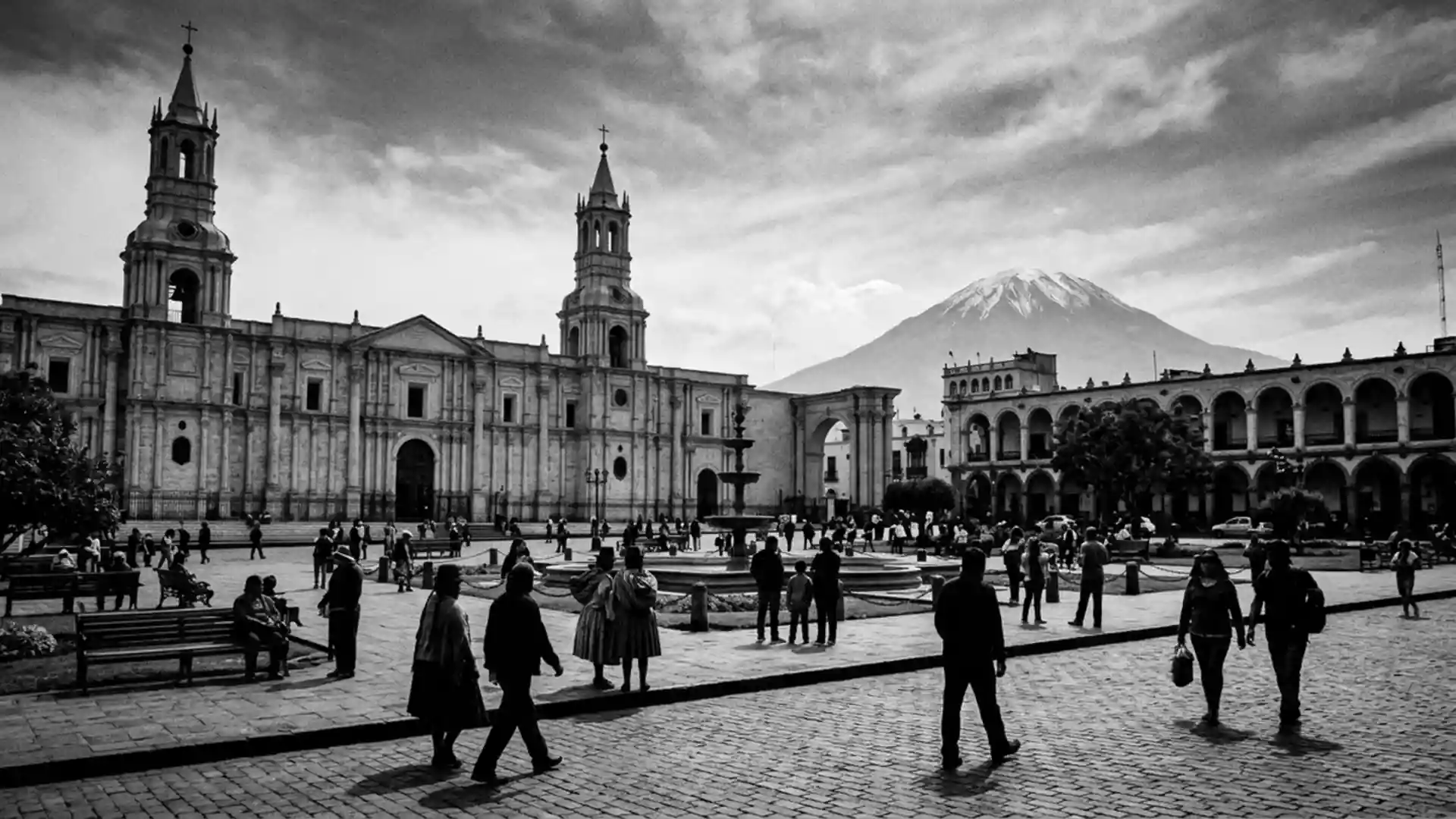
Centro Historico de Arequipa and its white volcanic stone cityscape
Published on 09/02/2026 at 10:26 | Editorial responsibility: Rafael Müller, Editor-in-Chief AD HOC NEWS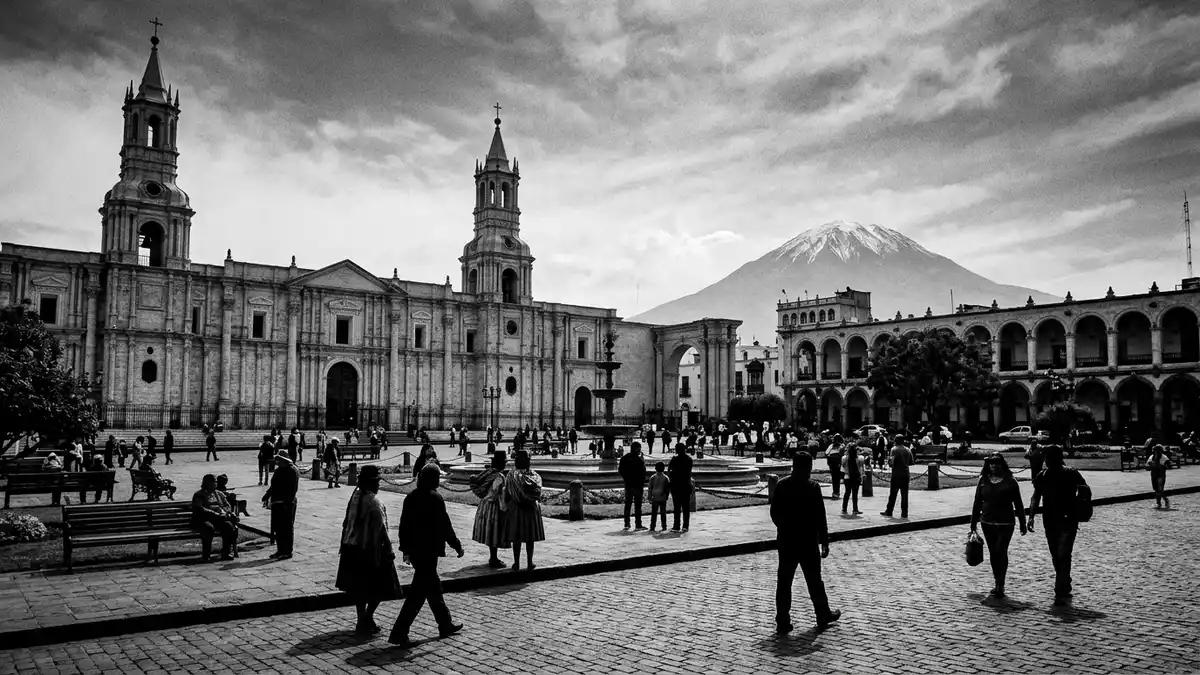
Centro Historico de Arequipa in southern Peru is the historic core of Arequipa, a World Heritage city shaped by pale volcanic stone and framed by Andean volcanoes. In this central district, streets, churches and townhouses form an urban ensemble built largely from sillar, a white volcanic tuff that gives the place its characteristic light colour and sharp relief in strong mountain sunlight.
Sillar stone and a “white city” of thick walls
The defining material of Centro Historico de Arequipa is sillar, a volcanic tuff quarried from deposits around nearby volcanoes such as Chachani and Misti. Many religious and civil buildings in the historic centre are constructed with thick walls, arcades and vaults carved from this stone, creating façades whose pale tones help explain Arequipa’s common description as a white city.built in volcanic sillar The stone is soft enough to be worked with hand tools yet robust in mass, a combination that has enabled elaborate carving at entrances while supporting substantial masonry structures.Building material sillar
In street after street, sillar blocks form continuous fronts of townhouses with courtyards behind, punctuated by churches and convents whose façades carry carved ornament. The Plaza de Armas is surrounded by buildings in this stone, including the Basilica Cathedral of Arequipa and arcaded frontages that frame the central square.Arequipa Main Square From the square and nearby streets, the silhouettes of volcanoes form a backdrop beyond the rooflines, tying the stone visually to its geological origin.
World Heritage urban fabric and mestizo Baroque
Centro Historico de Arequipa is inscribed on the UNESCO World Heritage List as the “Historical Centre of the City of Arequipa”, recognised for the way European and local traditions are integrated in its architecture.Historical Centre of the City of Arequipa UNESCO notes robust walls, archways, vaults, courtyards and open spaces built in sillar, with intricate Baroque decoration on façades executed by colonial masters and Criollo and Indigenous masons.integration of European and native characteristics The site was added to the World Heritage List in 2000, giving formal recognition to a historic core that had already developed over centuries.
The architectural style strongly associated with Centro Historico de Arequipa is mestizo Baroque, in which Spanish Baroque forms are combined with decorative motifs from Andean flora, fauna and pre-Columbian patterning.Architectural style Mestizo Baroque Twisted columns, curved pediments and richly carved portals appear alongside representations of animals such as condors and pumas and native plants. Religious monuments, military structures and civil buildings are all present within the historic area, which covers hundreds of hectares and contains thousands of individual properties, of which a significant number are formally recognised as cultural heritage buildings.core covers 332 hectares
Streets, squares and monastic quarters
The core of Centro Historico de Arequipa follows a grid laid out in the colonial period, with straight streets forming blocks around the Plaza de Armas and other squares. Within this layout, many casonas—large townhouses—open onto internal courtyards that bring light and air into deep plots, while arcades and passages link public and semi-private spaces.nucleus and agglomeration of barrios Among the religious complexes, the Monasterio de Santa Catalina stands out as a substantial enclosure whose streets, plazas and chapels form a kind of city within the city.Monasterio de Santa Catalina
Walking through the historic centre, the contrast between enclosed courtyards and open squares is a consistent feature. Thick entrance walls give onto planted inner spaces, and in places arcaded galleries run along one or more sides of a courtyard. Many façades carry carved stonework with floral motifs, geometric borders and representations of Andean animals, using the workable nature of sillar to create depth and texture.elaborate stonework with floral motifs At corners and along main thoroughfares, the alignment of façades, balconies and parapets builds continuous perspectives of pale masonry.
Visiting Centro Historico de Arequipa: what travellers from Western Europe should know
- Centro Historico de Arequipa lies at the centre of Arequipa in southern Peru, with the Plaza de Armas acting as a reference point surrounded by sillar-built civic and religious buildings.
- The terrain within the historic centre is urban but uneven in places, with cobbled or paved streets and some approaches involving staircases or sloping passages between courtyards and squares.
- Arequipa is reached by air via Rodríguez Ballón International Airport and by long-distance road links; from the airport, road connections lead towards the historic centre and the Plaza de Armas.
- The official language is Spanish and the currency is the Peruvian sol.
- Entry requirements depend on your nationality; UK travellers can check the FCDO travel advice at gov.uk/foreign-travel-advice, Irish travellers the Department of Foreign Affairs at ireland.ie.
Searching for Centro Historico de Arequipa on social platforms
These links open searches for Centro Historico de Arequipa on each platform.Frequently asked questions about Centro Historico de Arequipa
Where is Centro Historico de Arequipa located?
Centro Historico de Arequipa is the historic centre of the city of Arequipa in southern Peru, with its core around the Plaza de Armas and nearby streets.
What can visitors expect on a visit to Centro Historico de Arequipa?
Visitors encounter streets, squares, churches and townhouses built largely from pale volcanic sillar, with courtyards, arcades and carved façades set against an Andean volcanic backdrop.
What makes Centro Historico de Arequipa distinctive among historic centres?
The combination of sillar masonry, mestizo Baroque decoration and a formally recognised World Heritage urban fabric gives Centro Historico de Arequipa a character closely tied to its volcanic setting.