
Centro Historico de Arequipa and the white volcanic stone city
Published on 08/24/2026 at 12:26 | Editorial responsibility: Rafael Müller, Editor-in-Chief AD HOC NEWS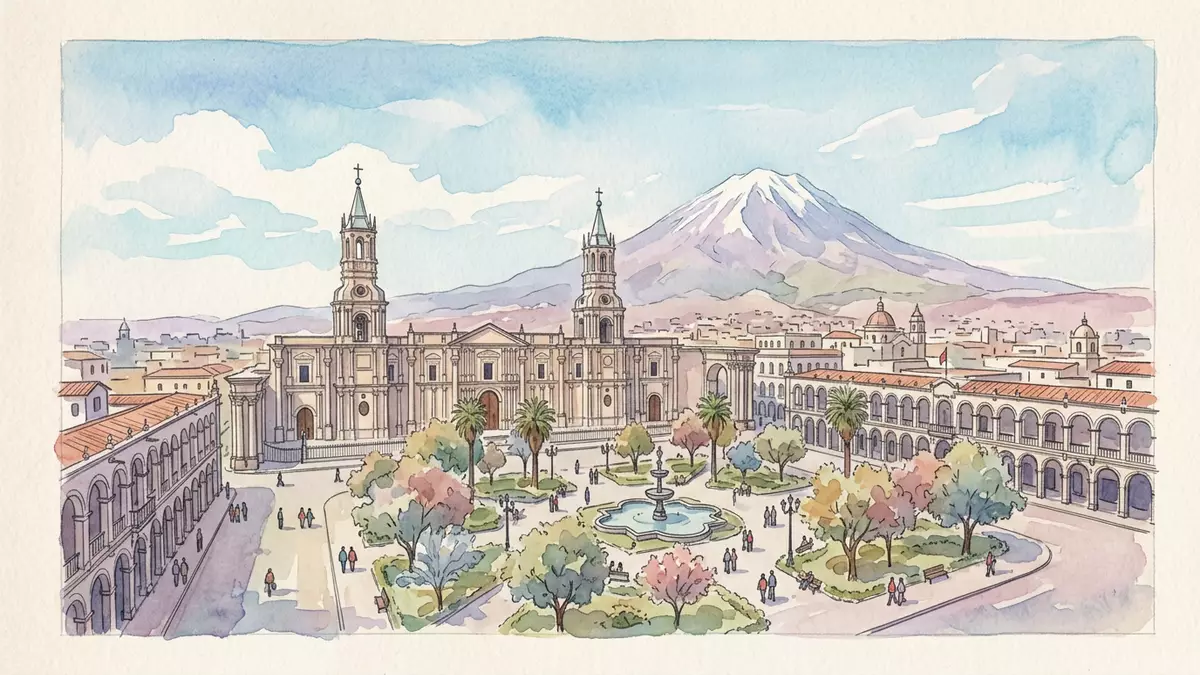
Centro Historico de Arequipa is the colonial core of Arequipa in southern Peru, a World Heritage city built in pale volcanic stone under the shadow of Andean volcanoes. The historic centre stretches across a compact grid of streets by the Chili River, where thick-walled houses, arcaded plazas and churches reveal the long dialogue between European urban plans and local materials from the sixteenth century onwards.
Sillar stone and the making of the “White City”
The most striking feature of Centro Historico de Arequipa is the material from which so much of it is built: sillar, a white and sometimes pink volcanic tuff carved from deposits around nearby volcanoes such as Chachani and Misti. In the historic centre, entire street fronts of townhouses and churches are constructed from blocks of this stone, giving façades a luminous, almost uniform colour in strong Andean light.The historic centre
Sillar is soft enough to be carved with hand tools yet strong enough to support thick walls and arcades, a combination that has shaped the architecture of Centro Historico de Arequipa since at least the seventeenth century.Arequipa's signature architectural style Many façades carry elaborate stonework with floral motifs, animals from the Andes and geometric borders cut deeply into the volcanic tuff. Interior walls in historic houses are notably thick, and some churches in the centre have walls over 2 m (6.6 ft) wide, a dimension that adds visible mass to their profiles against the sky.Sillar walls
Colonial grid, Plaza de Armas and cathedral façades
Centro Historico de Arequipa occupies a regular grid of streets laid out after the city was founded on 15 August 1540 by Garci Manuel de Carbajal as Villa de la Asunción de Nuestra Señora del Valle Hermoso de Arequipa.Foundation of the city In the centre of that grid lies Plaza de Armas, a rectangular square framed by arcaded stone buildings and closed on its northern side by the Cathedral Basilica of Santa María. The plaza is one of the clearest places to read the city’s colonial plan: a central open space, civic buildings in continuous blocks and the main church occupying an entire edge.
The cathedral itself stands out through its long façade in sillar, punctuated by a pair of towers and a neoclassical composition with Gothic influence, the result of a construction process that ran from the mid sixteenth century into the seventeenth century and later reconstructions.Cathedral construction Around the square, arcades supported on stone columns link commercial spaces at ground level with upper galleries, giving Plaza de Armas a unified appearance when viewed from any side.Plaza de Armas de Arequipa
World Heritage status and mestizo Baroque façades
Centro Historico de Arequipa is inscribed on the UNESCO World Heritage List as the “Historical Centre of the City of Arequipa”, recognised for its integrated mix of European and local architectural traditions in volcanic stone.Historical Centre of the City of Arequipa UNESCO notes the robust walls, arcades, vaults, courtyards and open spaces of the centre, as well as the elaborate baroque decoration of façades built by colonial masters and Indigenous masons.Volcanic sillar rock The designated area covers a protected core where building materials, heights and street alignments maintain a coherent historic character.
Architecturally, Centro Historico de Arequipa is strongly associated with mestizo Baroque, a style in which Spanish Baroque forms such as twisted columns, curved pediments and richly carved portals are combined with decorative motifs drawn from Andean flora, fauna and pre-Columbian patterning.Mestizo Baroque Many religious and civil buildings in the centre have courtyards that open off thick entrance walls, with arcades at ground level and rooms arranged around planted inner spaces. The ensemble of casonas, churches and convents in sillar, laid out on the Spanish grid and facing the surrounding volcanoes, gives Centro Historico de Arequipa a distinctive architectural and landscape setting.
Visiting Centro Historico de Arequipa: what travellers from Western Europe should know
- Centro Historico de Arequipa lies by the Chili River in the city of Arequipa in southern Peru, reached by road from the wider region and by air through Arequipa’s airport.
- Walking the historic centre involves cobbled or paved streets and pavements, arcades with steps and occasional uneven surfaces inside older courtyards and churches.
- The official language is Spanish and the currency is the Peruvian sol.
- Entry requirements depend on your nationality; UK travellers can check the FCDO travel advice at gov.uk/foreign-travel-advice, Irish travellers the Department of Foreign Affairs at ireland.ie.
Searching for Centro Historico de Arequipa on social platforms
These links open searches for Centro Historico de Arequipa on each platform.
Frequently asked questions about Centro Historico de Arequipa
Where is Centro Historico de Arequipa located?
Centro Historico de Arequipa is the historic core of Arequipa in southern Peru, laid out beside the Chili River on a Spanish colonial street grid.
What should visitors expect on a visit?
Visitors encounter streets lined with sillar-built townhouses, arcaded plazas such as Plaza de Armas, and churches and convents with courtyards and carved stone façades.
What makes Centro Historico de Arequipa distinctive?
The combination of volcanic sillar architecture, mestizo Baroque decoration and the formal colonial grid recognised by UNESCO gives the centre a character closely tied to its Andean setting.


