
Canyon de Chelly’s sandstone corridors near Chinle
Published on 09/21/2026 at 19:33 | Editorial responsibility: Rafael Müller, Editor-in-Chief AD HOC NEWS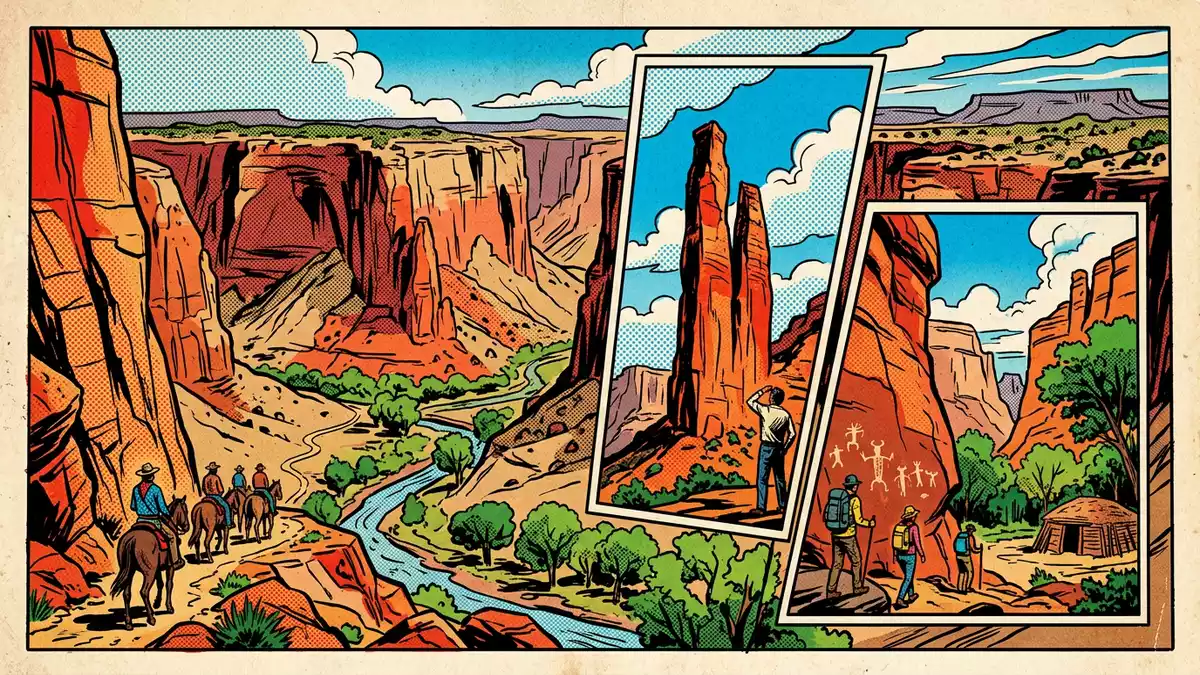
Canyon de Chelly near Chinle in northeastern Arizona is a sandstone canyon system where vertical rock walls rise above cultivated valley floors and long-inhabited homesteads.
Sandstone walls shaped over deep time
The rock record in Canyon de Chelly spans hundreds of millions of years of geological history in the rocks exposed along its cliffs.geologic resources inventory The oldest layers belong to the Supai Formation, a sequence of maroon sandstone, siltstone and mudstone deposited during the Pennsylvanian and early Permian periods.Supai Formation description
Above the Supai beds lies De Chelly Sandstone, a light red unit formed from desert sand dunes during the Permian period, followed by Triassic strata of the Chinle Formation represented by stream-deposited gravels and finer sediments.Permian and Triassic strata Regional uplift associated with structures such as the Defiance Uplift increased stream gradients and water cut the present canyon system into these layered rocks, leaving vertical sandstone corridors that frame the valley floors.sandstone corridors near Chinle
A long-inhabited landscape on Navajo land
Canyon de Chelly is designated as Canyon de Chelly National Monument and lies entirely on Navajo Tribal Trust Land, managed jointly by the Navajo Nation and the National Park Service.Navajo Tribal Trust Land The monument, covering around 83,840 acres (approximately 339 km²), preserves a landscape with a history of Indigenous habitation dating back several thousand years.monument area and setting
Families live and farm on the canyon floors where streams, cultivated fields and traditional structures sit beneath the sandstone escarpments.Navajo families in the canyon The monument encompasses several main branches, including the canyon known as Canyon de Chelly itself along with Canyon del Muerto and Monument Canyon, each with its own mix of sheer walls and valley bottom.
Approaching the canyon from Chinle
The national monument lies on the outskirts of Chinle in Apache County in northeastern Arizona.field guide location note The recommended driving route reaches the park by following Highway 191 to Chinle and turning east on Indian Route 7, where the entrance and Welcome Center stand a short distance from the junction.recommended driving route
From the rim, visitors encounter a series of overlooks along drives on both sides of the canyon, providing views down to cultivated fields, sandstone walls and freestanding rock pillars.
Visiting Canyon de Chelly: what travellers from Western Europe should know
- The monument lies east of Chinle in northeastern Arizona, reached by road via Highway 191 and Indian Route 7, where the entrance road leads towards the canyon area.
- The rim drives follow the edges of the canyon and their viewpoints look down onto steep sandstone walls and valley floors, with short walks from parking areas to fenced overlooks.
- The interior canyon floors combine unpaved tracks, cultivated parcels and stream beds, and a guided vehicle tour with a Navajo guide provides access to these corridors.
- The official language is English and the currency is the United States dollar.
- Entry requirements depend on your nationality; UK travellers can check the FCDO travel advice at gov.uk/foreign-travel-advice, Irish travellers the Department of Foreign Affairs at ireland.ie.
Searching for Canyon de Chelly on social platforms
These links open searches for Canyon de Chelly on each platform.
Frequently asked questions about Canyon de Chelly
Where is Canyon de Chelly located?
Canyon de Chelly National Monument lies near Chinle in Apache County in northeastern Arizona on Navajo Tribal Trust Land.
What should visitors expect on a first visit?
Visitors encounter rim drives with viewpoints above steep sandstone corridors and, with authorised guides, vehicle access to valley floors where Navajo homesteads stand beneath the cliffs.
What makes Canyon de Chelly distinctive among canyon landscapes?
Canyon de Chelly combines tall sandstone walls carved into Permian and Triassic rock with long-inhabited valley floors where contemporary Navajo life and ancient sites share the same corridors.


