
Burj Al Arab and its sail-shaped tower off Jumeirah Beach
Published on 09/15/2026 at 16:42 | Editorial responsibility: Rafael Müller, Editor-in-Chief AD HOC NEWS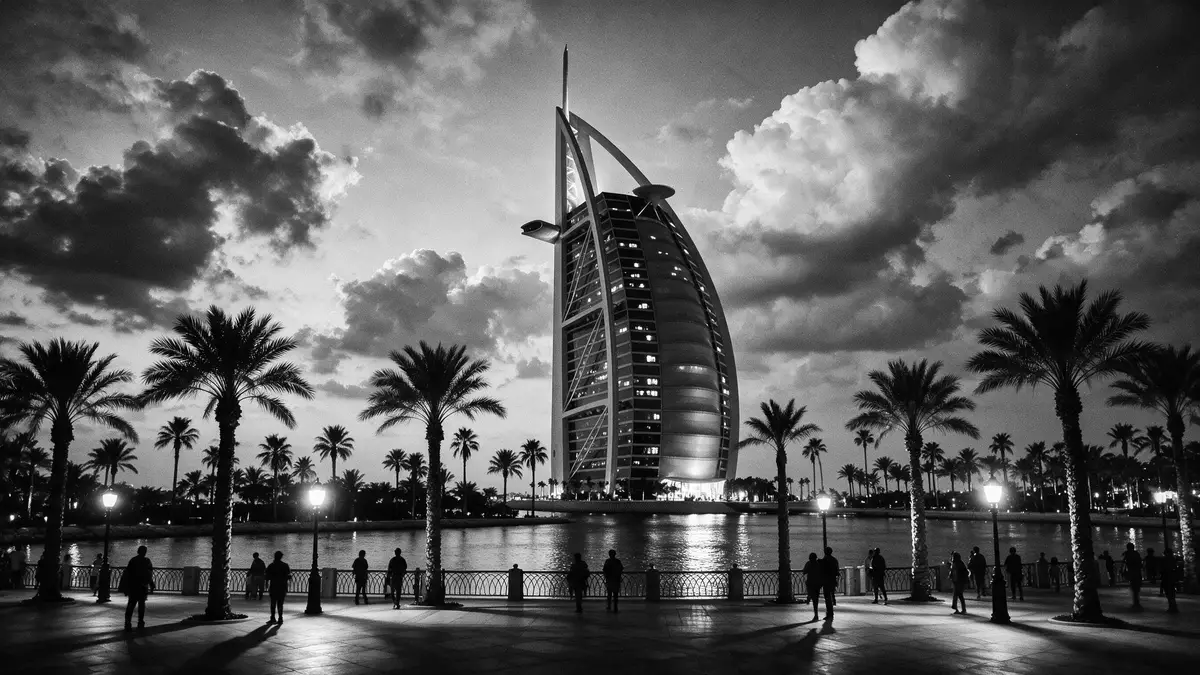
Burj Al Arab stands offshore from Dubai’s Jumeirah Beach as a sail-shaped tower rising from a man-made island, a luxury hotel completed in 1999 under British architect Tom Wright. Reaching an architectural height of 321 m (1,053 ft), it has become a permanent marker of Dubai’s late twentieth-century push towards high-rise waterfront development along the Arabian Gulf.
A sail on an artificial island in the Gulf
Burj Al Arab is located in Dubai in the United Arab Emirates, set on an artificial island constructed off the low shoreline of Jumeirah Beach and linked to the mainland by a private bridge for vehicles.artificial island about 280 metres offshore From the shore, the tower appears to rise directly out of the sea, with the island platform forming a broad base just above the waterline.
The hotel’s form was shaped to evoke the sail of an Arabian dhow, a traditional boat of the Gulf, with a single sweeping profile facing out towards open water.resembles the billowing sail of a dhow The building reaches 321 m (1,053 ft) from the island platform to the top of its structural mast, placing it among the tallest hotels constructed so far and giving it a clear frame against the relatively low coastal cityscape.architectural height of 321 m
Late twentieth-century hotel engineering
Planning and construction of Burj Al Arab took place in the 1990s, with work on the tower beginning in 1994 and the hotel opening to guests on 1 December 1999.construction between 1994 and 1999 The project was developed by the British consultancy Atkins, with architect Tom Wright leading the design team, and the structure is frequently described in engineering literature as an example of structural expressionism in high-rise hotel design.Tom Wright of WS Atkins
The tower rises to around 56 floors above the island platform and includes additional levels below, with its interior planned around large suites arranged over two storeys rather than conventional single-level rooms.56 above ground floors The structure sits on its artificial island some distance offshore from Jumeirah Beach, and the approach from the mainland follows a curving bridge that leads directly to the base of the hotel, where vehicle access meets external terraces and entrance levels.
The sail-shaped silhouette and interior atrium
The most striking feature of Burj Al Arab is its sail-shaped silhouette, formed by two broad wings that flare outward from a central spine and then converge, enclosing a tall void that contains the hotel’s atrium and circulation spaces.two sweeping wings around a central void Within this space, the atrium extends upwards for around 180 m, making it one of the tallest interior atriums among hotel buildings and a defining element of the tower’s internal experience.height of approximately 180 metres
The building’s sail profile is supported by a concrete and steel frame, clad in glass and other façade materials that catch the strong Gulf light and mark the tower out from the lower buildings along the shore.sail-shaped silhouette rising 321 metres Inside, the suites are arranged along the edges of the atrium, with internal balconies and corridors overlooking the central space and lifts linking the multiple levels from the base on the island platform to the higher floors.
Visiting Burj Al Arab: what travellers from Western Europe should know
- Burj Al Arab stands on a man-made island off Jumeirah Beach in Dubai, reached by a private bridge for vehicles from the mainland, with the tower visible from the coastal road.
- The approach from the bridge leads to the island platform at sea level, and travellers encounter steps and lifts between outdoor areas, entrance levels and the higher interior floors.
- The hotel faces out towards the Arabian Gulf, and the surrounding seafront is low and open, so weather on the coast can influence conditions on external terraces and exposed walkways.
- The official language of the United Arab Emirates is Arabic and the currency is the UAE dirham.
- Entry requirements depend on your nationality; UK travellers can check the FCDO travel advice at gov.uk/foreign-travel-advice, Irish travellers the Department of Foreign Affairs at ireland.ie.
Searching for Burj Al Arab on social platforms
These links open searches for Burj Al Arab on each platform.Frequently asked questions about Burj Al Arab
Where is Burj Al Arab located?
Burj Al Arab stands on an artificial island off Jumeirah Beach in Dubai in the United Arab Emirates, linked to the mainland by a private bridge for vehicles.
What can travellers expect when visiting?
Travellers approach Burj Al Arab by road across the bridge, arriving at the island platform at sea level, with steps, lifts and internal corridors connecting exterior terraces and interior floors.
What makes Burj Al Arab distinctive as a hotel building?
Burj Al Arab combines a sail-shaped silhouette rising 321 m (1,053 ft) from an offshore island with a very tall interior atrium and suites arranged on multiple levels around the central space.


