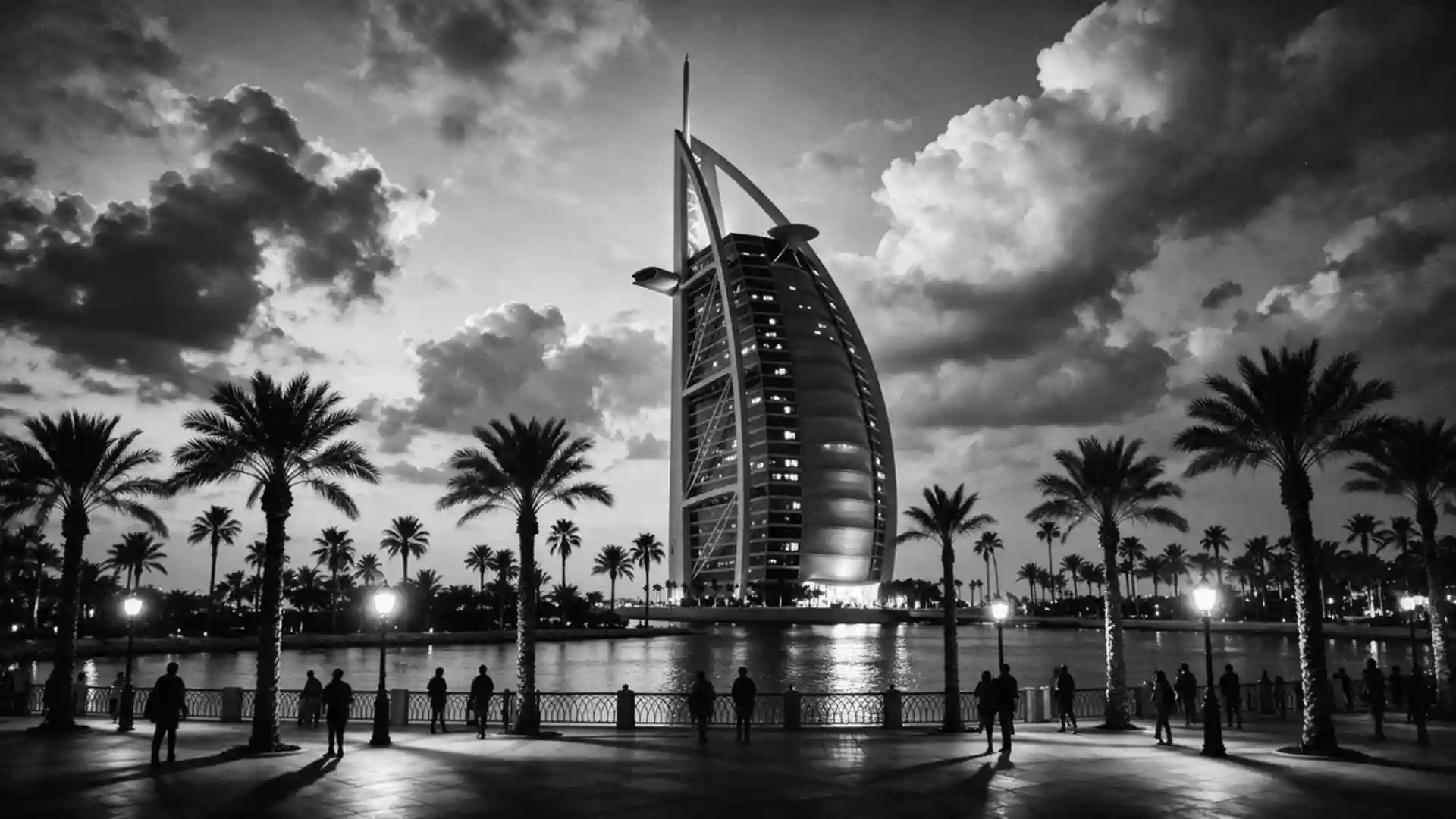
Burj Al Arab and its sail-shaped tower on the Gulf
Published on 09/11/2026 at 12:03 | Editorial responsibility: Rafael Müller, Editor-in-Chief AD HOC NEWS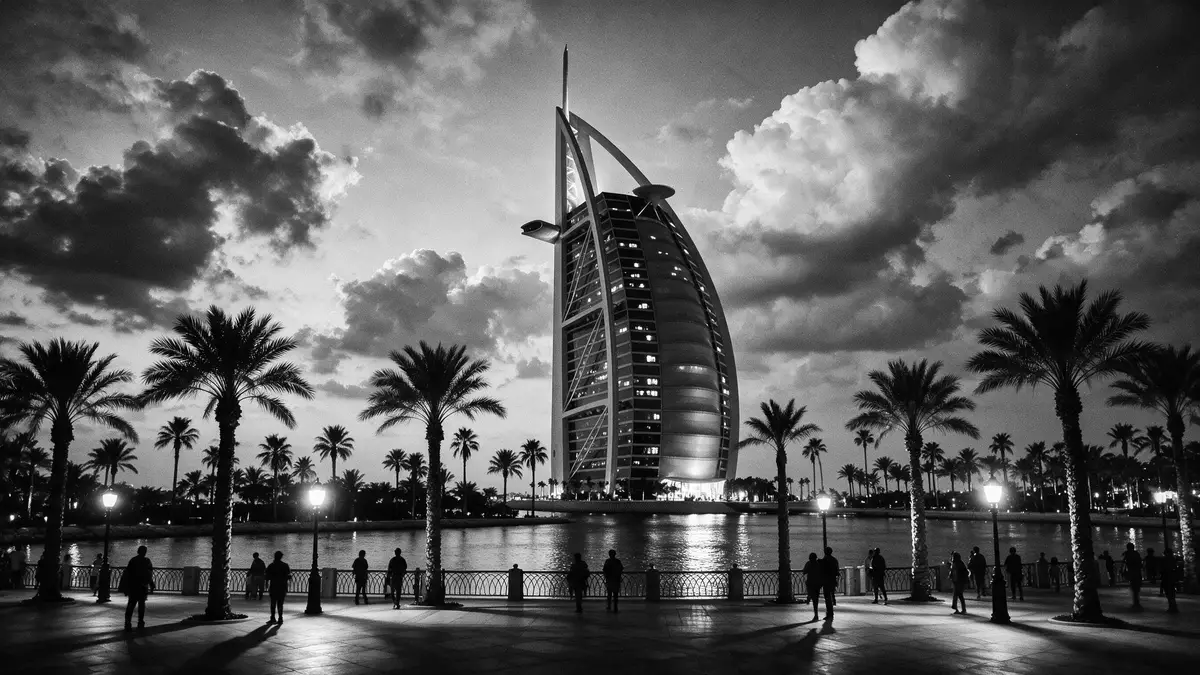
Burj Al Arab is a luxury hotel standing on an artificial island off Dubai’s Jumeirah coastline, its sail-like tower rising above the waters of the Arabian Gulf. Completed in 1999 and designed by British architect Tom Wright, the building has become one of the most recognisable structures associated with Dubai’s waterfront.
A sail-shaped hotel rising from the sea
The defining impression of Burj Al Arab is its profile: a tall white tower whose outline recalls the taut curve of a sail rising from a narrow island platform in the Gulf. At an architectural height of 321 m (1,053 ft), the hotel is among the tallest buildings used entirely as a hotel, giving it a commanding presence on the low shoreline of Jumeirah.321 m (1,053 ft) The building’s form consists of two sweeping wings that flare outward from a central spine and then converge, enclosing a vast volume of space at the centre. Inside, that volume is occupied by an atrium rising through many levels, creating a continuous vertical interior that extends across the height of the hotel.two wings enclose space
Burj Al Arab stands on a man-made island set some distance offshore from Jumeirah Beach, linked to Dubai’s mainland by a curving private bridge for vehicles.man-made island 280 metres offshore From the shore, the tower appears to rise directly out of the sea, with the low island platform forming a base just above the waterline. The overall composition makes the hotel read as a single object in the Gulf rather than part of a continuous row of buildings, emphasising its separation from the coastline by the surrounding water.
Engineering a superstructure on an artificial island
The decision to place Burj Al Arab offshore required substantial engineering to create and secure the artificial island before construction of the tower could begin.constructed on a man-made island The island rests on piles driven deep into the seabed, forming a foundation designed to deal with the surrounding sand and water. Above this base, the main structure of the hotel combines reinforced concrete with structural steel, with the two principal wings forming a broad V-shaped arrangement when seen in plan.hybrid V shape structure The wings are tied back to a central concrete core that houses vertical circulation and services, creating a rigid frame for the building.
One of the striking external elements is the large steel structure projecting from the upper part of the tower on one side, supported by a cantilevered truss system connected to the core.cantilevered steel truss system The hotel’s outer surface is clad in a membrane of Teflon-coated fibreglass, which gives the sail-like facade a smooth, bright appearance against the Gulf’s light.Teflon-coated fiberglass membrane Seen from a distance, the tall white surface of this cladding forms a backdrop to the structural elements that frame it, including the slender diagonal members that define the outer edges of the sail form.
A late twentieth-century landmark of Dubai’s waterfront
Burj Al Arab was designed in the early 1990s and opened to guests on 1 December 1999, placing it firmly in the late twentieth-century phase of Dubai’s rapid coastal development.doors officially opened on 1 December 1999 The project was developed by the British consultancy Atkins, with Tom Wright leading the architectural design, and the building’s height and offshore position quickly made it a visual marker along the Gulf shore.project developed by Atkins As a luxury hotel, Burj Al Arab offers suites arranged on multiple levels rather than conventional rooms, with the split-level approach contributing to the building’s tall profile.
The atrium occupying the central space between the two wings rises through dozens of storeys and has been described in engineering documentation as reaching around 180 m in height, forming one of the tallest enclosed hotel atria constructed.largest atrium standing about 180m From the base level, the view upwards follows the layered balconies and interior surfaces of the suites along the sides, all set back behind the outer structure. This vertical interior emphasises the building’s height as much as its exterior sail profile, making the experience of its scale part of the hotel’s character.
Visiting Burj Al Arab: what travellers from Western Europe should know
- Burj Al Arab stands on an artificial island off Jumeirah Beach in Dubai in the United Arab Emirates, reached by a private bridge for vehicles from the mainland.
- The hotel rises to 321 m (1,053 ft), and access from the bridge leads to the island platform at sea level, so visitors encounter steps and lifts between outdoor areas and interior levels.
- Burj Al Arab lies south of central Dubai along the Gulf shoreline; major city roads run towards the Jumeirah coastal district, and the island itself is clearly signposted locally.
- The official language is Arabic and the currency is the United Arab Emirates dirham.
- Entry requirements depend on your nationality; UK travellers can check the FCDO travel advice at gov.uk/foreign-travel-advice, Irish travellers the Department of Foreign Affairs at ireland.ie.
Searching for Burj Al Arab on social platforms
These links open searches for Burj Al Arab on each platform.
Frequently asked questions about Burj Al Arab
Where is Burj Al Arab located?
Burj Al Arab is in Dubai in the United Arab Emirates, standing on an artificial island just off Jumeirah Beach and connected to the mainland by a private bridge.
What can visitors expect when approaching the hotel?
Visitors arrive along the curving bridge from the shore, crossing the water to reach the island platform at the base of the tall sail-shaped tower before entering the interior.
What makes Burj Al Arab distinctive among hotels?
Its combination of a 321 m (1,053 ft) offshore tower, sail-like silhouette, central atrium spanning many storeys and artificial island setting gives Burj Al Arab a specific role on Dubai’s Gulf skyline.