
Bukchon Hanok Maeul and the tiled roofs of Seoul
Published on 09/15/2026 at 21:00 | Editorial responsibility: Rafael Müller, Editor-in-Chief AD HOC NEWS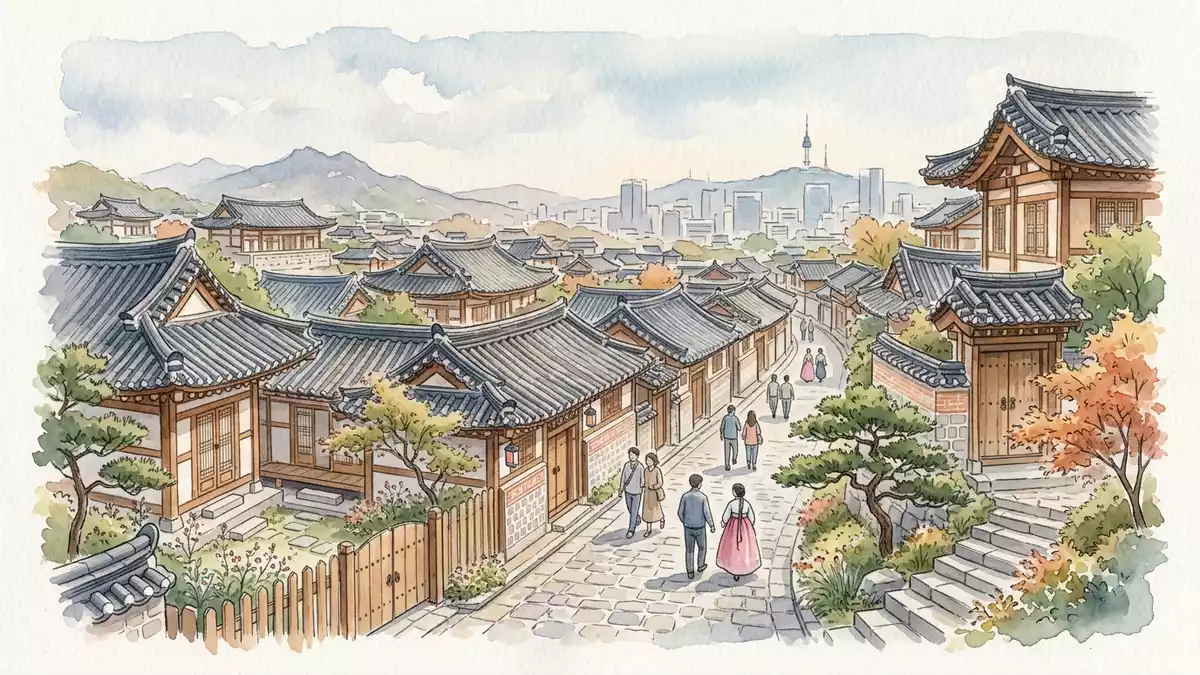
Bukchon Hanok Maeul is a hanok district in Jongno-gu, Seoul, set on the hill between Gyeongbokgung Palace and Changdeokgung Palace. Its timber houses, grey tiled roofs and narrow lanes give the area a distinct residential rhythm.
Bukchon Hanok Maeul between the palaces
The district sits in central Seoul, north of Cheonggyecheon and close to Jongno. Its position links the old royal quarter with streets that remain closely tied to everyday city life.central Seoul
Bukchon is closely associated with the Joseon dynasty, which ruled Korea from 1392 to 1910. The district’s hanok form a dense residential fabric rather than a single monumental building, and that gives it its character.Joseon dynasty
Hanok streets and timber houses
Hanok in Bukchon are traditionally built with wooden frames, tiled roofs and enclosed courtyards. Their low profiles and close spacing create long street views of repeating rooflines and walls.traditional hanok houses
The district is also tied to Seoul’s wider hanok conservation story. Its surviving streets show how domestic architecture can remain part of a living city rather than a sealed museum quarter.conservation district
Seoul’s historic residential quarter
Bukchon is one of the clearest surviving examples of Seoul’s older residential fabric. It connects the city’s palace district with a neighbourhood scale of lanes, walls and house plots that remain easy to read on foot.
The name Bukchon means “northern village”, pointing to its location north of Cheonggyecheon. That geographic name suits a place defined by its place in the city as much as by its buildings.northern village
Visiting Bukchon Hanok Maeul: what travellers from Western Europe should know
- The district lies in Jongno-gu in Seoul, between Gyeongbokgung Palace and Changdeokgung Palace. Anguk Station on Line 3 is the usual rail reference point.
- The streets rise over a hillside and include steps and sloping lanes. Comfortable footwear is useful for the steeper passages.
- The area is a residential neighbourhood as well as a heritage district. Respect for homes and doorways matters throughout the lanes.
- The official language is Korean and the currency is the South Korean won.
- Entry requirements depend on your nationality; UK travellers can check the FCDO travel advice at gov.uk/foreign-travel-advice, Irish travellers the Department of Foreign Affairs at ireland.ie.
Searching for Bukchon Hanok Maeul on social platforms
These links open searches for Bukchon Hanok Maeul on each platform.
Frequently asked questions about Bukchon Hanok Maeul
Where is Bukchon Hanok Maeul?
It is in Jongno-gu, central Seoul, between Gyeongbokgung Palace and Changdeokgung Palace. The neighbourhood sits north of Cheonggyecheon.
What does a visit involve?
Expect a hillside district with lanes, steps and traditional houses. It is a lived-in neighbourhood, so the streets feel residential rather than staged.
What makes it distinctive?
Bukchon combines hanok, palace-side location and a strong urban grain in one compact area. The repeated tiled roofs and enclosed house plots make that clear at street level.


