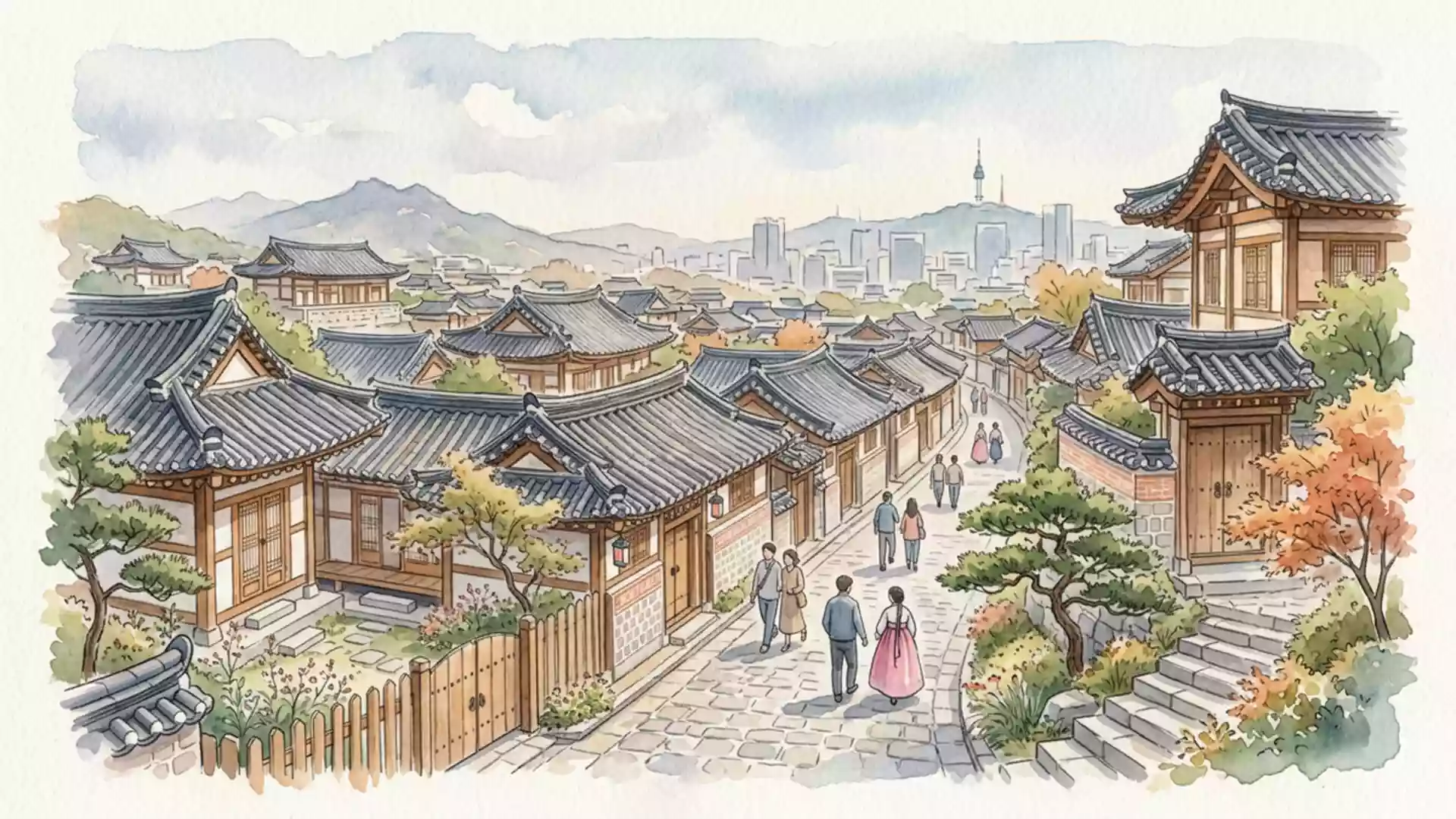
Bukchon Hanok Maeul between Seoul’s royal palaces
Published on 09/09/2026 at 19:16 | Editorial responsibility: Rafael Müller, Editor-in-Chief AD HOC NEWS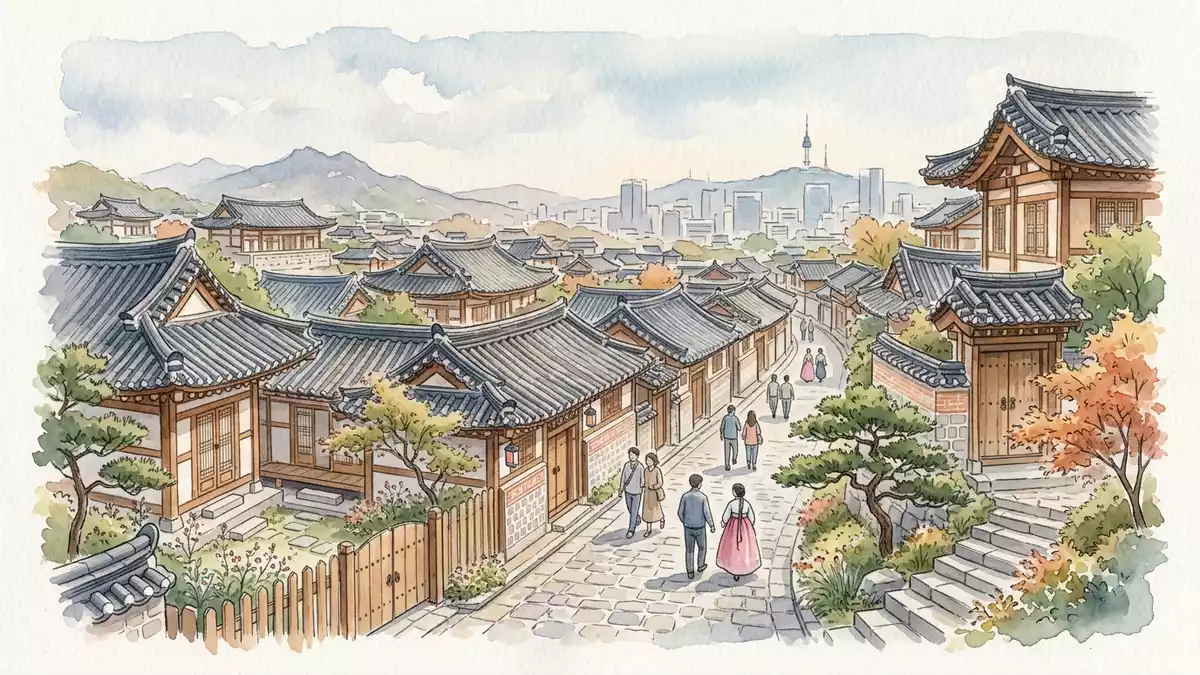
Bukchon Hanok Maeul in Seoul is a historic neighbourhood of traditional Korean houses on the slopes between Gyeongbokgung and Changdeokgung palaces, where tiled roofs still follow lines set in the Joseon dynasty.Surrounded by royal palaces and Jongmyo Shrine, the area preserves a dense patch of timber-framed hanok embedded inside Seoul’s central Jongno-gu district.The neighbourhood sits on a hillside between the city’s two most important royal palaces
Hanok roofs and courtyards on the northern hill
The name Bukchon, meaning “northern village”, refers to the quarter’s position north of Cheonggyecheon stream and Jongno, on ground that rises into a corridor between palace walls.The name came about because the neighbourhood lies north of Cheonggyecheon and Jongno Timber posts and beams rest on stone foundations, with clay walls and tiled roofs giving the streets a continuous low skyline that is rare inside a major capital city.The houses are built according to traditional Korean principles with wooden frames, tiled roofs and interior courtyards
Hanok in Bukchon are arranged around inner courts, or madang, which sit behind gates along the stepped lanes and hold light and domestic space at the centre of the home.Interior courtyards bring light and air into the rooms Many houses keep wooden floors and paper-lined doors, while alterations add glass panels and modern fittings alongside older timber and tile.Bukchon’s hanok were renovated with new materials such as glass doors and extended eaves
From Joseon noble quarter to conserved urban village
Bukchon’s identity as a residential quarter dates back to the Joseon dynasty, when Seoul became the capital of a unified Korean kingdom in 1392 and remained so until 1910.Black tile roofs gather where nobles lived between Gyeongbokgung and Changdeokgung in the Joseon Dynasty The area housed members of the yangban elite, a scholar-official class whose proximity to the palaces reflected its place in court life.The quarter was traditionally home to high-ranking government officials and nobility
In the early twentieth century housing companies bought land across Bukchon and laid out standardised hanok that answered the new urban grid, giving today’s streets their shoulder-to-shoulder pattern of roofs.Housing management firms built groups of medium-sized hanok in the 1930s, creating the current dense residential areas Later conservation projects by Jongno-gu and Seoul Metropolitan Government recognised the architectural value of these houses and put zoning and regeneration schemes in place to keep the neighbourhood’s timber and tile fabric largely intact.Urban regeneration initiatives treated Bukchon as a historic neighbourhood and protected its hanok
Walking Bukchon’s lanes between palaces
Walking through Bukchon Hanok Maeul means moving along narrow, sloping streets where hanok stand close to one another, their rooflines stepping with the hill and framing views towards both royal compounds.The neighbourhood sits on a hillside between Gyeongbokgung to the west and Changdeokgung to the east Small side alleys branch off the main lanes, leading to clusters of courtyard houses, local workshops and cultural spaces that occupy converted hanok.
Many buildings continue to serve as residences, while others host guesthouses, cultural centres, restaurants and tea houses that introduce visitors to traditional interiors and domestic layouts.Hanok in Bukchon now operate as cultural centres, guesthouses, restaurants and tea houses The proximity to Gyeongbokgung, Changdeokgung and Jongmyo Shrine means views across palace walls and temple roofs are part of any walk, linking the residential architecture with the ceremonial and dynastic structures that shaped the city.Bukchon is surrounded by the two palaces and Jongmyo Shrine
Visiting Bukchon Hanok Maeul: what travellers from Western Europe should know
- Bukchon Hanok Maeul lies in Jongno-gu in central Seoul, on the hillside between Gyeongbokgung Palace and Changdeokgung Palace, north of Cheonggyecheon stream and Jongno.
- The streets rise and fall across the slope, and several routes involve staircases and inclines, so exploring the lanes requires steady walking on paved but sometimes steep ground.
- Bus and metro lines in central Seoul serve Gyeongbokgung and Anguk stations, from which the hanok quarter is reached on foot through side streets and alleyways.
- Nearby landmarks include Gyeongbokgung Palace to the west, Changdeokgung Palace to the east and Jongmyo Shrine to the south, all within walking distance of the hanok neighbourhood.
- The official language is Korean and the currency is the South Korean won; entry requirements depend on your nationality, UK travellers can check the FCDO travel advice at gov.uk/foreign-travel-advice, Irish travellers the Department of Foreign Affairs at ireland.ie.
Searching for Bukchon Hanok Maeul on social platforms
These links open searches for Bukchon Hanok Maeul on each platform.Frequently asked questions about Bukchon Hanok Maeul
Where is Bukchon Hanok Maeul in Seoul?
Bukchon Hanok Maeul is in Jongno-gu in central Seoul, on hillside streets between Gyeongbokgung Palace and Changdeokgung Palace, north of Cheonggyecheon stream and Jongno.
What can visitors expect on a walk through Bukchon Hanok Maeul?
Visitors encounter sloping lanes lined with hanok houses, inner courtyards behind gates and views towards nearby palaces and Jongmyo Shrine as the streets rise and turn.
What makes Bukchon Hanok Maeul distinctive among Seoul neighbourhoods?
It combines a large concentration of timber-framed hanok from the Joseon period with conserved twentieth-century urban layouts, all between two major royal palaces.