
Basilique Notre-Dame de Montreal and its neo-Gothic glow over Place d’Armes
Published on 09/22/2026 at 02:50 | Editorial responsibility: Rafael Müller, Editor-in-Chief AD HOC NEWS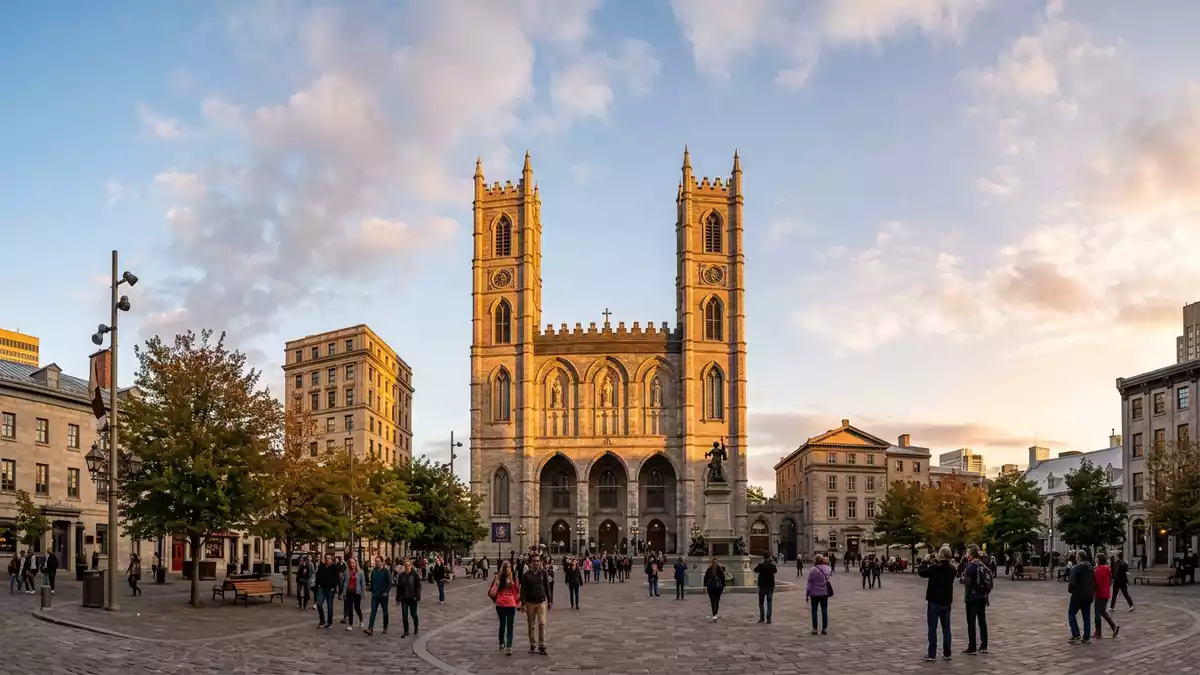
Basilique Notre-Dame de Montreal stands on Notre-Dame Street in Old Montreal, facing Place d’Armes with a broad stone front and twin towers that define the square. Built as a nineteenth-century parish church in the Gothic Revival style and consecrated in 1829, it later became a minor basilica and remains Montreal’s mother church within the Catholic tradition.
A Gothic Revival landmark in stone
The basilica’s exterior is a study in nineteenth-century Gothic Revival, rendered in grey stone and laid out as a large rectangular volume with a tower at each side of the main façade. James O’Donnell, an Irish-born architect based in New York, submitted his design for a Gothic-style church in 1823 and saw construction begin in 1824, giving Montreal a stone building whose pointed arches and vertical lines echoed medieval models.James O’Donnell’s Gothic proposal The main mass of the church was completed and consecrated in 1829, marking the end of a building phase that changed the scale of parish worship in the city.construction from 1824 to 1829
The façade draws inspiration from European churches, combining its twin towers with a central front pierced by large openings and framed by buttress-like vertical elements. Contemporary descriptions link the design to the towers of Notre-Dame de Paris and the Church of Saint-Sulpice, set here against the narrower street grid of Old Montreal.inspiration from Parisian churches In its completed form the church became the first major example of the Gothic Revival style in Canada and, for a time during the nineteenth century, ranked among the largest places of worship in North America.
From early parish church to mother church
The site carries a longer parish history that reaches back to the seventeenth century, when the growing settlement of Ville-Marie was served by earlier churches along what became Notre-Dame Street. A baroque-style parish church designed by Sulpician priest François Dollier de Casson stood here in the late seventeenth century, before the decision in the early nineteenth century to build a larger stone church for an expanding city.seventeenth-century parish origins The nineteenth-century basilica emerged from that parish, replacing its predecessor while preserving the continuity of Catholic worship on the street.
In ecclesiastical terms Basilique Notre-Dame de Montreal is recognised as Montreal’s mother church and as the first Gothic Revival church in Canada, a status tied to its role in the city’s religious life and to the architectural step it represented.mother church and first Gothic Revival church Its standing was further marked in the twentieth century, when it was raised to the rank of minor basilica in 1982 and later recognised as a National Historic Site of Canada in 1989, placing it within national frameworks of heritage protection.minor basilica and National Historic Site designations
An intensely coloured neo-Gothic interior
Stepping inside Basilique Notre-Dame de Montreal reveals a contrast between the comparatively sober exterior and an interior transformed during the second half of the nineteenth century. The original décor by James O’Donnell was relatively plain, and under pastor Benjamin-Victor Rousselot the parish commissioned Montreal architect Victor Bourgeau to redesign the interior in a more elaborate neo-Gothic idiom.Victor Bourgeau’s interior redesign From around 1870 into the late nineteenth century, Bourgeau and Rousselot worked on a programme inspired in part by Sainte-Chapelle in Paris, introducing carved woodwork, colour and rich detailing across the nave, sanctuary and chapels.
The result is an interior whose vaults and columns are covered with blue tones, gold-leaf motifs and figurative sculpture arranged within a neo-Gothic framework. Altarpieces and side chapels integrate religious iconography with architectural elements, while the ceiling carries decorative patterns that emphasise the length of the nave. Alongside the main body of the church stands the chapel of Notre-Dame-du-Sacré-Cœur, which forms part of the basilica ensemble and presents a more modern architectural treatment within the same complex.chapel of Notre-Dame-du-Sacré-Cœur
Visiting Basilique Notre-Dame de Montreal: what travellers from Western Europe should know
- Basilique Notre-Dame de Montreal stands on Notre-Dame Street West, facing Place d’Armes in the historic Old Montreal district, with the Saint-Sulpice Seminary nearby.
- The basilica’s interior is reached from street level by an entrance that leads directly into the nave, with further circulation through aisles and towards the chapel complex.
- Montreal is in Canada; the official languages are French and English and the currency is the Canadian dollar.
- Entry requirements depend on your nationality; UK travellers can check the FCDO travel advice at gov.uk/foreign-travel-advice, Irish travellers the Department of Foreign Affairs at ireland.ie.
Searching for Basilique Notre-Dame de Montreal on social platforms
These links open searches for Basilique Notre-Dame de Montreal on each platform.
Frequently asked questions about Basilique Notre-Dame de Montreal
Where is Basilique Notre-Dame de Montreal located within Montreal?
The basilica stands on Notre-Dame Street West in Old Montreal, facing Place d’Armes and forming part of a dense ensemble of historic stone buildings.
What can visitors expect inside the basilica?
Visitors encounter a neo-Gothic interior reshaped in the later nineteenth century, with blue vaults, gold-leaf motifs, carved woodwork and a chapel complex integrated into the ensemble.
What makes Basilique Notre-Dame de Montreal distinctive among Canadian churches?
It combines its role as Montreal’s mother church with the status of being the first major Gothic Revival church in Canada and carries minor basilica and National Historic Site designations.


