
Basilique Notre-Dame de Montreal and its celestial blue interior
Published on 09/10/2026 at 12:41 | Editorial responsibility: Rafael Müller, Editor-in-Chief AD HOC NEWS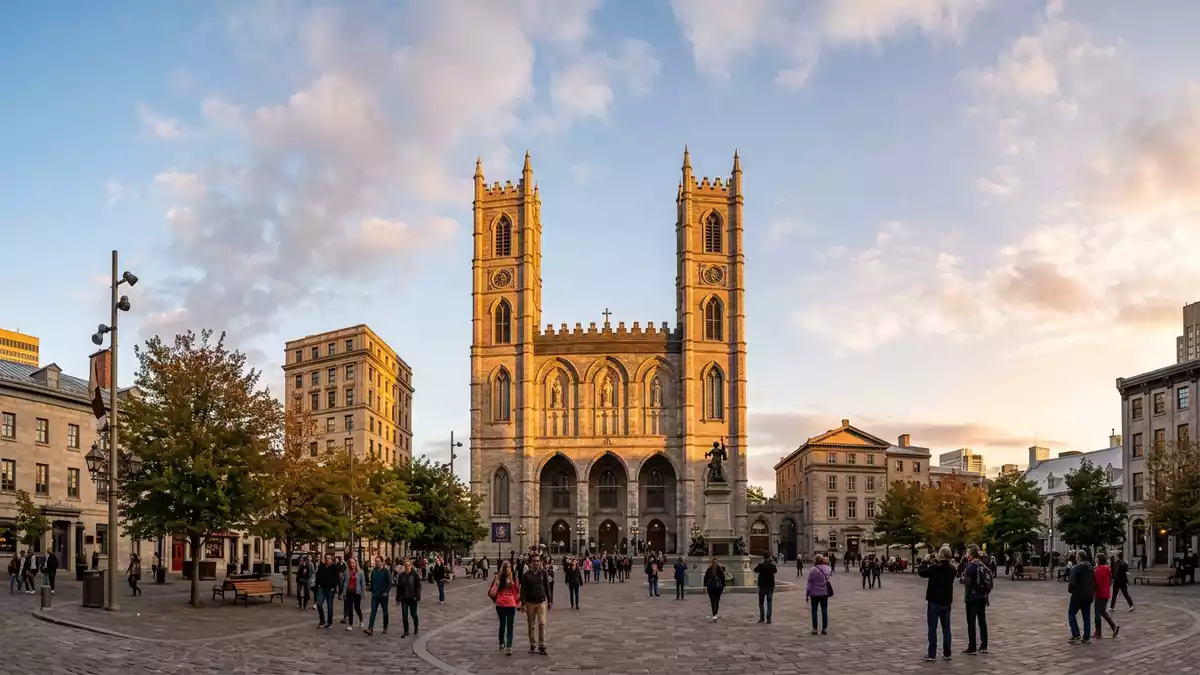
Basilique Notre-Dame de Montreal stands on Place d’Armes in the historic centre of Montreal, a Gothic Revival stone church whose restrained exterior conceals an interior of deep-blue vaults and gold-leaf stars. Built in the nineteenth century as the city’s principal Catholic parish church and later recognised as a National Historic Site of Canada, it anchors the story of Montreal’s growth from a colonial town to a major North American city.National Historic Site of Canada
A Gothic Revival landmark shaped by James O’Donnell
The present basilica dates to the nineteenth century and is the work of Irish-born New York architect James O’Donnell, who was commissioned in the early 1820s to design a new parish church in the Gothic Revival style.Irish-born New York architect James O’Donnell Construction began in 1824 and the main structure was completed and consecrated in 1829, giving Montreal an ambitious stone church at a time when the city’s population was expanding rapidly.Construction began in 1824
The exterior presents a broad facade in grey Montreal limestone with massive twin bell towers and pointed Gothic arches arranged in a symmetrical, rectilinear composition.Massive twin bell towers and pointed arches O’Donnell drew inspiration from European precedents such as Notre-Dame de Paris and the Church of Saint-Sulpice, translating their towered west fronts into a North American context with a stone structure that could accommodate large congregations.inspired by Notre-Dame de Paris and Saint-Sulpice
From sober nave to celestial blue and gold
Inside, the basilica’s appearance changed markedly during the second half of the nineteenth century, when Montreal architect Victor Bourgeau was commissioned to redesign the decor in a neo-Gothic idiom that contrasted with the earlier, plainer interior.Victor Bourgeau redesign Renovation work began in the 1870s and stretched into the 1880s, reshaping the vaults, columns, sanctuary and chapels with carved wood, vivid colours and religious symbolism.neo-Gothic architecture and decor phases
One of the most striking elements of Bourgeau’s programme is the deep-blue ceiling of the nave, scattered with gold-leaf stars that create the impression of a celestial canopy above the congregation.deep-blue vaulted ceiling with gold-leaf stars The sanctuary at the east end is framed in carved walnut, designed as part of the nineteenth-century redecoration and populated with statues, pinnacles and traceried panelling that echo medieval Gothic forms in a North American setting.carved-walnut sanctuary Around the nave, stained-glass windows illustrate episodes from Montreal’s own parish history alongside biblical scenes, linking the basilica’s architecture to the narrative of the city.paintings, sculptures and stained glass
Organ, chapels and heritage status
High at the west end of the nave, above the main entrance, stands the Casavant Frères pipe organ, installed in 1891 by the Saint-Hyacinthe firm that became a major organ builder across North America.Casavant Frères pipe organ installed in 1891 The instrument is noted for its large number of pipes and technical innovations of the late nineteenth century, and it remains integral to liturgical music and concert life within the basilica.organ with 7,000 pipes
Alongside the principal nave, the basilica complex includes the chapel of Notre-Dame-du-Sacré-Cœur, which forms part of the ensemble while presenting a more modern architectural treatment than the nineteenth-century main interior.chapel of Notre-Dame-du-Sacré-Cœur In 1982 the church was elevated to the rank of minor basilica within the Catholic Church, a recognition that sits alongside its status as Montreal’s mother church and as a designated heritage property in Quebec’s cultural inventory.heritage property in Quebec
Visiting Basilique Notre-Dame de Montreal: what travellers from Western Europe should know
- Basilique Notre-Dame de Montreal stands on Place d’Armes in Old Montreal, a short walk inland from the St Lawrence River and near the headquarters of the former Saint-Sulpice Seminary.
- The interior involves moving between levels on staircases and through aisles lined with pews and chapels, and visitors who wish to explore upper galleries encounter additional flights of steps.
- Montreal is in Canada, where the official languages are French and English and the national currency is the Canadian dollar.
- Entry requirements depend on your nationality; UK travellers can check the FCDO travel advice at gov.uk/foreign-travel-advice, Irish travellers the Department of Foreign Affairs at ireland.ie.
Searching for Basilique Notre-Dame de Montreal on social platforms
These links open searches for Basilique Notre-Dame de Montreal on each platform.
Frequently asked questions about Basilique Notre-Dame de Montreal
Where is Basilique Notre-Dame de Montreal located?
Basilique Notre-Dame de Montreal is located on Place d’Armes in Old Montreal, in the province of Quebec in eastern Canada.
What should visitors expect inside the basilica?
Visitors encounter a neo-Gothic interior with a deep-blue vaulted ceiling, gold-leaf stars, carved woodwork, stained glass and a large Casavant Frères pipe organ.
What makes Basilique Notre-Dame de Montreal distinctive among Canadian churches?
It is recognised as Montreal’s mother church and as Canada’s first major Gothic Revival church, combining a monumental nineteenth-century stone exterior with an intensely coloured interior.


