
Basilica i Temple Expiatori de la Sagrada Familia and its forest of stone
Published on 08/28/2026 at 10:50 | Editorial responsibility: Rafael Müller, Editor-in-Chief AD HOC NEWS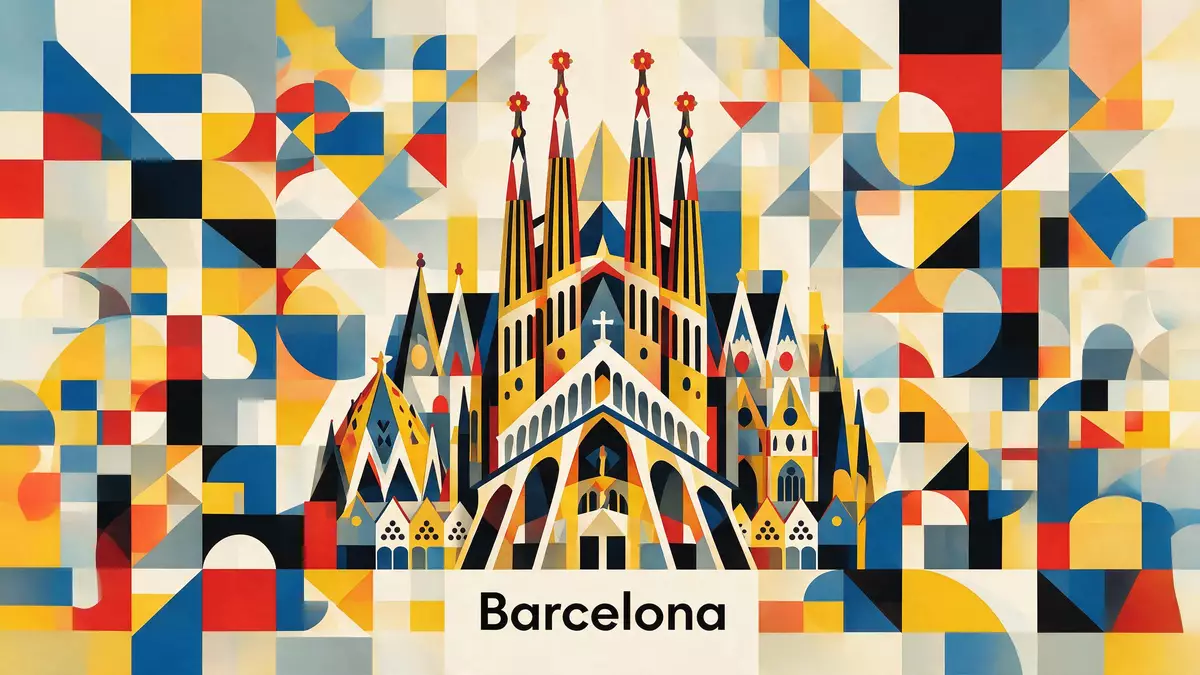
Basilica i Temple Expiatori de la Sagrada Familia is a Roman Catholic basilica in Barcelona, conceived as an expiatory temple and transformed by Antoni Gaudí into a soaring landscape of stone that still climbs above the Eixample district. Groundbreaking for the church took place in 1882, and Gaudí took over the project in 1883, reshaping its design into the experimental structure recognisable today.
A basilica born from nineteenth-century Barcelona
The origins of Basilica i Temple Expiatori de la Sagrada Familia lie in the late nineteenth century, when Barcelona was expanding beyond its old walls and new neighbourhoods were spreading across the Catalan plain. In 1882, construction began under the diocesan architect Francisco de Paula del Villar, whose initial plans followed a neo-Gothic direction with pointed arches and a more conventional church layout.works beginning in 1882 Within a year, Villar resigned, and the commission passed to Antoni Gaudí, a young Catalan architect whose work was already marked by an idiosyncratic approach to structure and ornament.designed by Antoni Gaudí in 1883
Gaudí devoted much of the rest of his life to Basilica i Temple Expiatori de la Sagrada Familia, continually revising models and drawings until his death in 1926. At that time only parts of the church, including sections of the eastern Nativity façade and associated towers, had risen above the streets of Barcelona.at the time of his death in 1926 The Nativity façade and the crypt are now recognised within a wider UNESCO World Heritage listing for Gaudí’s works, underscoring the basilica’s place in the history of Catalan Modernisme.parts of the complex form part of a UNESCO World Heritage Site
Architecture between Gothic revival and Catalan Modernisme
Basilica i Temple Expiatori de la Sagrada Familia stands as Gaudí’s masterwork, weaving together Gothic revival forms, curvilinear Art Nouveau lines and Catalan Modernisme into a single project. The church is laid out as a Latin cross, with a nave, transepts and a raised apse, yet its columns and vaults depart from conventional Gothic geometry, branching and tilting in ways that recall trees and organic growth.Gothic revival, Art Nouveau, Catalan Modernisme The building is constructed largely in stone, with façades articulated by sculptural programmes that narrate episodes from the life of Christ and the Holy Family.
The basilica’s height makes it a landmark on Barcelona’s skyline. With the raising of the central Tower of Jesus Christ, the church has reached a height that gives it the status of the tallest church in the world, a record now associated directly with Basilica i Temple Expiatori de la Sagrada Familia.making the Sagrada Família the tallest church in the world Gaudí intended the principal tower to rise above a group of subsidiary towers, each symbolising elements of Christian faith, so that the ensemble of spires would read as a vertical expression of the creed. The completed and planned towers together form a dense crown of stone, visible from many parts of Barcelona and from the Mediterranean approaches.
Façades, interior and an unfinished work of devotion
Three great façades structure the external perception of Basilica i Temple Expiatori de la Sagrada Familia. On the eastern side, the Nativity façade, designed largely by Gaudí himself, is heavily modelled, with intricate carvings of flora, fauna and biblical scenes, creating an almost topographical surface. On the opposite side, the Passion façade presents the story of the Crucifixion in a more austere sculptural language, reflecting later twentieth-century interpretations of Gaudí’s geometric principles.Nativity and Passion façades A third façade, dedicated to the Glory of Christ, is planned as the principal entrance, facing towards the city.
Inside, the nave of Basilica i Temple Expiatori de la Sagrada Familia is supported by columns that rise and branch like trees, with capitals and vaults configured to distribute loads while evoking a stone forest. Light filters through coloured glass set into tall windows, casting patterns across the floor and the structural elements. The crypt below, where Gaudí is buried, belongs to the earliest phase of the project and forms part of the UNESCO-inscribed portion of the complex.Gaudí is buried in the church's crypt In 2010, Pope Benedict XVI consecrated the church and elevated it to the status of basilica, marking a significant moment in its ecclesiastical life.consecrated basilica by Pope Benedict XVI in 2010
Visiting Basilica i Temple Expiatori de la Sagrada Familia: what travellers from Western Europe should know
- Basilica i Temple Expiatori de la Sagrada Familia stands in Barcelona’s Eixample district, north of the old city; it is reached by the city’s metro network and local buses, which stop near the church.
- The basilica’s interior rises to significant heights, and access to the towers involves narrow staircases and confined passages that require a sure footing and comfort with enclosed spaces.
- The official language is Spanish and Catalan, and the currency is the euro.
Searching for Basilica i Temple Expiatori de la Sagrada Familia on social platforms
These links open searches for Basilica i Temple Expiatori de la Sagrada Familia on each platform.
Frequently asked questions about Basilica i Temple Expiatori de la Sagrada Familia
Where is Basilica i Temple Expiatori de la Sagrada Familia?
Basilica i Temple Expiatori de la Sagrada Familia is in the Eixample district of Barcelona, in north-eastern Spain, a short distance north of the historic centre.
What can visitors expect inside the basilica?
Inside, visitors encounter a nave carried by branching stone columns, coloured light from stained glass windows and access to the crypt, which belongs to the earliest phase of construction.
What makes Basilica i Temple Expiatori de la Sagrada Familia distinctive among churches?
The basilica combines Gothic revival forms with Catalan Modernisme, rises to a height that gives it the tallest-church record and remains an unfinished work defined by Gaudí’s experimental vision.


