
Bagh-e Fin, Kaschan’s walled Persian garden of water and trees
Published on 09/14/2026 at 07:06 | Editorial responsibility: Rafael Müller, Editor-in-Chief AD HOC NEWS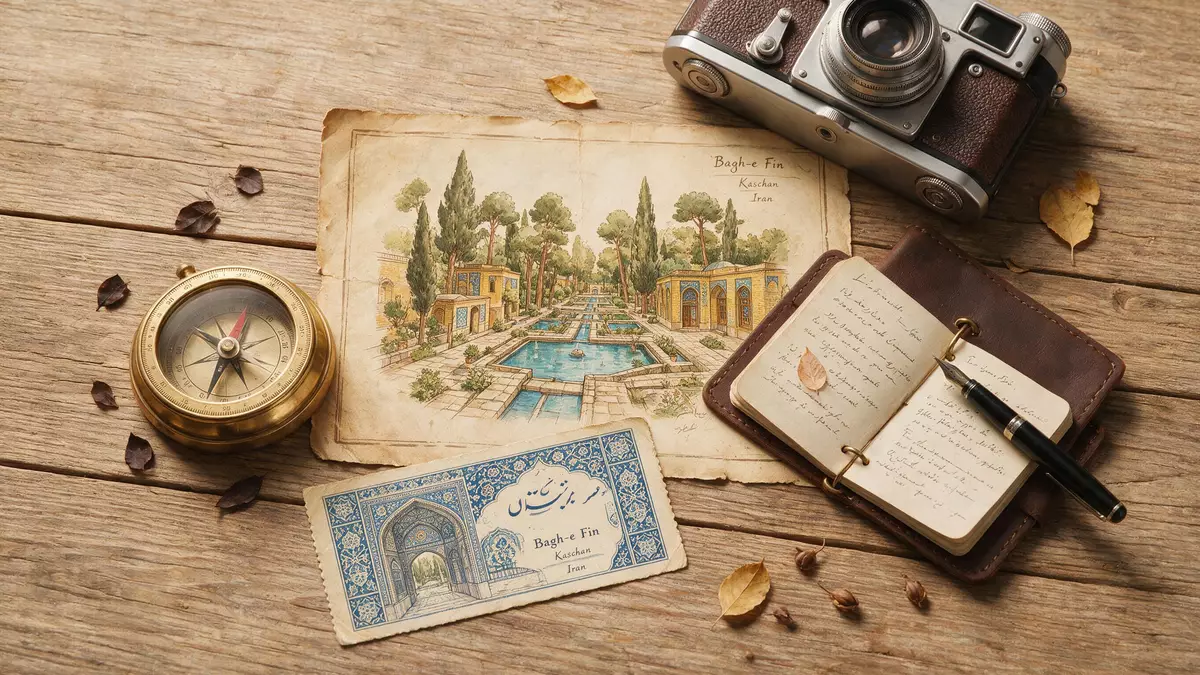
Bagh-e Fin on the south?western edge of Kaschan in Iran is a historic Persian garden where spring water, brick pavilions and tall trees are held within one walled rectangle. Laid out in its present form under Shah Abbas I in the late sixteenth century, it combines Safavid and Qajar structures around a geometric grid of channels and garden plots that has become a reference point for the classical Persian garden.
Water drawn from the desert margin
Bagh-e Fin sits near the Fin suburb outside Kaschan, close to the point where the Soleimaniyeh spring rises at the margin of the central Iranian desert. The garden captures this flow and directs it into a network of channels and basins that run along straight axes, feeding pools and fountains in front of the main pavilions.captures the Soleimaniyeh spring Within the enclosure the contrast between the surrounding semi?arid landscape and the dense planting of trees and hedged plots is immediately visible once visitors pass through the entrance portal.
The overall plan follows the chahar bagh layout, the quadripartite scheme long associated with classical Persian gardens and used in many later sites across Iran. Long channels mark the main axes, crossing near the centre and creating rectangular garden compartments framed by paths and water on several sides.chahar bagh plan Watercourses and basins are set at different levels, so running water appears in successive terraces as it moves away from the spring towards the outer walls.
Safavid walls and Qajar interiors
A garden existed at Fin before the Safavid period, but Bagh-e Fin in its present shape dates to the reign of Shah Abbas I, who ruled from 1588 to 1629 and made Kashan a centre of royal patronage.time of Shah Abbas I The standing structures combine elements from Safavid and Qajar eras, with the outer wall, monumental gateway, central pavilion and an early bathhouse attributed to Safavid construction, and later additions including a larger bathhouse and other service buildings from the Qajar period.Safavid and Qajar periods
The enclosure is defined by high curtain walls punctuated by towers that mark the corners and reinforce the garden’s rectangular outline.high walls and towers Inside, the principal pavilion stands close to the intersection of the main axes, raised above surrounding plots and facing water channels that reflect its arches and brickwork. Smaller buildings, including the two bathhouses associated with different historical phases, occupy positions along the western side, partially screened by trees yet linked to the main paths. Together these structures show how successive dynasties layered their architecture within an established garden frame.
Bagh-e Fin as part of the Persian Garden tradition
Bagh-e Fin is widely recognised as an example of the classical Persian garden, combining water, shade, geometry and enclosure in one planned composition. The garden, completed around 1590, is described as the oldest surviving garden of its type in Iran, and its influence can be traced in later gardens across the country.completed in 1590 In 2011 it was inscribed on the UNESCO World Heritage List as part of the serial property “The Persian Garden”, bringing it together with other historic gardens that share similar principles of layout and water management.UNESCO World Heritage List
Within this broader group Bagh-e Fin stands out for the way its geometric water grid is combined with substantial built elements and a strong narrative of political history. The Kashan Fin Bathhouse inside the garden is known as the site where Amir Kabir, the Qajar period chancellor, was killed in 1852, a story that gives one corner of the garden a distinct historical association.Amir Kabir in 1852 Elsewhere, the presence of a museum with collections from archaeological sites such as Sialk connects the garden to a wider historical landscape around Kaschan.museum with archaeological finds
Visiting Bagh-e Fin: what travellers from Western Europe should know
- Bagh-e Fin lies south?west of central Kaschan near the Fin suburb and is reached by road along Amir Kabir Road from the city’s main squares and historic bazaars.
- The garden interior is largely level, with straight paths running beside channels and plots, but staircases connect different terraces around the pavilions and bathhouses.
- The enclosure sits near the margin of the central Iranian desert, so conditions can be dry, with strong sun on exposed paths contrasted with shaded areas beneath the trees.
- The official language is Persian and the currency is the Iranian rial.
- Entry requirements depend on your nationality; UK travellers can check the FCDO travel advice at gov.uk/foreign-travel-advice, Irish travellers the Department of Foreign Affairs at ireland.ie.
Searching for Bagh-e Fin on social platforms
These links open searches for Bagh-e Fin on each platform.
Frequently asked questions about Bagh-e Fin
Where is Bagh-e Fin located?
Bagh-e Fin is situated near the Fin suburb south?west of Kaschan in central Iran, on the margin of the central Iranian desert.
What can visitors expect inside the garden?
Visitors encounter a walled garden laid out on a geometric grid of water channels, pools, brick pavilions, bathhouses and dense planting of trees and garden plots.
What makes Bagh-e Fin distinctive among Persian gardens?
Bagh-e Fin is noted for its early Safavid origins, its role within the UNESCO “Persian Garden” group and its strong combination of water geometry, architecture and political history.


