
Bagh-e Fin, Kaschan’s garden of water and walls
Published on 08/26/2026 at 14:12 | Editorial responsibility: Rafael Müller, Editor-in-Chief AD HOC NEWS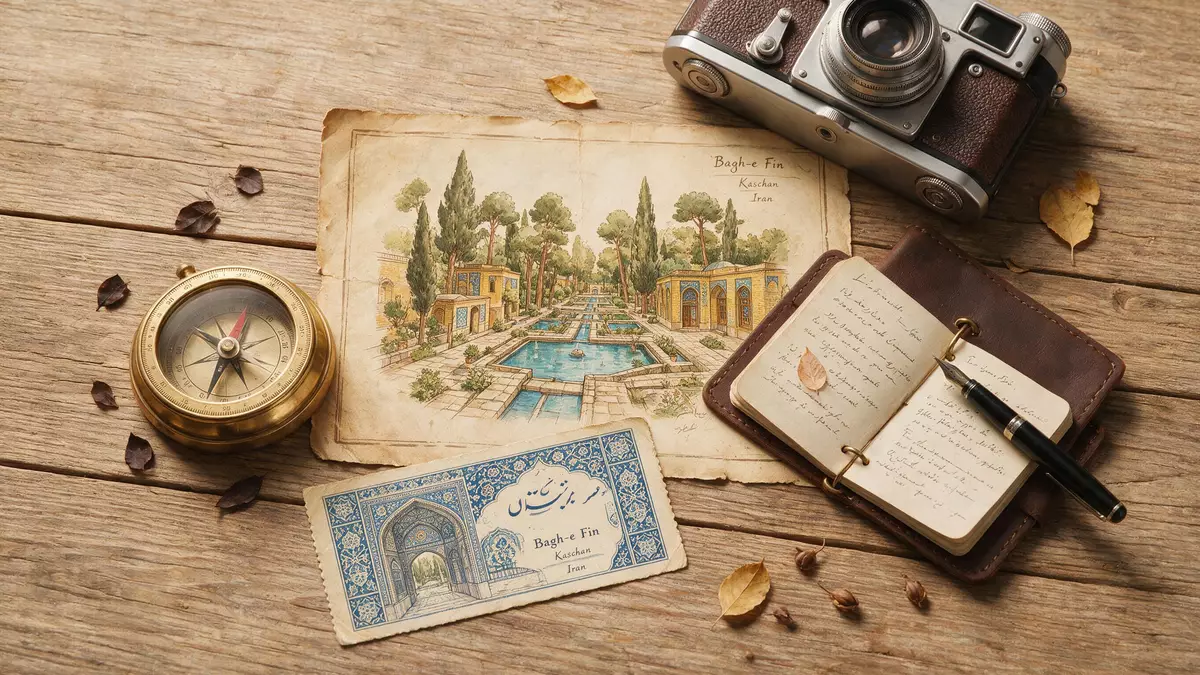
Bagh-e Fin on the south-western edge of Kaschan in Iran is a walled Persian garden where spring water, Safavid pavilions and Qajar layers coexist within one ordered rectangle. Laid out under Shah Abbas I in the late sixteenth century, it brings channels, trees and brick architecture together in a single planned landscape.
Water from the desert hills
The starting point of Bagh-e Fin is its water. The garden stands close to the village of Fin, at the point where a natural spring emerging from the hills feeds a network of channels and garden plots that sit slightly apart from the fabric of Kaschan.The garden in Fin captures the Soleimaniyeh spring and directs it into a geometric pattern of watercourses and pools framed by architecture and planting.
The enclosure is laid out on a chahar bagh plan, the quadripartite scheme long associated with classical Persian gardens.Fin Garden is described as a historic Persian garden completed in 1590 and associated with Kashan, and its long axial channels still structure the main paths and sightlines. Water runs in shallow rills flanking walkways, gathers in basins beside pavilions and feeds trees that soften the geometry with trunks and canopy.
Safavid order and Qajar layers
Bagh-e Fin took its present form under Shah Abbas I, the fifth Safavid king of Iran, whose reign from 1588 to 1629 left a series of royal gardens and pavilions across the country.Reports on the garden trace its current layout to the Safavid period and to Shah Abbas I, and they describe walls, an entrance portal and a central pavilion from that era. The standing complex mixes Safavid brickwork with later additions that reflect the tastes of the Qajar court.
Inside the walls, small pavilions sit at key points along the water axes and among the trees, combining enclosed rooms with open verandas and upper viewing levels. A central pavilion rises over a main pool, while secondary buildings mark corners and crossings. Later Qajar interventions added another bathhouse and a library, giving the garden a layered architectural history that still reads in the differing details of tiles, inscriptions and construction.
A garden tied to political memory
Bagh-e Fin is not only a garden of water and shade; it is also a place where political history is anchored in space. Within the enclosure lies Kashan’s Fin Bathhouse, associated with the assassination of Amir Kabir, the Qajar-era chancellor, in 1852 during the reign of Naser al-Din Shah Qajar.Fin Bathhouse is recorded as the site of Amir Kabir’s murder in 1852, and the building remains one of the most charged corners of the site.
The garden’s significance has been recognised beyond Kaschan. Bagh-e Fin forms part of the serial World Heritage property known as “The Persian Garden”, a group of nine sites across Iran that together represent characteristic Persian approaches to enclosure, water management and planting.The property has been inscribed on the UNESCO World Heritage list as one of the Persian Gardens, placing Bagh-e Fin alongside other formal gardens that shaped ideas of paradise landscapes from Iran to India.
Visiting Bagh-e Fin: what travellers from Western Europe should know
- Bagh-e Fin stands south-west of central Kaschan near the Fin suburb, reached by road along Amir Kabir Street from the city’s main squares and bazaars.
- The garden lies within a walled enclosure with formal paths and water channels, so a visit involves walking on paved routes and stepping over narrow rills between trees and basins.
- Kaschan sits on the margins of Iran’s central desert, and Bagh-e Fin lies where low hills meet the plain, so the contrast between the garden’s irrigated plots and the surrounding dry terrain is clear on the approach.
- The official language is Persian and the currency is the Iranian rial.
- Entry requirements depend on your nationality; UK travellers can check the FCDO travel advice at gov.uk/foreign-travel-advice, Irish travellers the Department of Foreign Affairs at ireland.ie.
Searching for Bagh-e Fin on social platforms
These links open searches for Bagh-e Fin on each platform.
Frequently asked questions about Bagh-e Fin
Where is Bagh-e Fin?
Bagh-e Fin is a historic walled garden on the south-western edge of Kaschan in central Iran, near the settlement of Fin and the desert hills beyond the city.
What can visitors expect inside Bagh-e Fin?
Visitors encounter a formal Persian garden with long water channels, basins, trees and pavilions, all enclosed by garden walls that separate the irrigated plots from the surrounding landscape.
What makes Bagh-e Fin distinctive among Persian gardens?
Bagh-e Fin combines a Safavid chahar bagh layout, Qajar-period buildings and a bathhouse linked to Amir Kabir’s assassination, and it is recognised within UNESCO’s “The Persian Garden” World Heritage listing.


