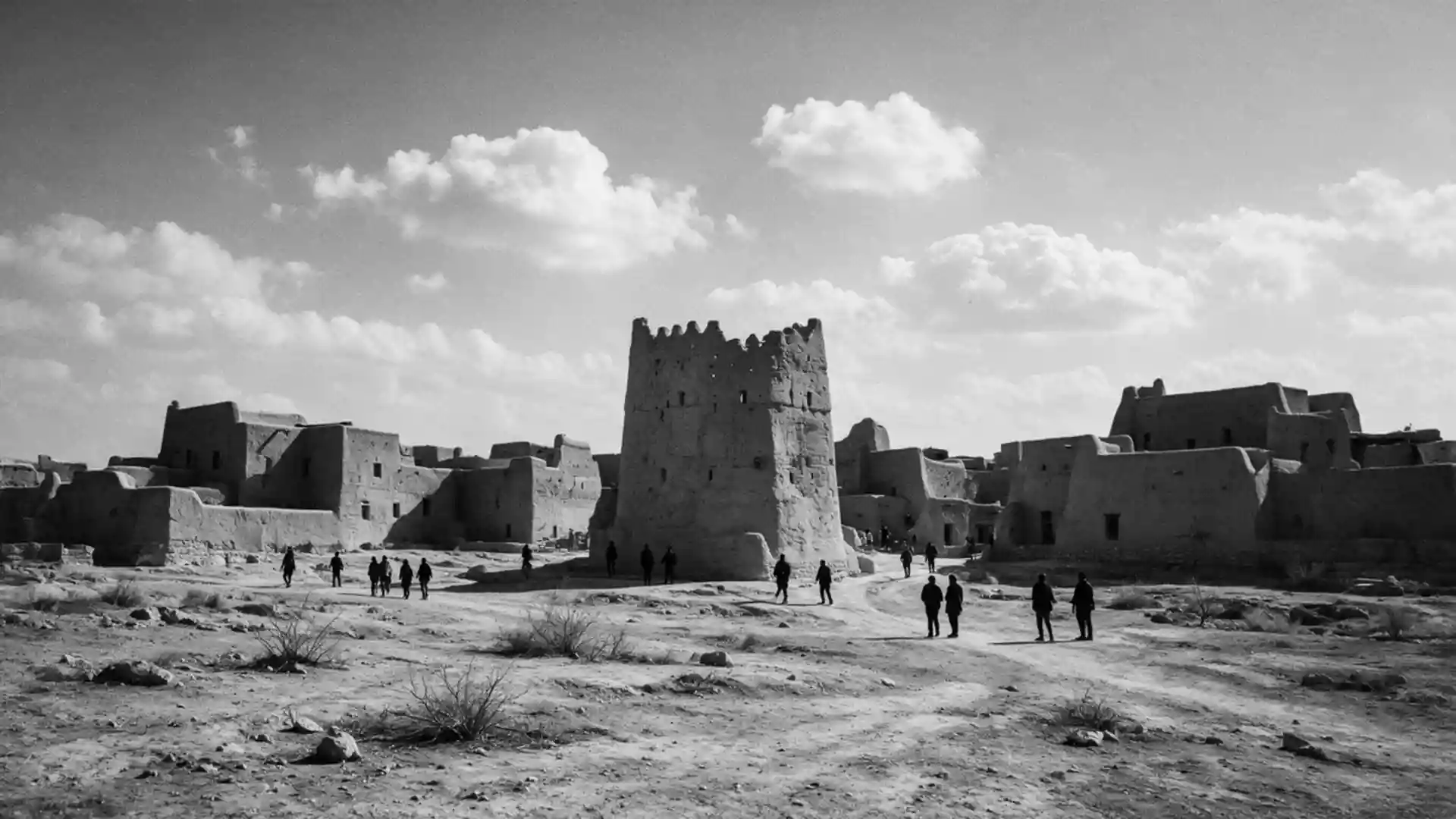
At-Turaif, earthen capital above the oasis of Diriyah
Published on 09/09/2026 at 11:24 | Editorial responsibility: Rafael Müller, Editor-in-Chief AD HOC NEWS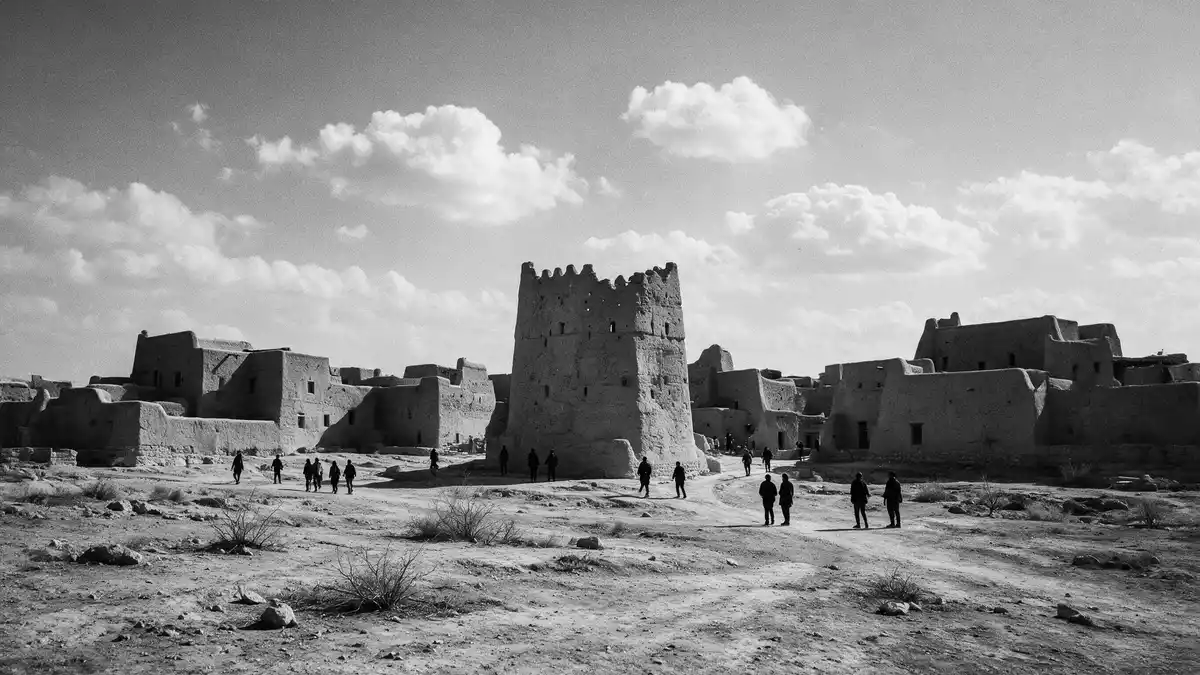
At-Turaif in Diriyah is a historic earthen district overlooking the palm-lined Wadi Hanifah, once the political heart of the First Saudi State and now a recognised UNESCO World Heritage Site. Founded in the fifteenth century and inscribed on the World Heritage List in 2010, it brings the Najdi mudbrick building tradition into focus as a compact ensemble of palaces, mosques and houses rising above the oasis.
Mudbrick citadel above Wadi Hanifah
At-Turaif occupies a raised spur on the edge of Wadi Hanifah, northwest of Riyadh in central Saudi Arabia, with its buildings forming a dense citadel above the greenery of the valley.At-Turaif District in ad-Dir'iyah The district’s fabric is largely composed of mudbrick laid on stone foundations, a hallmark of Najdi construction that turns local earth into thick load-bearing walls and terraces.traditional Najdi mudbrick From the valley floor, the ensemble reads as an irregular mass of earth-toned volumes, stepped parapets and projecting towers that rise above the palms.
Walking into At-Turaif, the transition from oasis to citadel becomes clear in the way the ground lifts and narrows into lanes between high earthen walls. Compounds unfold around internal courtyards with enclosed outer faces and more open inner fronts, a configuration characteristic of Najdi urban design in a desert setting.Najdi architectural tradition The material continuity between walls, terraces and the surrounding plateau reinforces the impression that At-Turaif is built from the landscape itself rather than set upon it.
Capital of the First Saudi State
Historically, At-Turaif was the core district of Diriyah, which became the capital of the Emirate of Diriyah in the eighteenth century and is regarded as the first Saudi State.Diriyah as first capital Its origins are traced to the fifteenth century, when Mani' bin Rabi'a al-Muraydi, ancestor of the Al Saud family, chose the area as a residence and established the settlement that later expanded into a regional power centre.founding of Diriyah Within the earthen walls of At-Turaif, ruling palaces, religious institutions and administrative quarters stood side by side, forming the seat of governance for central Arabia.
UNESCO inscribed At-Turaif on the World Heritage List in 2010 as a cultural property that bears “outstanding universal value” for its role in the formation of the Saudi state and its preserved Najdi architecture.World Heritage inscription in 2010 The district’s palaces, mosques and houses together illustrate a phase when Diriyah functioned as a political and religious centre on the central Arabian plateau, with earthen construction techniques adapted to the plateau and oasis landscape.
Najdi architecture in a walkable open-air museum
The layout of At-Turaif can be understood as a series of terraces stepping down towards Wadi Hanifah, each carrying clusters of buildings with varying heights and configurations.terraced earthen fabric Narrow lanes weave between compounds, occasionally opening into small squares or courtyards framed by taller structures. The arrangement creates sequences of enclosed passages and wider spaces, with views back over the oasis and across to other parts of the district.
Najdi architecture at At-Turaif relies on straight-edged facades punctuated by small openings, thick earthen walls and parapets that define rooflines against the sky.Najdi architectural features Decorative elements such as geometric patterns and crenellations animate the surfaces of more prominent buildings, distinguishing palatial complexes from simpler residential quarters.earthen architecture ensemble As an open-air museum, At-Turaif presents this architectural language at district scale, allowing the relationship between individual structures, streets and the oasis to be traced on foot.
Visiting At-Turaif: what travellers from Western Europe should know
- At-Turaif stands in Diriyah, northwest of Riyadh in central Saudi Arabia, above the Wadi Hanifah valley, reached overland from the wider Riyadh urban area.
- Exploring the district involves walking on earthen terraces and through lanes that can be uneven underfoot, with stairways and changes in level between compounds.
- The surrounding landscape combines the cultivated palm groves of Wadi Hanifah with the higher plateau; At-Turaif itself rises above the oasis and looks across the valley.
- The official language is Arabic and the currency is the Saudi riyal.
- Entry requirements depend on your nationality; UK travellers can check the FCDO travel advice at gov.uk/foreign-travel-advice, Irish travellers the Department of Foreign Affairs at ireland.ie.
Searching for At-Turaif on social platforms
These links open searches for At-Turaif on each platform.
Frequently asked questions about At-Turaif
Where is At-Turaif and what kind of place is it?
At-Turaif is a historic earthen district in Diriyah, northwest of Riyadh in Saudi Arabia, occupying a raised spur above the Wadi Hanifah oasis.
What can visitors expect on a visit to At-Turaif?
Visitors encounter mudbrick palaces, mosques and residential quarters arranged on terraces and linked by narrow lanes and courtyards that overlook the valley landscape.
What makes At-Turaif distinctive among heritage sites?
At-Turaif stands out for its concentration of Najdi mudbrick architecture at district scale and for its documented role as capital of the First Saudi State, recognised by UNESCO.