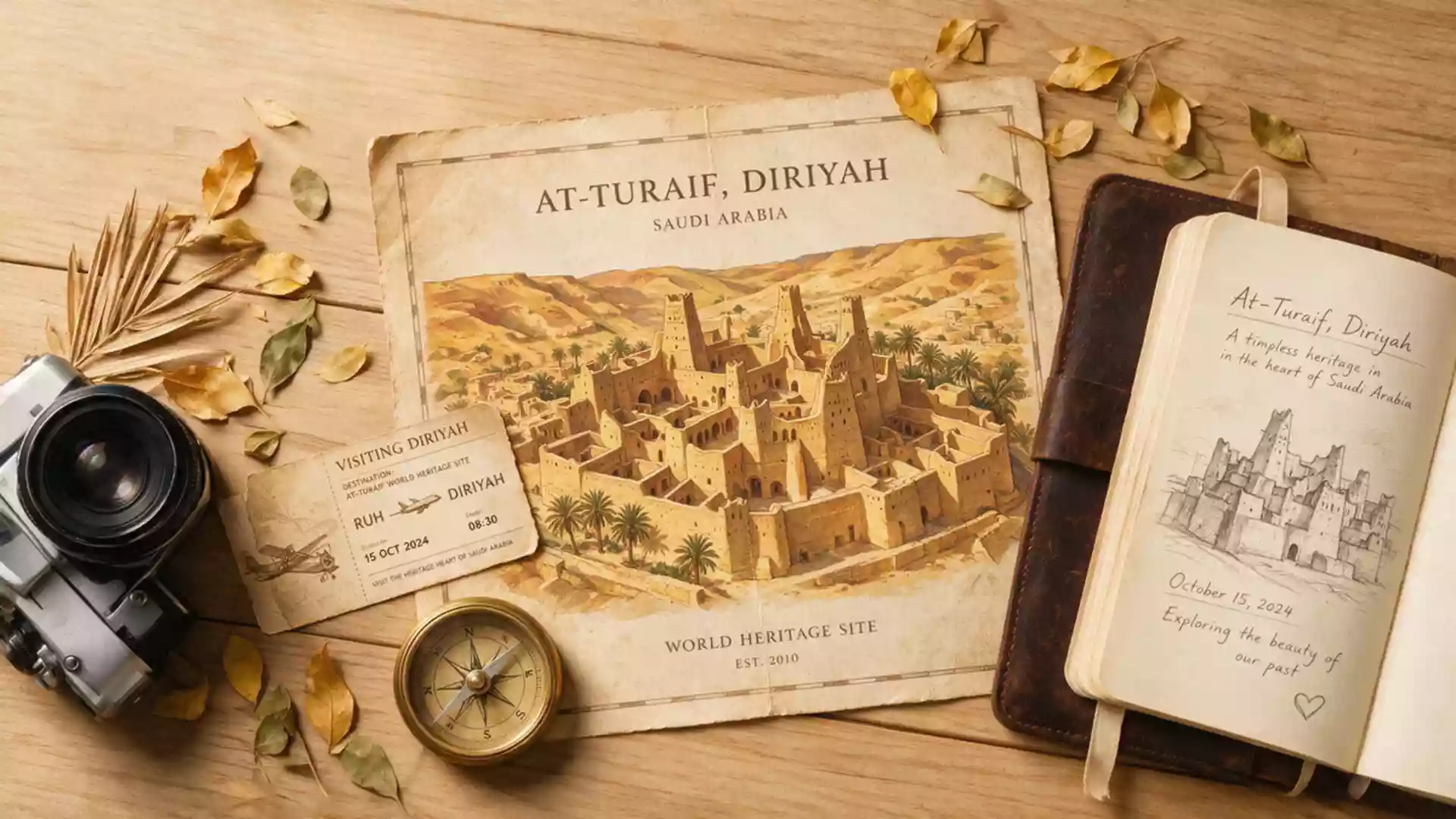
At-Turaif, mudbrick capital of the first Saudi state
Published on 08/29/2026 at 12:16 | Editorial responsibility: Rafael Müller, Editor-in-Chief AD HOC NEWS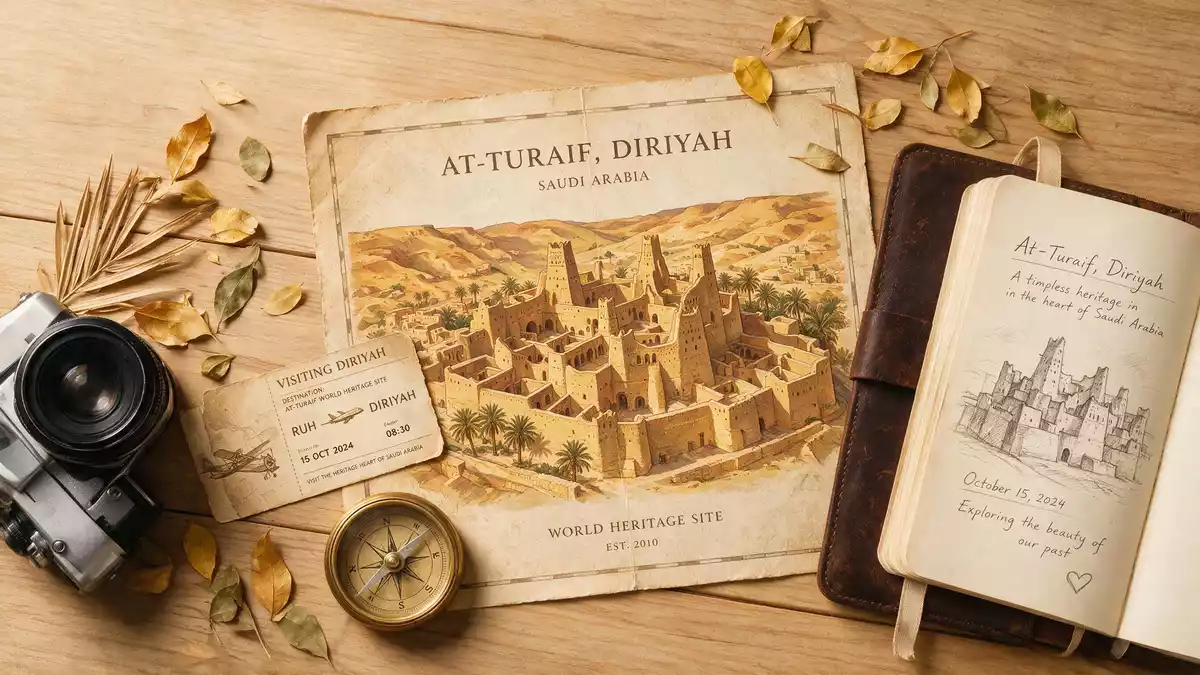
At-Turaif in Diriyah is a mudbrick citadel on the edge of Wadi Hanifah, once the political heart of the First Saudi State and now a carefully restored UNESCO World Heritage Site. Founded in the fifteenth century and inscribed on the World Heritage List in 2010, it brings Najdi desert architecture into focus as a walkable historic district.
Mudbrick walls and Najdi architectural rhythms
The core of At-Turaif is a dense cluster of earthen buildings rising above the palm groves of Wadi Hanifah, their walls built from compacted mudbrick and coated in earth-toned plaster that mirrors the surrounding plateau.The citadel of At-Turaif shows how Najdi builders created fortified urban ensembles in an oasis landscape, with thick walls, projecting volumes and narrow lanes that thread between houses and palaces.The district bears traces of the Najdi architectural style
Najdi architecture in At-Turaif relies on straight-edged facades punctuated by small openings, stepped parapets and buttressed corners that articulate the citadel’s skyline against the desert sky.At-Turaif represents a major example of the Najdi architectural tradition The earthen fabric is organised in layered terraces, with buildings stepping down towards the oasis and creating sequences of courtyards, alleyways and elevated walkways that reveal new angles on the same structures as visitors move through the district.
From fifteenth-century settlement to First Saudi State capital
At-Turaif is traditionally dated to the fifteenth century, when a settlement took shape on the western bank of Wadi Hanifah in what is now the outskirts of Riyadh.The historic district stands on the western banks of Wadi Hanifah In 1744, the Al Saud family established the First Saudi State here, making At-Turaif the seat of power and transforming the settlement into a fortified capital with palaces, mosques and administrative buildings.At-Turaif was the first capital of the Saudi dynasty from 1744 to 1818
The First Saudi State, which lasted from 1727 to 1818, anchored its political and religious authority in At-Turaif, and the district’s layered structures preserve that period in built form.The site served as the original seat of power for the first Saudi state founded in 1727 Walking through the restored streets brings that eighteenth- and early nineteenth-century chapter to life, with traces of domestic quarters alongside grander compounds that once housed the ruling family’s functions.
Palaces, mosques and the layout of a desert capital
Among the most recognisable structures in At-Turaif is Salwa Palace, a sprawling complex that crowns the citadel and once formed the main residence and ceremonial focus of the Al Saud rulers.Salwa Palace and Saad bin Saud Palace are among the historic compounds Nearby stand Saad bin Saud Palace and a group of administrative buildings, arranged around courtyards that open onto lanes running along the ridge above the oasis.
The religious centre of the district is the Imam Mohammad bin Saud Mosque, integrated into the urban fabric with its prayer hall and courtyard aligned to the surrounding streets.The Imam Mohammad bin Saud Mosque forms part of At-Turaif’s key monuments Other buildings include the Bayt Al-Mal treasury and the Guest House and At-Turaif Bath House, completing a layout that combines governance, worship and daily life within the same fortified envelope.
Visiting At-Turaif: what travellers from Western Europe should know
- At-Turaif lies in Diriyah, north-west of Riyadh, on the western side of Wadi Hanifah; it is reached by road from the Saudi capital and forms part of the wider Diriyah development.
- The historic district stands on a low plateau above the oasis, and visiting involves walking along sloping pathways and stairways between terraces and courtyards.
- The official language is Arabic and the currency is the Saudi riyal. Entry requirements depend on your nationality; UK travellers can check the FCDO travel advice at gov.uk/foreign-travel-advice, Irish travellers the Department of Foreign Affairs at ireland.ie.
Searching for At-Turaif on social platforms
These links open searches for At-Turaif on each platform.
Frequently asked questions about At-Turaif
Where is At-Turaif?
At-Turaif is a historic district in Diriyah, on the north-western outskirts of Riyadh in central Saudi Arabia, standing above the palm-lined Wadi Hanifah.
What can visitors expect at At-Turaif?
Visitors encounter a restored mudbrick citadel with palaces, mosques and residential quarters, laid out in terraces and narrow lanes that overlook the oasis and surrounding desert landscape.
What makes At-Turaif distinctive among historic sites?
At-Turaif combines fifteenth-century origins, its role as capital of the First Saudi State and a rare concentration of Najdi earthen architecture, recognised through its inscription as a UNESCO World Heritage Site in 2010.