
Arco de Santa Catalina and the yellow street towards Volcán de Agua
Published on 09/12/2026 at 06:47 | Editorial responsibility: Rafael Müller, Editor-in-Chief AD HOC NEWS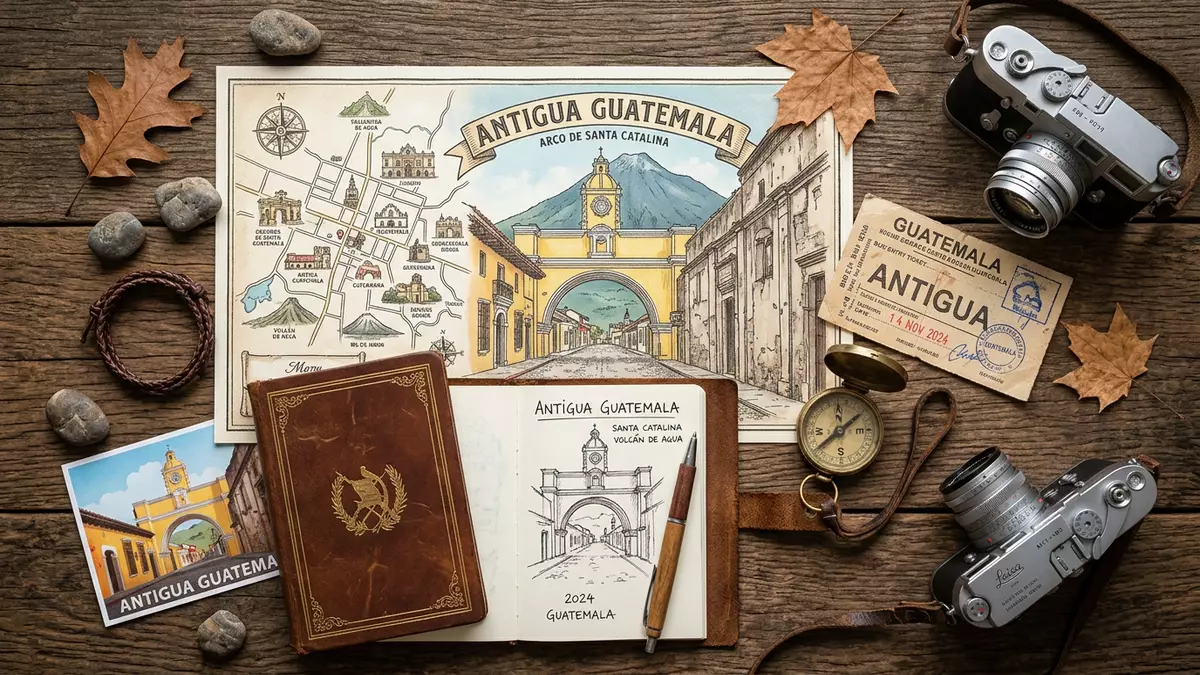
Few city streets anywhere are defined as clearly by one structure as the yellow lane under Arco de Santa Catalina in Antigua Guatemala. The colonial arch links former convent buildings above the roadway and, at the same time, frames a direct view towards the volcanic cone of Volcán de Agua in the distance.
A convent passage turned into a city landmark
Arco de Santa Catalina takes its name from the Convento de Santa Catalina Virgen y Mártir, a convent for cloistered nuns established in the early seventeenth century in what was then Santiago de los Caballeros de Guatemala.Convento de Santa Catalina Mártir Within this religious complex, the arch functioned as an enclosed passage between convent buildings on either side of the street, giving the nuns a way to cross above the traffic without stepping into public view.enclosed footbridge over the street
Construction of Arco de Santa Catalina belongs to the late seventeenth century, with several historical summaries placing its completion in 1693 or 1694, during the colonial period when Antigua’s baroque churches and convents were flourishing.completed in 1693 The arch survived major earthquakes in 1773 that damaged many religious structures in the city, and later reconstructions in the nineteenth and twentieth centuries gave it much of its present appearance.series of reconstructions and restorations
Yellow walls, clock tower and baroque detail
Seen from the street, Arco de Santa Catalina presents a painted facade that spans the road and connects two wings of the former convent, with a simple baroque-profiled arch opening above the cobbles. The walls are finished in a warm yellow tone with white trim, a colour combination that appears on several colonial buildings in Antigua and reinforces the arch’s role as part of the city’s historic streetscape.yellow street under the arch
Above the roadway, the structure thickens into a block containing the passageway and, higher still, a small tower that carries a clock on each side. A timepiece was added to Arco de Santa Catalina in the nineteenth century, when a clock tower was built as part of a programme of repairs under General Manuel Lisandro Barillas, giving the arch its familiar silhouette against the sky.torrecilla and clock added in the 1890s Mouldings, pilasters and the curved cornice give the facade a restrained baroque profile, closer to a modest civic gateway than to the elaborate fronts of Antigua’s churches.
A street that becomes a frame for Volcán de Agua
What makes Arco de Santa Catalina distinct in Antigua’s urban fabric is the way it anchors Calle del Arco, the street that runs beneath it, and turns that street into a kind of corridor towards Volcán de Agua. Looking along the cobbled roadway through the arch, the light-coloured walls and low roofs line up to form a frame around the volcanic cone that rises beyond the city.street that frames Volcán de Agua
This alignment binds together architecture, street layout and landscape, so that a short walk under the arch brings the dormant volcano visually into the colonial centre. The result is a streetscape in which convent walls, merchant houses and distant mountain form one composition, with the arch sitting at its narrowest point like a hinge between the city and the wider valley.
Visiting Arco de Santa Catalina: what travellers from Western Europe should know
- Arco de Santa Catalina stands along Calle del Arco in the historic centre of Antigua Guatemala, west of the main plaza, and is easily reached on foot from the surrounding streets.
- The roadway beneath the arch is paved with cobbles and can feel uneven underfoot, and the pavements beside it are narrow, so walking in the area calls for attention to footing.
- Antigua Guatemala sits in a basin surrounded by volcanoes, and the section of street where the arch stands is level but lies at an altitude where the air can feel thinner than at sea level.
- Spanish is the official language and the currency is the Guatemalan quetzal.
- Entry requirements depend on your nationality; UK travellers can check the FCDO travel advice at gov.uk/foreign-travel-advice, Irish travellers the Department of Foreign Affairs at ireland.ie.
Searching for Arco de Santa Catalina on social platforms
These links open searches for Arco de Santa Catalina on each platform.
Frequently asked questions about Arco de Santa Catalina
Where is Arco de Santa Catalina located within Antigua Guatemala?
Arco de Santa Catalina stands on Calle del Arco in the historic centre of Antigua Guatemala, on a street that runs west from the central plaza beneath its span.
What can visitors expect when walking under the arch?
Visitors find a cobbled street, painted colonial facades and the low tunnel of the arch itself, with a view towards Volcán de Agua opening along the street in one direction.
What makes Arco de Santa Catalina distinctive among Antigua’s colonial structures?
Its role as an elevated convent passage, its yellow-painted baroque facade with clock tower and its alignment with Volcán de Agua together make it one of Antigua’s most recognisable street features.


