
Arco de Santa Catalina and the yellow street that frames a volcano
Published on 08/28/2026 at 06:58 | Editorial responsibility: Rafael Müller, Editor-in-Chief AD HOC NEWS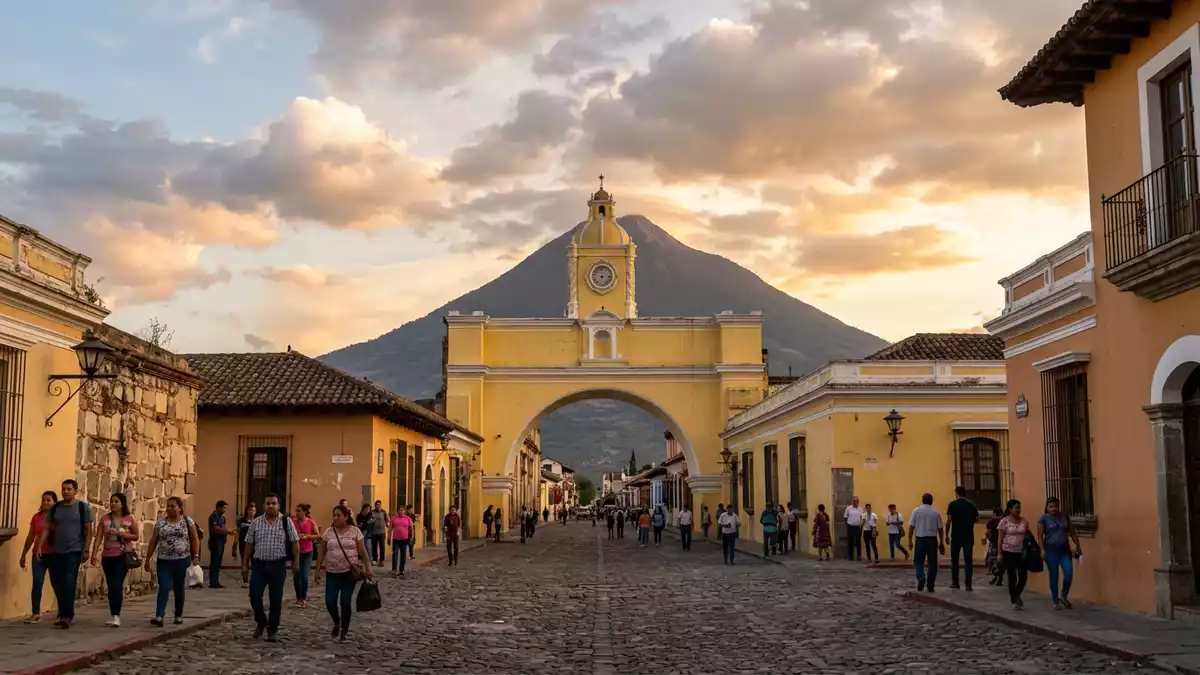
Arco de Santa Catalina in Antigua Guatemala is a baroque archway that spans 5a Avenida Norte, framing views towards the volcanic slopes beyond and linking two former convent buildings in the city’s historic centre. Built in the late seventeenth century as part of the Convent of Santa Catalina Virgen y Mártir, it has become one of Antigua’s most recognisable street scenes and a concise lesson in how architecture, religion and landscape meet in colonial Guatemala.
A baroque arch over a colonial street
The Santa Catalina Arch stands on what is now known as Calle del Arco, a stretch of 5a Avenida Norte lined with single-storey houses and former convent buildings from the Spanish colonial period.Calle del Arco The arch forms part of this continuous street frontage, rising above the roadway to connect structures on either side, and creating a clear visual focus when looking along the avenue towards the volcano that dominates the skyline.
Construction of the arch is closely tied to the Convent of Santa Catalina Virgen y Mártir, which was established by Dominican nuns in Antigua Guatemala in the seventeenth century.Dominican nuns in Antigua Within this convent complex, the arch functioned as an enclosed passage between buildings, and archival research places its construction in the early 1690s, with completion recorded in June 1694.completion recorded in June 1694 The resulting structure belongs to the baroque architectural language that characterised many religious buildings in Antigua during the late colonial period.
From cloistered passage to city landmark
In its seventeenth-century context the Santa Catalina Arch formed part of a cloistered world, linking the convent quarters with teaching spaces while keeping the nuns out of public view along the street below.convent quarters with teaching spaces Inside the masonry shell of the archway runs a hidden corridor, enclosed from the outside, which allowed movement between the buildings as a continuation of the convent interior rather than a separate urban bridge.
The wider convent complex suffered during the powerful earthquakes that struck Antigua Guatemala in 1773, which damaged many religious structures in the city, yet the Santa Catalina Arch remained standing and later repairs gave it much of its current appearance.later repairs gave it much of its current appearance In the nineteenth century a small turret was added above the passage and fitted with a mechanical clock, an element documented as a Lamy and Lacroix clock of French manufacture that has become an integral part of the arch’s profile against the sky.a Lamy and Lacroix clock of French manufacture
Colour, clock and the framed volcano view
Seen from street level, the Santa Catalina Arch presents a composition of painted masonry volumes set above the cobbled roadway, with the tower and clock rising over the central span. The baroque influence appears in the gently modelled cornices and pilasters, yet the overall form remains compact, sitting comfortably among the low roofs of Antigua’s historic houses rather than dominating them.
The archway is painted in a warm yellow hue with white trim, a colour scheme documented in heritage studies that have identified multiple historical layers of paint and recorded at least twenty-six different colours used on the structure over time.multiple historical layers of paint Looking through the roadway opening, the street alignment leads the eye towards the slopes of Volcán de Agua, whose conical outline rises beyond the low roofs, so that the arch functions quite literally as a frame for the surrounding landscape and for the daily life of Antigua Guatemala’s historic centre.
Visiting Arco de Santa Catalina: what travellers from Western Europe should know
- Arco de Santa Catalina stands on 5a Avenida Norte in the historic centre of Antigua Guatemala, north of the city’s main plaza, and is reached along the paved streets of the old town.
- The immediate approach is along a gently sloping cobbled street, with uneven stone surfaces underfoot that can feel firm but irregular compared with a modern pavement.
- The Santa Catalina Arch forms part of a continuous frontage of one- and two-storey buildings, so moving around it involves sharing the narrow street space with local traffic patterns.
- The official language is Spanish and the currency is the Guatemalan quetzal. Entry requirements depend on your nationality; UK travellers can check the FCDO travel advice at gov.uk/foreign-travel-advice, Irish travellers the Department of Foreign Affairs at ireland.ie.
Searching for Arco de Santa Catalina on social platforms
These links open searches for Arco de Santa Catalina on each platform.
Frequently asked questions about Arco de Santa Catalina
Where is Arco de Santa Catalina located?
Arco de Santa Catalina spans 5a Avenida Norte in the historic centre of Antigua Guatemala, a colonial-era city in the central highlands of Guatemala.
What can visitors expect when they see Arco de Santa Catalina?
Visitors encounter a baroque archway painted in yellow tones with a clock tower above, standing over a cobbled street and framing a clear view towards Volcán de Agua.
What makes Arco de Santa Catalina distinctive among Antigua’s monuments?
Its combination of seventeenth-century convent history, the enclosed passage above the street and the later French-made clock tower gives it a distinctive profile within Antigua’s colonial streetscape.


