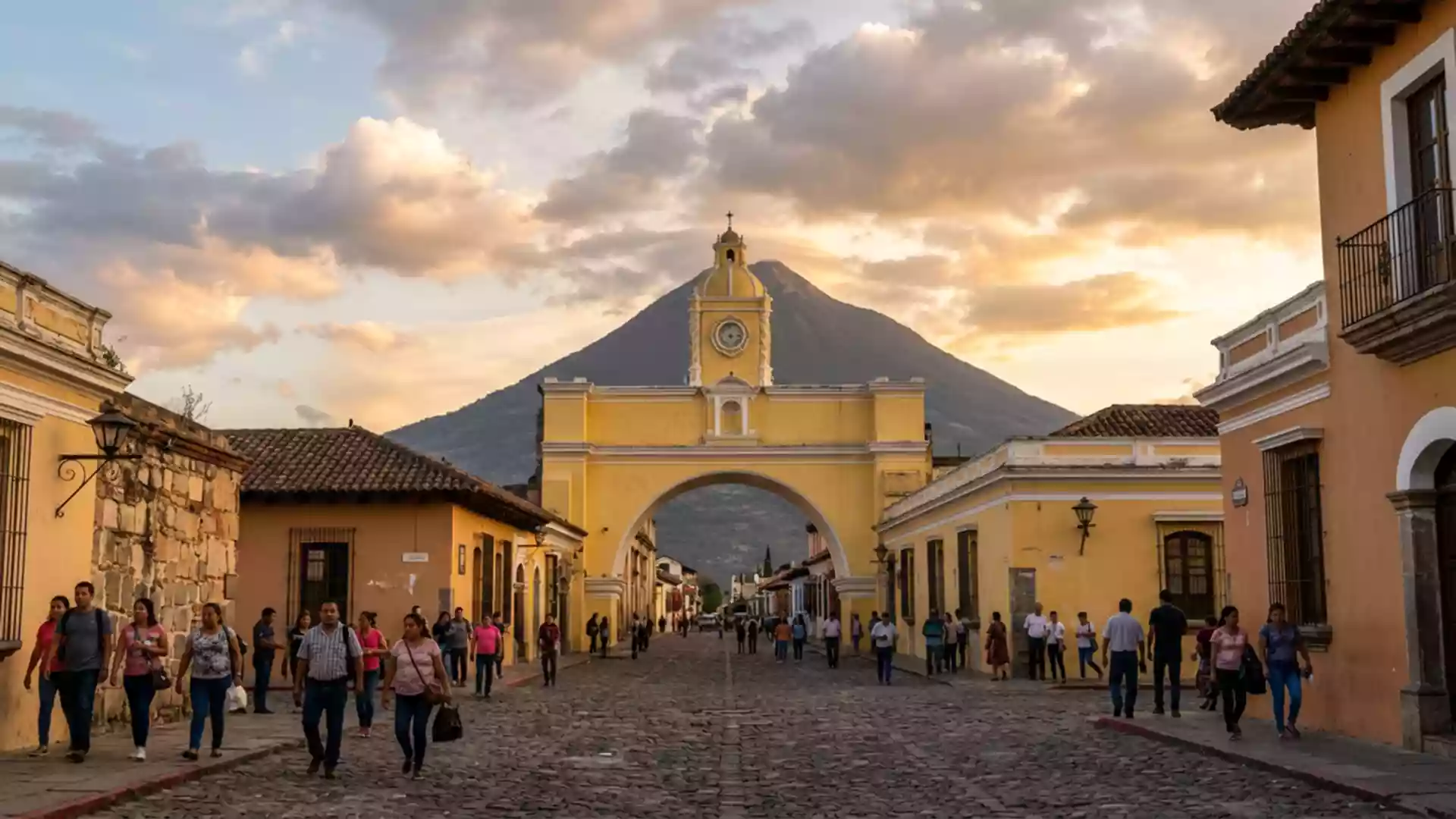
Arco de Santa Catalina and the yellow street of Antigua Guatemala
Published on 09/02/2026 at 07:07 | Editorial responsibility: Rafael Müller, Editor-in-Chief AD HOC NEWS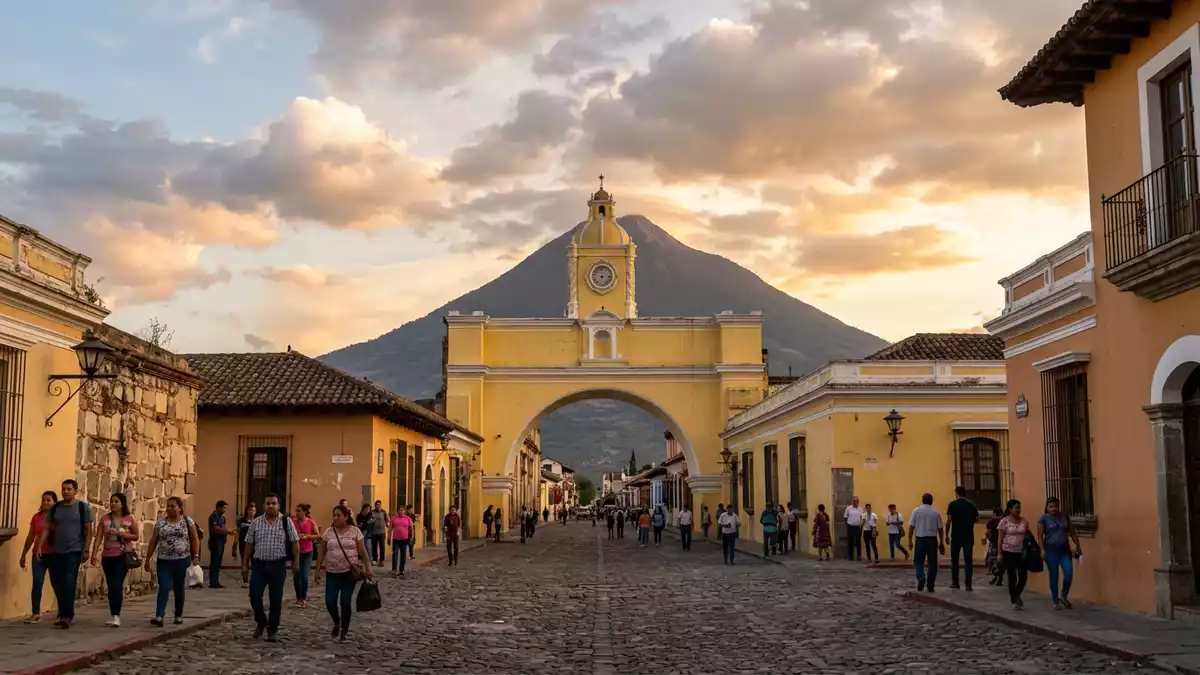
Arco de Santa Catalina in Antigua Guatemala is a baroque archway that links parts of the former Convent of Santa Catalina Virgen y Mártir and frames a direct view towards the volcano Agua. Built in the seventeenth century as an enclosed bridge between convent buildings, it has become one of the most recognisable street scenes in Guatemala’s former colonial capital.
A seventeenth-century arch above the street
Arco de Santa Catalina stands on a west–east axis along a cobbled street in the historic centre of Antigua Guatemala, a city laid out in a regular grid during the Spanish colonial period. The arch carries an enclosed passage between former convent buildings, raising a covered corridor above the traffic of the street below.Built in the 17th century, it forms part of the broader convent complex of Santa Catalina Virgen y Mártir and belongs to the baroque architectural language that characterised many religious structures in the city.The Santa Catalina Arch is a baroque structure built in the 17th century
Archival studies place the construction of the arch in the early 1690s, with completion recorded in June 1694.Concluded in June 1694 The convent itself grew from a seventeenth-century foundation by Dominican nuns, whose community developed on plots flanking the street.The convent was established by Dominican nuns in the early 17th century Within this setting Arco de Santa Catalina offered an internal link between buildings and survives as one of the clearest architectural reminders of monastic life in colonial Antigua.
A clock tower above a convent passage
The most striking external feature of Arco de Santa Catalina is the clock tower that rises from its upper level, giving the arch the profile of a compact tower set directly over the street. The clock structure belongs to a later phase of the arch’s history: sources describe a tower and clock added during the nineteenth century, following a series of reconstructions after major earthquakes.The clock tower now adorning the Arco de Santa Catalina was added in the 1890s Within the tower a mechanical clock imported from Europe has been documented as part of the twentieth-century restorations.A Lamy and Lacroix clock from France
The arch and its tower stand within a historic city that has experienced repeated seismic events, including the destructive earthquake of 1773 that reshaped much of Antigua Guatemala’s built fabric.The 1773 earthquakes damaged the convent and arch Later reconstructions in the nineteenth and twentieth centuries stabilised the structure and gave it much of its present appearance, with stuccoed surfaces and the now-familiar yellow colour documented in restoration studies.Restorations from the 19th and 20th centuries The result is a compact tower-arch whose profile is instantly recognisable in photographs and paintings of the city.
A yellow street that frames a volcano
Arco de Santa Catalina spans a street lined with low, stuccoed buildings painted in warm tones that echo the arch itself, creating a continuous run of colour punctuated by doorways, windows and balconies. The arch rises between these facades, its central opening framing the cobbles below and the sky above in a single axial view towards the distant volcano Agua.The yellow street that frames a volcano The alignment of street, arch and volcano is a feature visitors can see directly from the cobbles, where the volcanic cone rises beyond the city’s roofline.
The broader streetscape belongs to Antigua Guatemala’s colonial urban layout, with single-storey buildings and tiled roofs keeping the skyline relatively low. Within this context the arch and its tower form a vertical accent that draws the eye along the street towards the volcano.Gateway to Antigua’s colonial heart The composition of arch, painted walls, stone paving and distant mountain gives the place a strong sense of orientation within both the city and the surrounding landscape.
Visiting Arco de Santa Catalina: what travellers from Western Europe should know
- Arco de Santa Catalina stands on a central street in Antigua Guatemala’s historic grid, west of the city’s main plaza, and is reached on foot along cobbled streets.
- The immediate approach runs over uneven cobblestones, and the area beneath the arch is level but surfaced in stone rather than modern paving.
- The historic centre of Antigua Guatemala lies within a basin surrounded by volcanic peaks, and Arco de Santa Catalina stands on relatively flat urban terrain rather than on a hillside.
- The official language is Spanish and the currency is the Guatemalan quetzal.
- Entry requirements depend on your nationality; UK travellers can check the FCDO travel advice at gov.uk/foreign-travel-advice, Irish travellers the Department of Foreign Affairs at ireland.ie.
Searching for Arco de Santa Catalina on social platforms
These links open searches for Arco de Santa Catalina on each platform.
Frequently asked questions about Arco de Santa Catalina
Where is Arco de Santa Catalina located?
Arco de Santa Catalina spans a cobbled street in the historic centre of Antigua Guatemala, a colonial-era city in the central highlands of Guatemala.
What should visitors expect when seeing Arco de Santa Catalina?
Visitors encounter a seventeenth-century baroque arch with a clock tower above a cobbled street, framed by low stuccoed buildings and a clear view towards the volcano Agua.
What makes Arco de Santa Catalina distinctive?
Its combination of convent passageway, nineteenth-century clock tower and alignment that frames the volcano Agua gives Arco de Santa Catalina a distinctive presence within Antigua Guatemala’s historic grid.