
Antelope Canyon’s wave-carved sandstone corridors near Page
Published on 08/30/2026 at 10:49 | Editorial responsibility: Rafael Müller, Editor-in-Chief AD HOC NEWS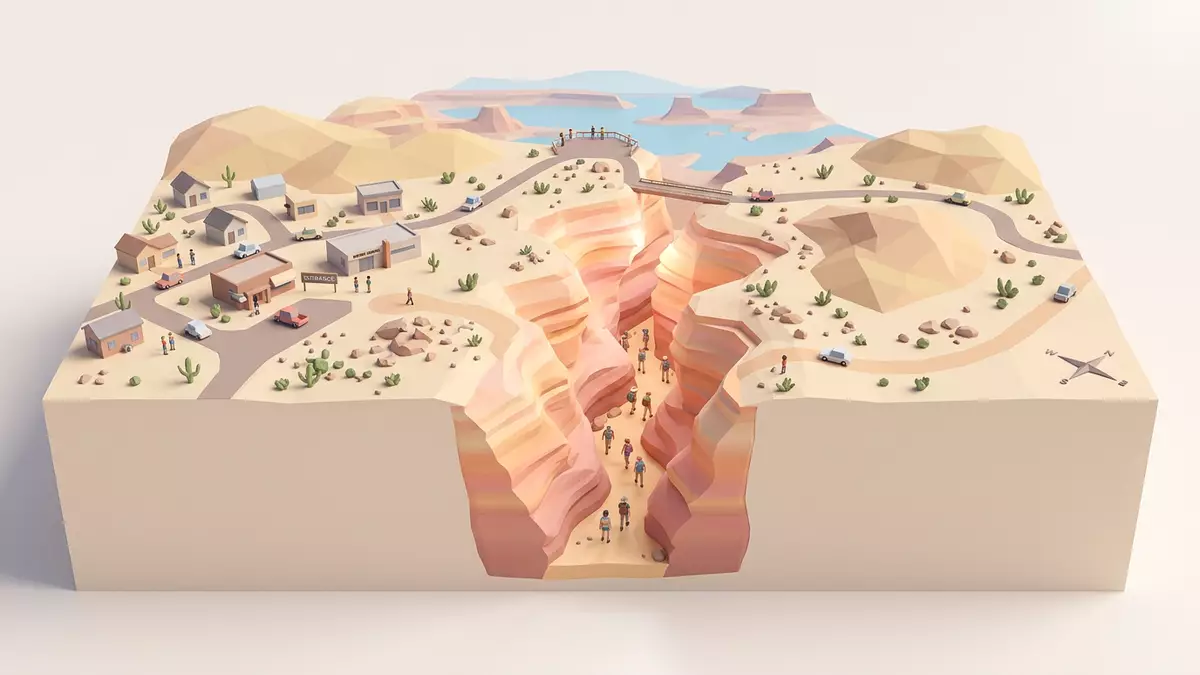
East of Page in northern Arizona, Antelope Canyon cuts a winding corridor through Navajo Sandstone on the Navajo Nation, turning desert rock into flowing surfaces of light and shadow. The slot canyon lies within Lake Powell Navajo Tribal Park on the Colorado Plateau, its narrow passages carved by flash flooding into Jurassic-era sandstone laid down as ancient dunes.
Sandstone, slot canyon and the story in the rock
Antelope Canyon is a sandstone slot canyon, a ravine much deeper than it is wide, incised into the desert bedrock by water that repeatedly found and enlarged a fracture in the Navajo Sandstone east of Page.sandstone slot canyon The rock itself belongs to the Navajo Sandstone formation, a massive deposit of wind-blown desert dunes that was laid down in the early Jurassic period and later lithified into stone before erosion carved the canyon through it.Navajo Sandstone deposited about 190 million years ago
Geologically, the walls record both their dune origin and the forces that reshaped them. Cross-bedded layers preserve changes in wind direction from the time when the sand lay as dunes, while bands and flutings mark shifts in sediment supply and water flow during flash floods that later scoured the rock.cross-bedded layers record changes in wind direction The combination gives each surface a layered, rippled character, with fine-grained sandstone shaped into what appear as frozen waves along the canyon walls.
Flash floods and the carving of narrow corridors
The form of Antelope Canyon owes much to flash flooding, sudden pulses of water that rush through the slot and have done so over long periods. Rain falling on the basin above the canyon gathers into channels that feed into the narrow fissure; as the water accelerates in the confined space, it carries sand and debris that abrade the sandstone, deepening and smoothing the passage.rainwater runs into the extensive basin above Repeated flood events gouge the floor and undercut the lower walls, gradually creating chambers and constrictions along the length of the canyon.
The result is a sequence of corridors whose proportions change from section to section. In some areas the floor narrows until the walls rise close together with only a ribbon of sky visible far above, while elsewhere the canyon opens slightly into taller rooms where surfaces curve in broad sweeps.walls reach about 37 m The sculpted sandstone shows where water cut more aggressively, hollowing alcoves and undercut grooves, and where slower erosion left straighter sections of wall. Flash floods can still occur, so the underlying process that formed the canyon remains active, even though individual visitors encounter the rock in dry conditions.
Upper and Lower Antelope Canyon: two aspects of the same sandstone
For travellers based in Western Europe the name Antelope Canyon usually refers to a group of slots east of Page, with Upper Antelope Canyon and Lower Antelope Canyon forming the best-known pair. Upper Antelope Canyon, sometimes called Navajo Upper Antelope Canyon, is reached from the desert surface and leads into a single, relatively short corridor where the sandstone walls tower above a level floor, making the space feel like a tall, enclosed passage within the rock.Navajo Upper Antelope Canyon Lower Antelope Canyon follows a more elongated course with a floor that undulates, requiring visitors to negotiate ladders and steps as they move between sections.
Despite these contrasts, both parts share the same Navajo Sandstone fabric and the same flash-flood origin. The sandstone ages cited in geological descriptions range around the early Jurassic, indicating that the rock was in place long before the canyon began to form.Navajo sandstone formed around 191-174 million years ago Within Upper and Lower Antelope Canyon, layers of sediment are visible as bands of different tones, and some sections show more pronounced curving surfaces, a sign that water concentrated its energy along particular lines. Together, the pair offers two ways of encountering the same geological story: one in a shorter, more enclosed corridor, the other in a more varied sequence of chambers and constrictions.
Visiting Antelope Canyon: what travellers from Western Europe should know
- Antelope Canyon lies east of Page in northern Arizona, on land belonging to the Navajo Nation within Lake Powell Navajo Tribal Park, reached along desert roads from the town.
- The slot canyon consists of narrow sandstone passages with high walls, where approaches and internal routes involve walking on uneven ground, negotiating steps, and moving through confined spaces.
- The surrounding terrain forms part of the high desert of the Colorado Plateau, so conditions combine arid climate with elevation; visits involve exposure to sun on the approach and shaded sandstone once inside.
- The official language is English and the currency is the US dollar.
- Entry requirements depend on your nationality; UK travellers can check the FCDO travel advice at gov.uk/foreign-travel-advice, Irish travellers the Department of Foreign Affairs at ireland.ie.
Searching for Antelope Canyon on social platforms
These links open searches for Antelope Canyon on each platform.
Frequently asked questions about Antelope Canyon
Where is Antelope Canyon and who manages it?
Antelope Canyon lies east of Page in northern Arizona on the Navajo Nation, forming part of Lake Powell Navajo Tribal Park administered by Navajo authorities.
What should visitors expect inside the canyon?
Visitors move through narrow sandstone passages with high walls, encountering changing corridor widths, uneven floors, steps and ladders, all within a confined slot cut into Navajo Sandstone.
What makes Antelope Canyon distinctive among desert landscapes?
Antelope Canyon combines early Jurassic Navajo Sandstone laid down as desert dunes with flash-flood erosion that carved deep, narrow corridors, creating flowing rock surfaces and a ribbon-like view of the sky.


