
Antelope Canyon’s sculpted sandstone corridors near Page
Published on 08/29/2026 at 11:38 | Editorial responsibility: Rafael Müller, Editor-in-Chief AD HOC NEWS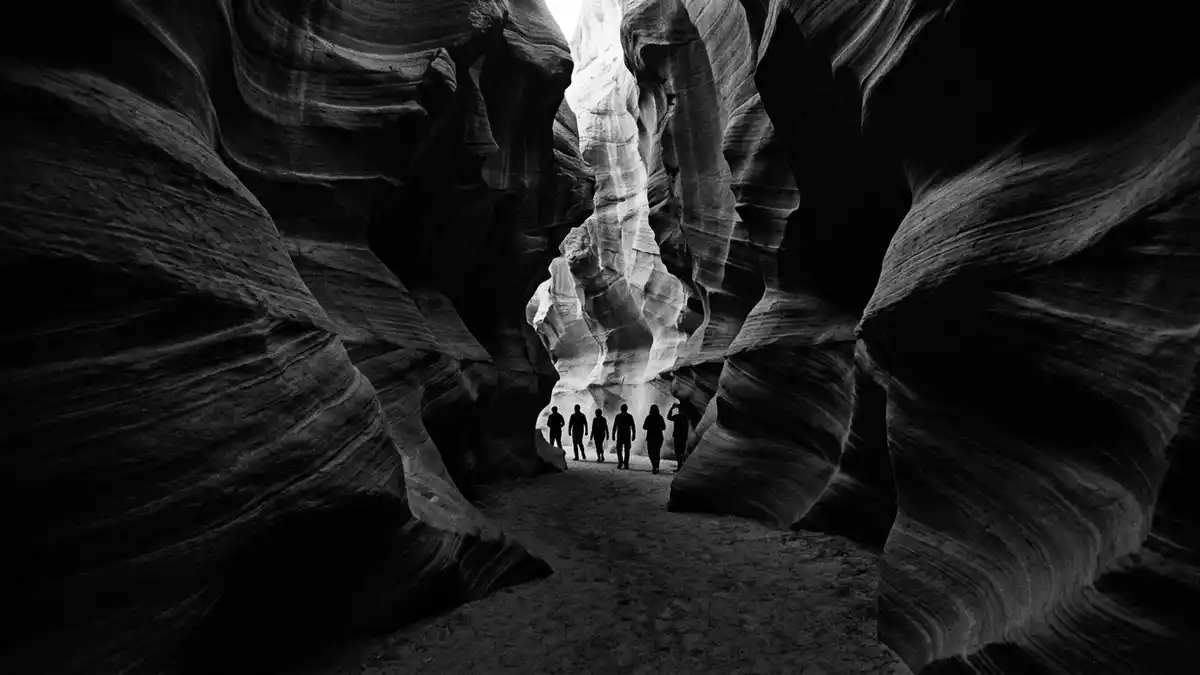
Antelope Canyon on Navajo Nation land near Page in northern Arizona is a narrow sandstone slot canyon where light and carved rock share the same confined space. Its winding corridors cut through Navajo Sandstone, a formation that dates back to the Jurassic period, and the canyon lies within Lake Powell Navajo Tribal Park east of Page, Arizona.Lake Powell Navajo Tribal Park
Sandstone, slot canyons and the scale of Antelope Canyon
Antelope Canyon is a sandstone slot canyon carved into Navajo Sandstone on the Navajo Nation near Page in northern Arizona.Navajo Sandstone Geologists describe slot canyons as long, narrow ravines cut into rock, where walls rise sharply from the streambed and daylight enters mainly from above.slot canyons In Antelope Canyon the walls consist largely of fine-grained sandstone, layered and cross-bedded, preserving the traces of ancient dunes.
Flash floods have been the principal force shaping this canyon, scouring the sandstone over millions of years and carving the narrow corridors now followed by guided groups.flash floods have been the principal force Water rushing from the basin above Page gathers sand and debris, cutting down through the rock and polishing the surfaces until they take on flowing forms that resemble frozen waves.frozen waves The age of the sandstone itself lies in the range between Triassic and early Jurassic, a reminder that the canyon’s narrow passages belong to a much older geological story.Triassic and early Jurassic
Upper and Lower Antelope: two sections of the same sandstone system
Antelope Canyon is divided into two main visitor sections, commonly known as Upper Antelope Canyon and Lower Antelope Canyon.two main visitor sections The Navajo name for the upper section is Tsé Bighánílíní, translated as “the place where water runs through rocks”, while the lower section is called Hasdestwazi, or “spiral rock arches”.Tsé Bighánílíní and Hasdestwazi These names reflect the canyon’s origins in flash floods and its twisting forms, and they sit alongside the English name that recalls the pronghorn antelope once roaming this part of northern Arizona.
Upper Antelope Canyon is known for comparatively even ground and a corridor that narrows towards the top, while Lower Antelope Canyon has a deeper, tighter path with a floor broken by steps and drops in the sandstone.deeper, tighter path The canyon system itself stretches for a considerable distance across Navajo Nation land, where several distinct slots are open to visitors and others remain closed.several distinct slots In both sections, the sculpted sandstone walls rise tens of metres above the streambed, enclosing a space that alternates between constricted passages and slightly wider chambers.
Light, colour and geology in a Navajo Nation landscape
Antelope Canyon lies just east of Page, Arizona, on Navajo Nation land outside the National Park Service system but close to Glen Canyon National Recreation Area and Lake Powell.east of Page, Arizona Within the canyon, narrow openings high above admit shafts of light that move across the sandstone surfaces as the sun shifts over northern Arizona, picking out layers that range from pale beige to deep red-brown. The walls themselves are composed of Navajo Sandstone, a sedimentary rock formed from ancient desert dunes whose cross-bedded layers record changes in wind direction and dune migration across what was once a vast erg.ancient desert dunes
The canyon’s elevation is around 4,000 ft (about 1,220 m), with walls that reach roughly 120 ft (around 37 m) above the streambed in places.around 4,000 ft Outside the slots, the surrounding landscape of the Colorado Plateau is marked by broad desert, mesas and the vast reservoir of Lake Powell, placing Antelope Canyon within a wider geological panorama shaped by erosion of sandstone and other sedimentary rocks across northern Arizona.
Visiting Antelope Canyon: what travellers from Western Europe should know
- Antelope Canyon lies south-east of Page in northern Arizona, close to Highway 98 and near the shores of Lake Powell on Navajo Nation land.
- Inside the canyon, passages are narrow and the ground can involve steps and short ladders, particularly in the lower section, so visitors move through confined sandstone corridors.
- The surrounding landscape forms part of the Colorado Plateau, with desert terrain and sandstone formations around Page and the wider Lake Powell area.
- The official language is English and the currency is the United States dollar.
- Entry requirements depend on your nationality; UK travellers can check the FCDO travel advice at gov.uk/foreign-travel-advice, Irish travellers the Department of Foreign Affairs at ireland.ie.
Searching for Antelope Canyon on social platforms
These links open searches for Antelope Canyon on each platform.Frequently asked questions about Antelope Canyon
Where is Antelope Canyon located?
Antelope Canyon is situated south-east of Page in northern Arizona on Navajo Nation land, near Highway 98 and close to Glen Canyon National Recreation Area.
What should visitors expect inside the canyon?
Visitors follow narrow sandstone corridors with high walls, where light enters from above and the ground can involve steps or ladders, particularly in the lower section.
What makes Antelope Canyon distinctive among desert landscapes?
Antelope Canyon combines sculpted Navajo Sandstone walls carved by flash floods with a confined slot-canyon layout, set within the broader desert and reservoir landscape around Page, Arizona.


