
Al-Mathaf al-Masri: Cairo’s great treasury of ancient Egypt
Published on 08/20/2026 at 08:17 | Editorial responsibility: Rafael Müller, Editor-in-Chief AD HOC NEWS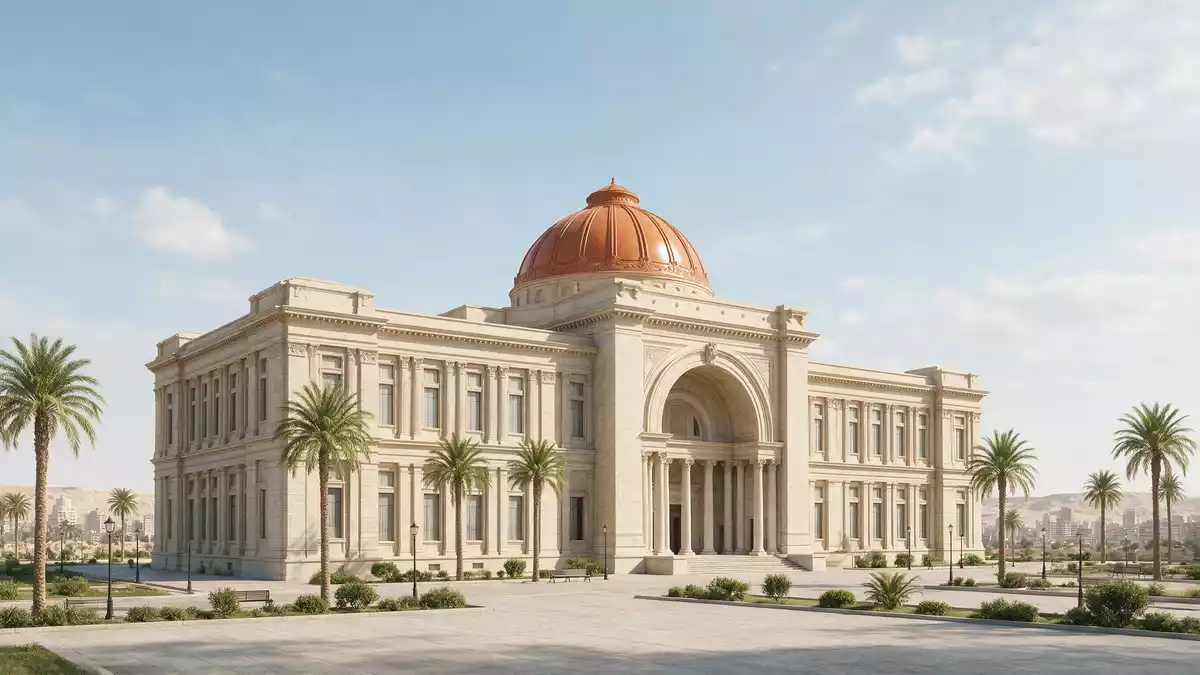
Al-Mathaf al-Masri, known in English as the Egyptian Museum in Cairo, is the great storehouse of Egypt’s ancient civilisation, rising in neoclassical form beside Tahrir Square in central Kairo. Opened in 1902 as a purpose-built national museum for antiquities, it gathers tens of thousands of artefacts from the Nile Valley under one roof and remains a key reference point for understanding Egypt’s pharaonic past.
A neoclassical landmark on Tahrir Square
The building that houses Al-Mathaf al-Masri was completed at the start of the twentieth century and opened to the public in 1902, giving Cairo a dedicated home for its growing national collection of ancient artefacts.Opened in 1902 The museum stands on the northern side of Tahrir Square, a central city space framed by major streets and close to the Nile embankment, which places it at the heart of the Egyptian capital’s urban life.On the northern side of Tahrir Square
The design of the museum is attributed to the French architect Marcel Dourgnon, whose winning competition scheme adopted a neoclassical language with a strong central entrance and long galleries lit from above.Architect Marcel Dourgnon Behind a substantial facade the interior unfolds as a series of halls and upper-level corridors that visitors trace in sequence, moving from monumental statuary to more intimate cases of jewellery, papyri and everyday objects.
From early collections to a national museum
The roots of Al-Mathaf al-Masri lie in the nineteenth century, when the French Egyptologist Auguste Mariette established an Egyptian antiquities service and began assembling a national collection of excavated material.Founded in the nineteenth century Early holdings were kept at Bulaq, north of central Cairo, and later in a palace at Giza, reflecting the search for a more permanent home for the artefacts that were emerging from archaeological work along the Nile.
In the 1890s, plans were set in motion for a permanent museum building in downtown Cairo, and a foundation stone was laid on what became the Tahrir Square site in 1897.Foundation stone in 1897 When the museum finally opened in 1902 it was recognised as a major institution for the study and presentation of pharaonic culture, concentrating material that had previously been scattered across multiple locations into a single public building.
Collections spanning millennia of Egyptian history
Al-Mathaf al-Masri is known for the breadth of its holdings, which range from predynastic artefacts to objects from the Graeco-Roman era, covering several thousand years of Egyptian history in chronological sequence.Artefacts from the Pre-Dynastic Period to the Graeco-Roman Era The galleries present stone vessels, reliefs, sarcophagi, statues, funerary equipment and domestic items, illustrating how artistic styles and religious practices changed between the early kingdoms and later dynasties.
The museum has long been associated with major discoveries such as the tomb of Tutankhamun, whose burial goods were brought to Tahrir Square and displayed in dedicated rooms that draw visitors into the story of a single New Kingdom pharaoh.Tutankhamun assemblage at the museum Alongside such highlights, large numbers of lesser-known pieces fill cases and storerooms, reflecting the scale of excavation activity and the ambition to preserve material from sites across Egypt within a central institution.
Visiting Al-Mathaf al-Masri: what travellers from Western Europe should know
- Al-Mathaf al-Masri stands on the northern side of Tahrir Square in central Kairo, close to the Nile corniche and within walking distance of Sadat station on the Cairo metro.
- Inside the museum, visiting the upper galleries involves climbing staircases between levels, and time spent on foot among long rows of display cases and statues.
- The official language is Arabic and the currency is the Egyptian pound.
- Entry requirements depend on your nationality; UK travellers can check the FCDO travel advice at gov.uk/foreign-travel-advice, Irish travellers the Department of Foreign Affairs at ireland.ie.
Searching for Al-Mathaf al-Masri on social platforms
These links open searches for Al-Mathaf al-Masri on each platform.
Frequently asked questions about Al-Mathaf al-Masri
Where is Al-Mathaf al-Masri located in Kairo?
Al-Mathaf al-Masri stands on the northern side of Tahrir Square in downtown Kairo, close to major streets and the Nile corniche.
What can visitors expect on a visit to Al-Mathaf al-Masri?
Visitors walk through large halls and upper galleries filled with statues, coffins, jewellery, papyri and everyday artefacts that trace ancient Egyptian history.
What makes Al-Mathaf al-Masri distinctive among museums?
It is a national museum dedicated to Egyptian antiquities, housed in a neoclassical building opened in 1902 and holding collections that span from early periods to the Graeco-Roman era.


