
Abu al-Hawl and the limestone colossus of Gizeh
Published on 09/18/2026 at 06:09 | Editorial responsibility: Rafael Müller, Editor-in-Chief AD HOC NEWS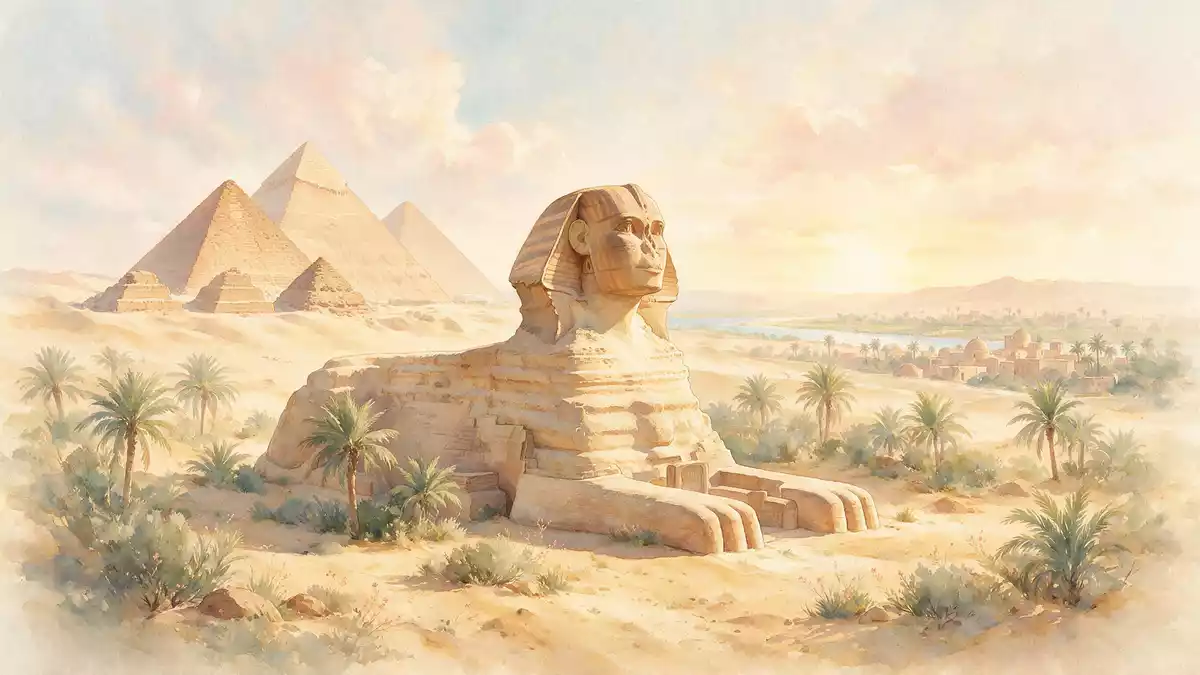
Abu al-Hawl is the Arabic name for the Great Sphinx of Giza, the limestone colossus on the Gizeh plateau. Its lion body and human head make it one of the most recognisable forms of ancient Egypt, and its scale is part of the first impression.
Khafre, limestone and a Fourth Dynasty monument
The monument belongs to ancient Egypt’s Fourth Dynasty and is linked with Khafre, the ruler whose pyramid stands nearby.Fourth dynasty Its carved body and head were cut from limestone bedrock, and the whole figure remains anchored to the Gizeh plateau rather than standing as a freestanding statue.limestone bedrock
Abu al-Hawl stretches about 73 m (240 ft) in length and rises roughly 20 m (66 ft) high.73 m in length That long, low profile gives the statue a horizontal sweep that differs from the vertical pyramid forms behind it.
The face, the paws and the long profile
The head sits high above the forepaws, with the body extending behind them in a single carved mass. The combination of a human face and a lion body gives Abu al-Hawl its most striking contrast, and the surviving surface still shows the monument as a work of bedrock sculpture rather than assembled blocks.
The statue’s proportions matter as much as its identity. The body runs far longer than it rises, so the figure reads at once as a guardian form, a monument and a piece of the plateau itself.guardian form
Abu al-Hawl and the Gizeh plateau setting
Abu al-Hawl stands beside the pyramid complex on the Gizeh plateau, within the landscape of ancient royal monuments in northern Egypt.Gizeh plateau The site belongs to a wider ceremonial and funerary setting, but the Sphinx itself remains a single, monumental figure cut from the rock.
Its location means the monument is read alongside the pyramids rather than in isolation. The relationship between the Sphinx, the plateau and the royal tombs is part of what makes the place so immediately legible to visitors.
Visiting Abu al-Hawl: what travellers from Western Europe should know
- Abu al-Hawl stands on the Gizeh plateau near the pyramid complex, within Greater Cairo. It is reached by road from the city and is usually visited as part of the wider Gizeh archaeological area.
- The monument is large, low and set in open ground. The approach is on level terrain rather than on a climb, and the stone base spreads across the site.
- The official language is Arabic and the currency is the Egyptian pound.
- Entry requirements depend on your nationality; UK travellers can check the FCDO travel advice at gov.uk/foreign-travel-advice, Irish travellers the Department of Foreign Affairs at ireland.ie.
Searching for Abu al-Hawl on social platforms
These links open searches for Abu al-Hawl on each platform.
Frequently asked questions about Abu al-Hawl
Where is Abu al-Hawl?
Abu al-Hawl stands on the Gizeh plateau near Cairo, beside the pyramid complex of ancient Giza. It is part of the archaeological landscape on the west bank of the Nile.
What should a visit expect?
The monument is viewed in open terrain, with the long limestone body set low against the plateau. The visit is centred on the statue’s scale, its carved surface and its position among the pyramids.
What makes Abu al-Hawl distinctive?
Its combination of a lion body, a human head and a single carved limestone mass gives it a form that is instantly recognisable. The Fourth Dynasty association and the name of Khafre are part of its historical identity.


